Photo: Wikipedia
Demographics of Kings County
Affluence Level in Kings County
A middle-class area roughly in line with national averages across income, home values, education, and employment.
People of Kings County
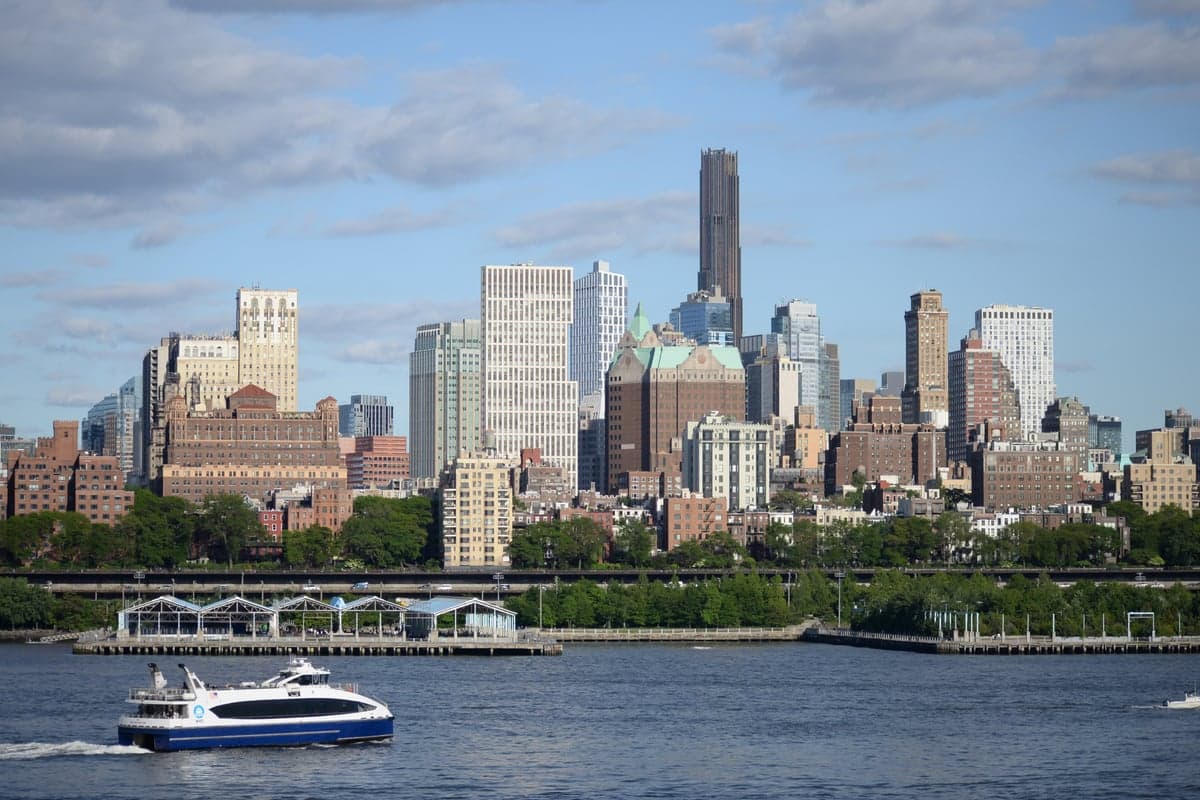
Kings County, New York — coterminous with Brooklyn — is the second-most densely populated county in the United States, home to 2.6 million residents who form a patchwork of ethnic enclaves, historic immigrant gateways, and rapidly gentrifying neighborhoods. Its population is 36.2% White, 27.5% Black, 18.9% Hispanic, 9.3% East/Southeast Asian, and 2.7% Indian subcontinent, with 13.4% foreign-born. Brooklyn’s identity is defined by its layered history of successive waves of arrivals, from Dutch colonists to Caribbean migrants to 21st-century tech workers, creating a borough where old-world traditions coexist with hyper-gentrified brownstone blocks.
Settlement & growth (pre-1960)
Before European contact, the Lenape people — specifically the Canarsie band — inhabited the coastal areas of what is now Kings County, living in seasonal villages along Jamaica Bay and the East River. Dutch colonists from the West India Company began settling the area in the 1630s, establishing the towns of Breuckelen (modern-day Brooklyn Heights), Flatbush, Flatlands, Gravesend, and New Utrecht. These were agricultural outposts, with Dutch patroons granting land to farmers who grew wheat and tobacco for export. The English took control in 1664, renaming the county after King Charles II, but the Dutch land patterns and place names persisted.
After the American Revolution, Kings County remained largely rural through the early 19th century. The first major demographic shift came with the completion of the Erie Canal in 1825 and the subsequent rise of Brooklyn as a manufacturing and shipping hub. Irish immigrants fleeing the Great Famine (1845–1852) poured into the Brooklyn Navy Yard area and the waterfront neighborhoods of Red Hook and Williamsburg, working as dockworkers, laborers, and domestic servants. By 1855, the Irish made up nearly a third of Brooklyn’s population.
German immigrants arrived in similar numbers during the same period, settling in Bushwick and Williamsburg, where they worked in breweries, sugar refineries, and piano factories. The German community established churches, beer gardens, and Turnverein (gymnastic clubs), creating a dense ethnic enclave that persisted into the early 20th century. Italian immigrants began arriving in large numbers after 1880, concentrating in Bensonhurst, Carroll Gardens, and East New York, where they worked in construction, garment manufacturing, and food service. Eastern European Jews — fleeing pogroms in Russia and Poland — settled in Brownsville, Williamsburg, and the Lower East Side (which straddles the Brooklyn-Manhattan border), building a vibrant Yiddish-speaking culture that included synagogues, newspapers, and labor unions.
The Great Migration of African Americans from the South began during World War I and accelerated through the 1940s. Black families moved into Bedford-Stuyvesant, Fort Greene, and Crown Heights, drawn by industrial jobs at the Navy Yard and the Brooklyn Army Terminal. By 1950, Brooklyn’s Black population had grown to roughly 8% of the county total. Puerto Rican migration — facilitated by U.S. citizenship after 1917 — brought a growing Hispanic community to Williamsburg and Bushwick in the 1940s and 1950s, working in factories and service jobs.
Modern era (post-1965)
The 1965 Hart-Cellar Act abolished national-origin quotas, fundamentally reshaping Brooklyn’s demographics. The most dramatic change was the surge of Caribbean immigration. Jamaicans, Haitians, Trinidadians, and Barbadians settled in Flatbush, East Flatbush, and Canarsie, creating a West Indian cultural corridor marked by churches, roti shops, and reggae music. By 2020, Brooklyn had the largest West Indian population of any U.S. county outside the Caribbean itself.
East/Southeast Asian immigration also accelerated after 1965. Chinese immigrants — many from Fujian province — established a growing enclave in Sunset Park, centered on Eighth Avenue, now known as “Brooklyn’s Chinatown.” This community expanded rapidly in the 1980s and 1990s, with Chinese-owned businesses, schools, and social service agencies. Smaller Vietnamese and Korean communities formed in Borough Park and Sheepshead Bay. The Indian subcontinent population — 2.7% of the county — is more dispersed, with concentrations in Midwood and Kensington, where Gujarati and Punjabi families run grocery stores, restaurants, and taxi services.
Domestic migration patterns shifted after 2000. White flight from Brooklyn to Long Island and New Jersey, which had been ongoing since the 1950s, reversed dramatically as young professionals and families began moving into Park Slope, Williamsburg, DUMBO, and Greenpoint. This gentrification wave — driven by tech and finance workers priced out of Manhattan — transformed formerly working-class neighborhoods into high-rent districts. The Hispanic population in Williamsburg and Bushwick declined as rents rose, while the Black population in Bedford-Stuyvesant and Crown Heights also fell. By 2020, Brooklyn’s White population had rebounded to 36.2%, while the Black share dropped from a peak of roughly 38% in 1990 to 27.5%.
The future
Brooklyn’s population is likely to continue its trend toward greater ethnic diversity and economic stratification. The foreign-born share (13.4%) is lower than in Queens or Manhattan, but immigrant communities are stabilizing in outer neighborhoods like Canarsie, Sheepshead Bay, and Bensonhurst. The East/Southeast Asian population is growing fastest, driven by Chinese immigration to Sunset Park and new arrivals from Fujian and Guangdong. The Indian subcontinent population is also rising, though more slowly, as families move to Midwood and Gravesend.
Gentrification is likely to continue in brownstone Brooklyn, with Gowanus, Sunset Park, and East New York seeing new development and rising rents. This will further displace lower-income Black and Hispanic residents to the outer boroughs or Long Island. The Hasidic Jewish community in Williamsburg and Borough Park is growing rapidly due to high birth rates, creating a distinct demographic pocket that resists assimilation. Overall, Brooklyn is becoming more polarized: wealthy, predominantly White and Asian neighborhoods in the northwest, and poorer, predominantly Black and Hispanic neighborhoods in the east and south.
For someone moving into Brooklyn now, the borough offers unmatched cultural density and job access, but at a high cost. The median home price exceeds $800,000, and rents are among the highest in the nation. The population is increasingly bifurcated between those who can afford the gentrified core and those who cannot. Brooklyn remains a place of intense ethnic clustering, where a 15-minute subway ride can traverse a dozen distinct cultural worlds — but the economic barriers to entry are higher than ever.

* Values derived from national, state, county, city and local statistics and may differ in a specific area. Last updated: 2026-06-05T13:16:54.000Z
Narrative content on this page is AI-generated and may contain mistakes. Verify any details that matter before acting on them.
ReloMaps may earn a commission from affiliate links at no extra cost to you.

