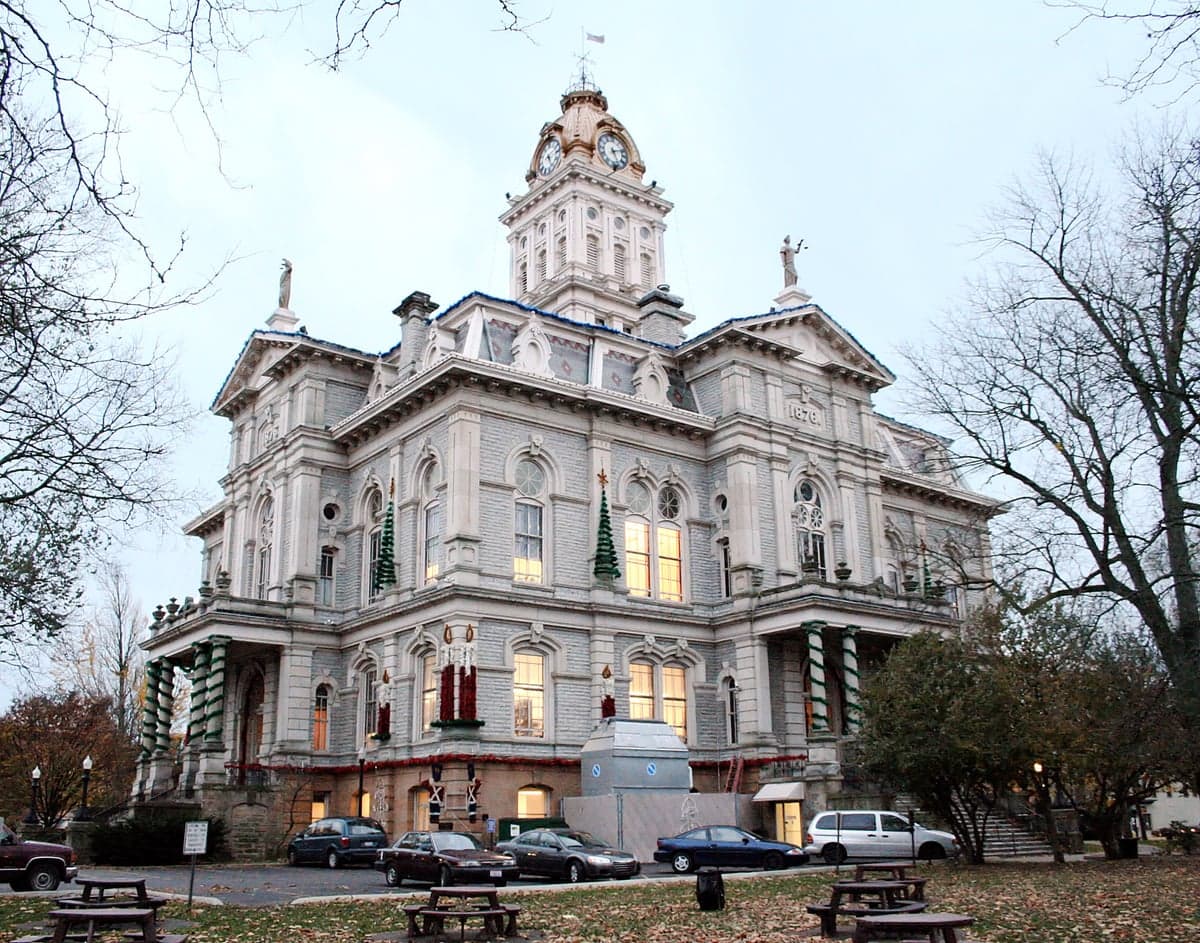
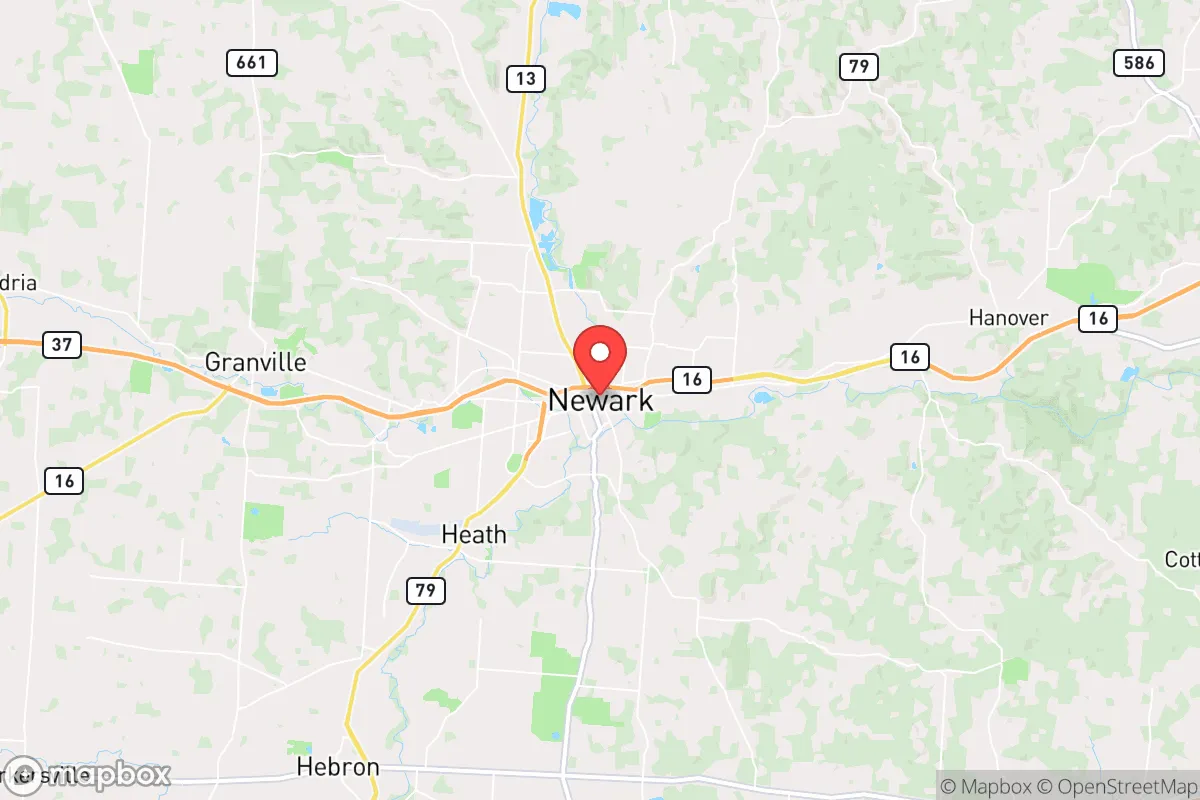
Photo: Wikipedia
Strategic Assessment of Newark, OH
Meaningful friction. Expect exposure to either population pressure, blast zones, or natural disaster risk. Consider buying a retreat property.
What does the Strategic Assessment tell us?
Our Strategic Assessment grades tactical survivability of an area. Major population centers, military targets, fallout zones, natural disasters, and border exposure all drive risk — lower exposure means a more defensible position in a crisis.
This is heavily inspired by Joel Skousen's Strategic Relocation book. Highly recommended you checkout the book ($)What does this tell us?
Our Strategic Assessment grades tactical survivability of an area. Major population centers, military targets, fallout zones, natural disasters, and border exposure all drive risk — lower exposure means a more defensible position in a crisis.
This is heavily inspired by Joel Skousen's Strategic Relocation book. Highly recommended you checkout the book ($)Strategic Pillars

Key Distances
Regional Safe Places
Below is our recommended "safe zones" in Ohio and the surrounding area based on our strategic heuristics. For most people, it's unrealistic to live in a “safe zone” full-time due to work, family or other personal reasons. They tend to be more rural. However, many of these areas are perfect for second homes and retreat properties that double as a vacation home or even a short-term rental.

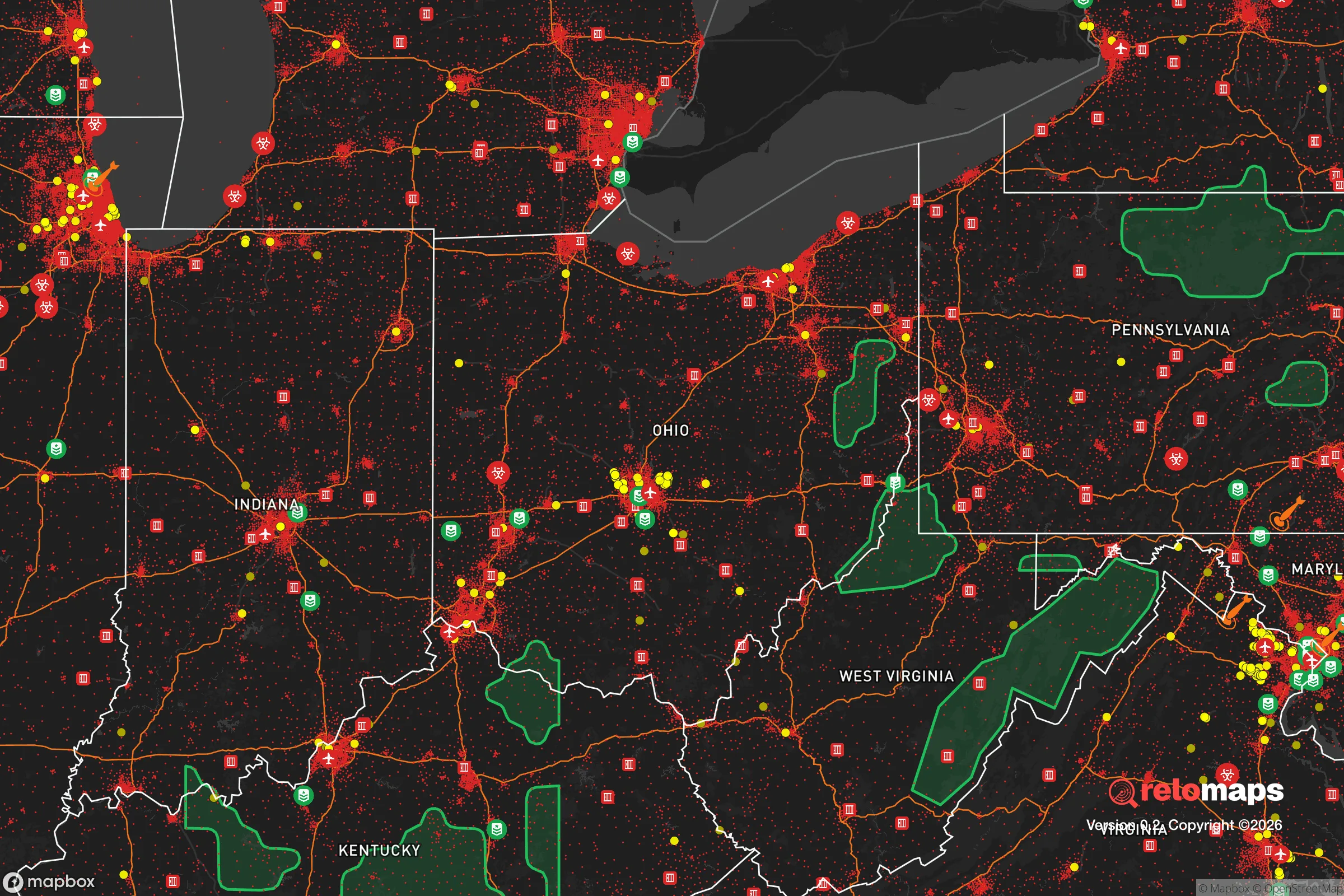


Important Note: For informational purposes only. This does not mean nothing bad ever happens in the green zones. Please use common sense. This is based on public data and modeled with AI. We tried to take a conservative approach but mistakes happen. We update this regularly as new information becomes available.
Solar Generator Recommendations
Backup power matters more here than in safer locations. We've picked three solar generators across budgets and capacity tiers — start with the budget unit if you only need a few essentials, or step up if you want to run a fridge and HVAC for days at a time.

Jackery Portable Power Station Explorer 300
Budget OptionPower on the Go: Weighing only 11 lbs, it's convenient to set up and store with book-sized foldable solar panels

BLUETTI Portable Power Station AC180
Designed for both indoor and outdoor scenarios, AC180 is highly capable as it has a robost capacity and continuous output power.

EF ECOFLOW DELTA Pro Ultra Power Station
Upgraded PickEcoFlow DELTA Pro Ultra is a whole-home energy system designed to grow with your family. Integrated with the Smart Home Panel 2, it scales to meet your evolving energy needs — keeping your home powered, intelligent, and secure through every stage of life.
We earn a commission, at no additional cost to you.
Strategic Assessment Analysis
Newark, Ohio, sits in a sweet spot that few relocators fully appreciate: close enough to Columbus for supply runs and medical access, but far enough that you won't be caught in the blast radius of a major urban collapse. The Licking County seat offers a blend of manufacturing resilience, agricultural buffer, and geographic isolation that makes it a serious contender for anyone thinking about long-term preparedness. With a population hovering around 50,000, Newark is large enough to have infrastructure but small enough that you're not competing with millions for the same resources when things go sideways.
Geographic position and natural advantages for long-term stability
Newark's location at the intersection of the Licking River and the old Ohio and Erie Canal gives it a natural water advantage that most Midwestern towns can't match. The surrounding terrain is rolling hills and hardwood forest, not flat cornfields — which means better drainage, more natural cover, and fewer choke points if you ever need to move discreetly. The area sits on the Allegheny Plateau, which provides a slight elevation advantage over the flatlands to the west, and the local geology includes the Black Hand Sandstone formation, which has historically supported reliable groundwater wells. For a prepper, that's not trivia — that's the difference between a dry well and a sustainable water source when municipal systems fail. The proximity to the Wayne National Forest, about 45 minutes southeast, offers a public-land buffer zone that could serve as a retreat corridor or foraging area, though it's not dense enough to rely on for long-term subsistence. Newark's position along I-70 and State Route 16 gives you east-west mobility without putting you directly on the interstate spine that would become a refugee highway during a crisis.
Risks, exposures, and proximity to fallout-relevant landmarks
Let's be blunt: Newark is not a fallout-free zone. The biggest liability is the proximity to Columbus, roughly 35 miles west. In a major civil unrest scenario or a mass casualty event, Columbus would become a dead zone — and Newark would see the ripple effects: refugees on foot, supply chain collapse, and potential looting from those who flee the city. The area also sits within 100 miles of the Portsmouth Gaseous Diffusion Plant site (now decommissioned but still a cleanup zone) and within 150 miles of the Davis-Besse nuclear power plant on Lake Erie. A worst-case release from either would put Newark in a downwind risk zone, though prevailing winds typically carry east or northeast, which mitigates some of that danger. On the plus side, Newark has no major military installations, no major dams upstream that could fail catastrophically, and no chemical storage facilities that would make it a primary target. The Licking River is prone to flooding in heavy rain events — the 2021 floods hit parts of the downtown area — so any property purchase needs to be above the 100-year floodplain. The real risk here isn't a single bomb or attack; it's the slow bleed of supply chain disruption and the influx of desperate people from the I-70 corridor.
Practical resilience for a relocator: food, water, energy, and defensibility
For someone serious about self-sufficiency, Newark offers a workable baseline. The surrounding Licking County is still agricultural — you'll find working farms, Amish markets, and enough open land to put in a substantial garden or small livestock operation without raising eyebrows. The local soil is mostly silt loam with decent drainage, and the growing season runs about 170 days, which is enough for corn, beans, squash, and cold-hardy greens. Water is the stronger play: the Licking River is perennial, and the area's groundwater is generally good quality, though you'll want to test for agricultural runoff if you're drilling a well. The city's water treatment plant draws from the river and has backup generators, but in a prolonged grid-down scenario, you'd want your own well or a rainwater catchment system. Energy-wise, Newark is served by AEP Ohio, which has a mixed grid of coal, gas, and renewables. Solar potential is decent — about 4.2 peak sun hours per day — and there are no HOA restrictions in the unincorporated areas that would prevent panels or a backup generator. Defensibility is where Newark gets interesting. The city itself is laid out in a grid with several natural chokepoints: the bridges over the Licking River, the railroad crossings, and the limited access points from the south. A rural property on the eastern or northern edge, with a single gravel road approach and tree cover, would give you a strong position. The local law enforcement presence is adequate for normal times — Licking County Sheriff's Office has about 60 deputies — but in a crisis, you're on your own. The nearest Level 1 trauma center is in Columbus, which is a liability if you need serious medical care during a breakdown.
The overall strategic picture for Newark is one of calculated trade-offs. You get a defensible position with reliable water, decent soil, and enough distance from Columbus to avoid the worst of a urban collapse — but you're not so remote that you can ignore the fallout. The area's manufacturing base (Owens Corning, Boeing, and several tool-and-die shops) means there's a skilled labor pool and industrial capacity that could be repurposed in a long-term crisis. The local population skews conservative and self-reliant, which is a cultural asset when you're talking about mutual aid and neighborhood watch dynamics. The downsides are real: the flood risk, the proximity to a major city that could become a humanitarian disaster zone, and the lack of a truly isolated retreat location within an hour's drive. For a single individual or a family willing to invest in a well, solar, and a defensible property on the eastern side of the county, Newark offers a solid B+ on the prepper scorecard. It's not the bunker-in-the-mountains fantasy, but it's a realistic, workable base for weathering the next decade of instability — provided you don't wait until the sirens go off to start preparing.

* Values derived from national, state, county, city and local statistics and may differ in a specific area. Last updated: 2026-04-19T10:25:57.000Z
Narrative content on this page is AI-generated and may contain mistakes. Verify any details that matter before acting on them.
ReloMaps may earn a commission from affiliate links at no extra cost to you.

