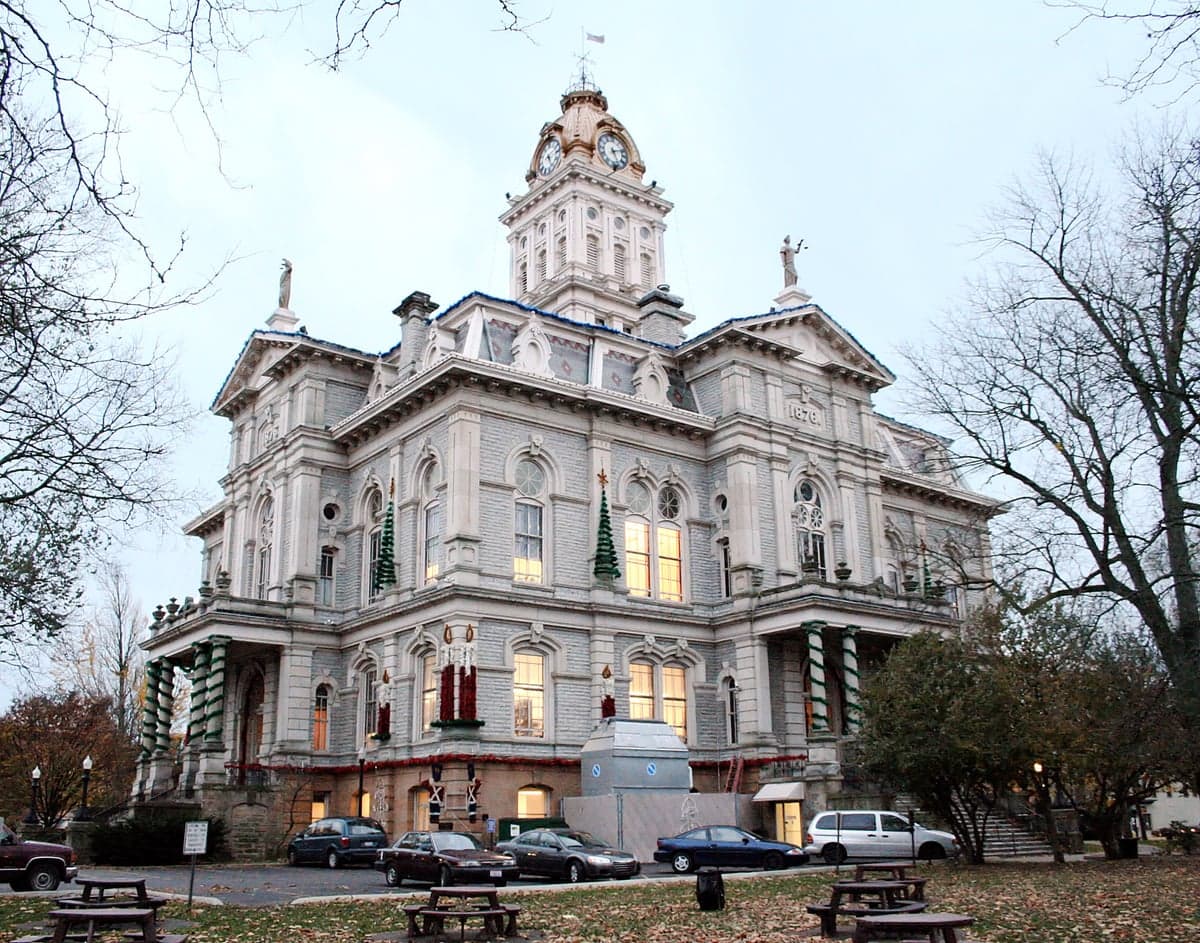
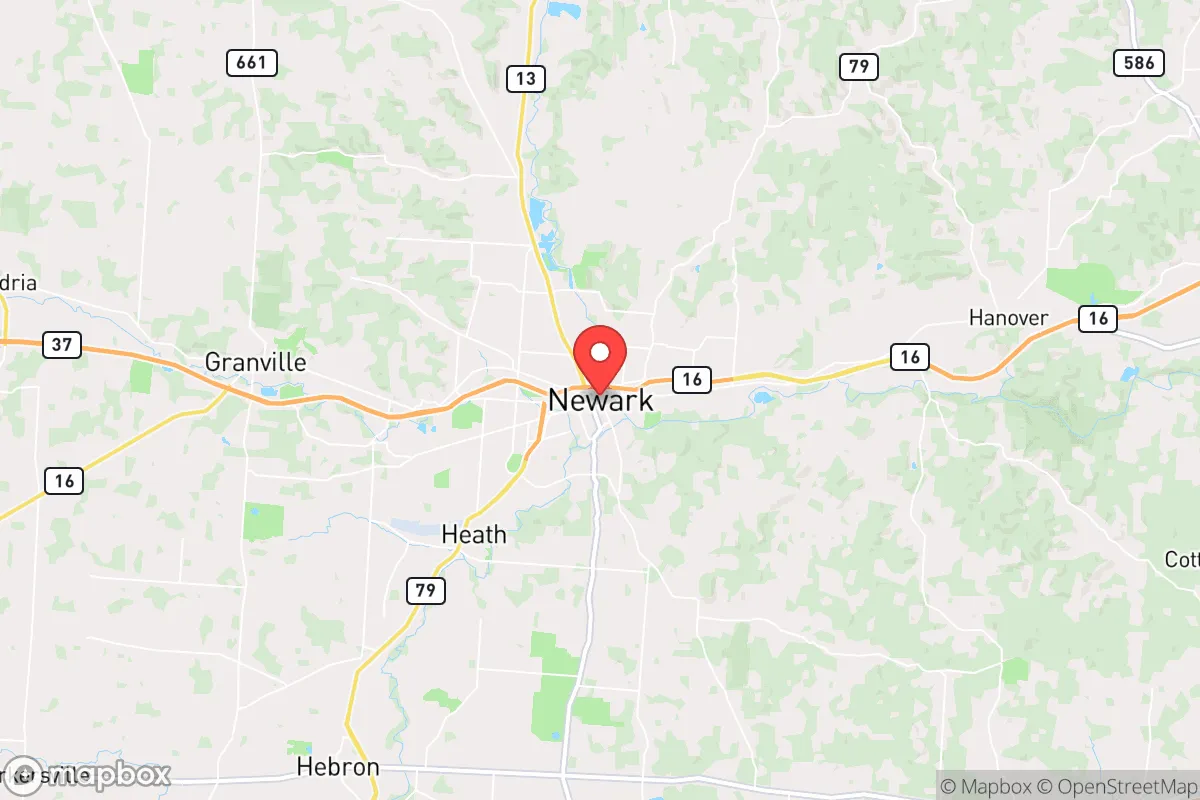
Photo: Wikipedia
Demographics of Newark, OH
Affluence Level in Newark, OH
A middle-class area roughly in line with national averages across income, home values, education, and employment.
People of Newark, OH
The people of Newark, Ohio, today form a predominantly white, native-born community of roughly 50,000, marked by a strong blue-collar and middle-class character rooted in manufacturing and healthcare employment. With a foreign-born population of just 0.5% and a 87.9% white share, Newark is one of Ohio's least ethnically diverse cities of its size, yet it retains a distinct identity shaped by successive waves of domestic migration tied to industry, transportation, and institutional growth. The city's population density is moderate for a Midwestern county seat, and its residents often describe a tight-knit, family-oriented atmosphere where local high school sports and church communities anchor social life.
How the city was settled and grew
Newark was founded in 1802 by settlers from Connecticut and other New England states, drawn by the Ohio Company's land grants and the promise of fertile soil along the Licking River. The original population was overwhelmingly of English, Scottish, and German Protestant stock, and they built the early core around the public square and along what is now Hudson Avenue, where many of the first frame houses still stand. The arrival of the Ohio and Erie Canal in the 1830s brought a wave of Irish laborers who settled in the West Side near the canal basin, forming a distinct working-class enclave that persisted through the 20th century. German immigrants followed in the 1840s and 1850s, establishing farms and businesses in the North Newark area around what is now Mount Vernon Road, and their influence remains visible in the city's Lutheran churches and the annual German festival. The late 19th century saw the rise of the glass and pottery industries, with companies like the Newark Glass Works and the American Encaustic Tiling Company attracting skilled workers from England and Italy. These immigrants concentrated in the South Side near the factories along the railroad lines, creating a dense, walkable neighborhood of brick rowhouses and corner groceries that still defines the area's character. By 1900, Newark's population had reached 18,000, and the city had become a regional manufacturing hub, drawing additional domestic migrants from rural Ohio and Appalachia.
Modern era (post-1965)
The post-1965 period brought little international immigration to Newark, as the city's industrial base began to contract and its location in central Ohio offered fewer entry-level opportunities for new arrivals than larger cities. Instead, the major demographic shift was domestic: the closure of several glass and tile plants in the 1970s and 1980s prompted an out-migration of younger workers to Columbus and other growing metros, while the expansion of the Denison University campus and the Newark campus of Ohio State University attracted a modest influx of faculty and students. The Cherry Valley area, a planned subdivision developed in the 1960s and 1970s, absorbed many of the white-collar families moving into the city for jobs at the Rockwell International plant (now Boeing) and the Licking Memorial Hospital. Meanwhile, the East Newark neighborhood, historically home to lower-income white families, saw a gradual aging of its population as younger residents left for suburbs like Heath and Granville. The city's Black population, which had grown to about 5% by 1970, has since declined to 3.1%, with most Black residents concentrated in the West Side near the former canal corridor. The Hispanic population, at 2.3%, is a recent and small presence, largely composed of Mexican-origin families working in warehousing and food processing along the Route 16 corridor. The East/Southeast Asian and Indian communities each represent just 0.4% of the population, with most households connected to professional roles at Denison University or the local hospital system.
The future
Newark's population is projected to remain stable or decline slightly over the next decade, as the city's low birth rate and minimal immigration are not offset by domestic in-migration. The foreign-born share, already negligible at 0.5%, shows no signs of significant growth, as the city lacks the ethnic networks and entry-level job clusters that attract immigrants to larger Ohio cities like Columbus or Dayton. The white population share, currently 87.9%, is likely to remain high, though the Hispanic and Asian shares may inch upward slowly as a few families relocate from Columbus for lower housing costs. The city is not tribalizing into distinct ethnic enclaves; rather, it is homogenizing into an older, whiter, and more native-born population, with the West Side and South Side aging in place while younger families gravitate toward the Cherry Valley and North Newark subdivisions. The college-educated share, at 22.1%, is below the national average and is unlikely to rise sharply unless the local healthcare and education sectors expand.
For someone moving to Newark now, the city offers a stable, low-cost, and culturally homogeneous environment where community ties are strong but demographic change is slow. It is a place where the past—canal workers, glassmakers, and factory hands—still shapes the present, and where the future looks much like today: quiet, family-centered, and overwhelmingly native-born.

* Values derived from national, state, county, city and local statistics and may differ in a specific area. Last updated: 2026-04-19T10:25:57.000Z
Narrative content on this page is AI-generated and may contain mistakes. Verify any details that matter before acting on them.
ReloMaps may earn a commission from affiliate links at no extra cost to you.

