
Photo by Tommy Bond on Unsplash
Demographics of Newcastle, OK
Affluence Level in Newcastle, OK
An upper-middle-class area. Household wealth, education levels, and homeownership run ahead of national benchmarks.
People of Newcastle, OK
The people of Newcastle, Oklahoma, today number 12,238 and form a predominantly white, family-oriented community with a notably low foreign-born share of 1.5%. The city’s identity is rooted in its small-town character and rapid suburban growth, with a population that is 77.6% white, 6.8% Hispanic, 1.9% Black, and less than 1% East/Southeast Asian or Indian. Newcastle is distinct for its high proportion of college-educated residents (34.6%) and its role as a bedroom community for Oklahoma City, attracting families seeking newer housing and lower crime rates while maintaining a distinct, locally governed identity.
How the city was settled and grew
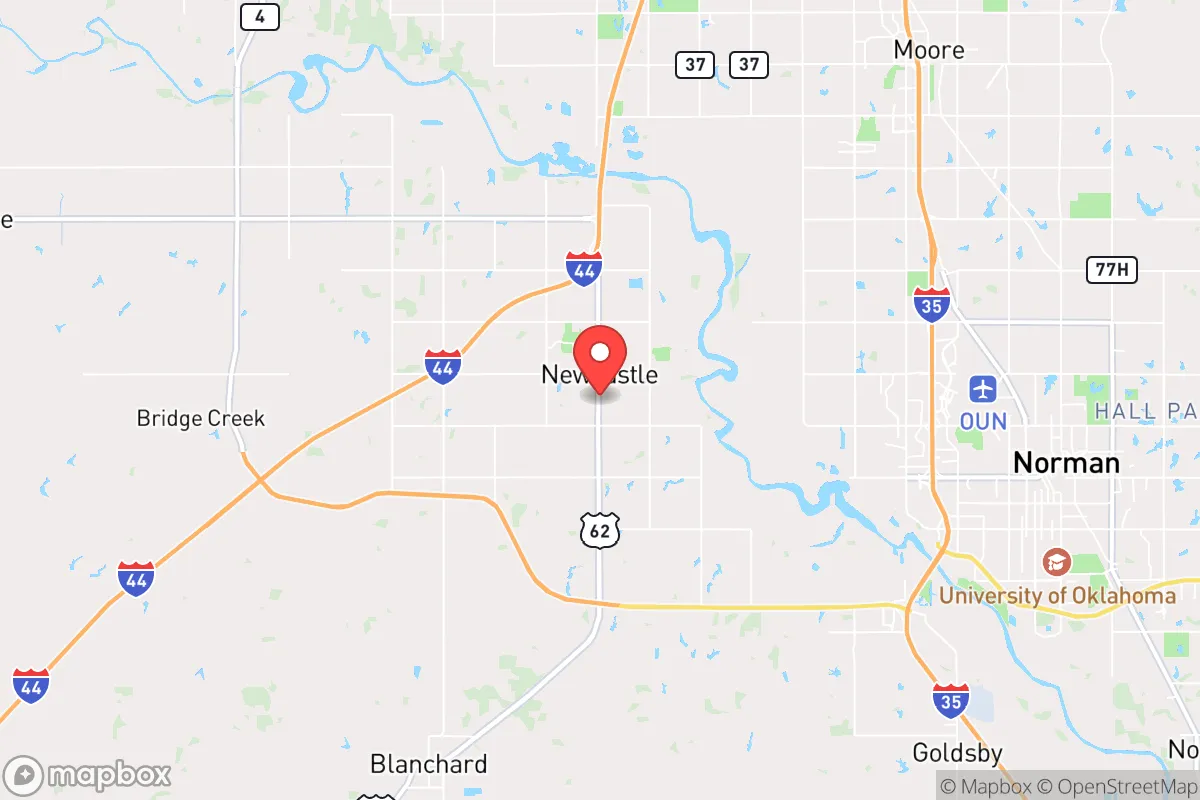
Newcastle was founded in the late 19th century as a railroad stop along the Chicago, Rock Island and Pacific Railway, with the first post office established in 1890. The original settlers were predominantly white farmers and ranchers drawn by the Land Run of 1889, which opened unassigned lands in central Oklahoma to non-Native settlement. These early homesteaders built the town around the railroad depot, with the historic Downtown Newcastle district (centered on Main Street and the old depot site) serving as the commercial and social hub. A second wave arrived during the oil boom of the 1910s–1920s, when prospectors and workers settled in the Oil Field Addition neighborhood near the town’s southern edge, though the boom was modest compared to larger Oklahoma oil towns. The population remained under 500 until the 1960s, as the town’s agricultural economy limited growth.
Modern era (post-1965)
The modern transformation of Newcastle began in the 1970s and accelerated after 1990, driven by suburban spillover from Oklahoma City, located just 15 miles north. The 1965 Hart-Cellar Act had minimal direct impact here—Newcastle’s foreign-born population remains tiny at 1.5%—but the post-1965 era saw domestic in-migration of white and Hispanic families seeking affordable land and new construction. The Newcastle Estates subdivision, developed in the 1980s, absorbed many of these early suburbanites, offering larger lots and a semi-rural feel. The 1990s and 2000s brought a wave of white middle-class families into the Stone Creek and Wildwood neighborhoods, both master-planned communities with modern amenities and access to Newcastle’s highly rated public schools. Hispanic growth, rising from negligible levels to 6.8% by 2020, concentrated in the South Newcastle area near the Canadian River, where older, more affordable housing stock attracted working-class families employed in construction and service industries. The Black population, at 1.9%, is dispersed across newer subdivisions like Fox Run, reflecting a pattern of integration rather than ethnic clustering. East/Southeast Asian (0.3%) and Indian (0.2%) residents are few and scattered, typically professionals commuting to Oklahoma City’s medical and energy sectors.
The future
Newcastle’s population trajectory points toward continued growth and gradual homogenization, with the white share likely remaining dominant but declining slightly as Hispanic and Black shares increase. The city’s low foreign-born rate (1.5%) means immigration will not drive significant ethnic diversification; instead, domestic migration from within Oklahoma and adjacent states will sustain growth. The Newcastle Crossing development, a large mixed-use project approved in 2023, is expected to add 1,500+ homes by 2035, attracting more white and Hispanic families from the Oklahoma City metro. The Hispanic population is projected to reach 10–12% by 2040, concentrated in the southern corridor, while Black and Asian shares will likely remain below 3% each. The city is not tribalizing into distinct enclaves—neighborhoods remain largely integrated by income and race—but the South Newcastle area may become more predominantly Hispanic as chain migration and affordable housing draw additional families. The college-educated share (34.6%) is expected to rise as Newcastle’s reputation for good schools and low crime attracts professionals priced out of Edmond and Norman.
Newcastle is becoming a solidly middle-class, family-oriented suburb with a modestly diversifying but still overwhelmingly white population. For a conservative-leaning individual or parent moving in now, the city offers a stable, low-crime environment with strong schools and a clear trajectory of managed growth—neither a rapidly changing melting pot nor a stagnant small town. The key dynamic to watch is the gradual Hispanic increase in southern neighborhoods, which will add cultural texture without fundamentally altering Newcastle’s character as a safe, suburban community.

* Values derived from national, state, county, city and local statistics and may differ in a specific area. Last updated: 2026-04-21T08:13:03.000Z
Narrative content on this page is AI-generated and may contain mistakes. Verify any details that matter before acting on them.
ReloMaps may earn a commission from affiliate links at no extra cost to you.

