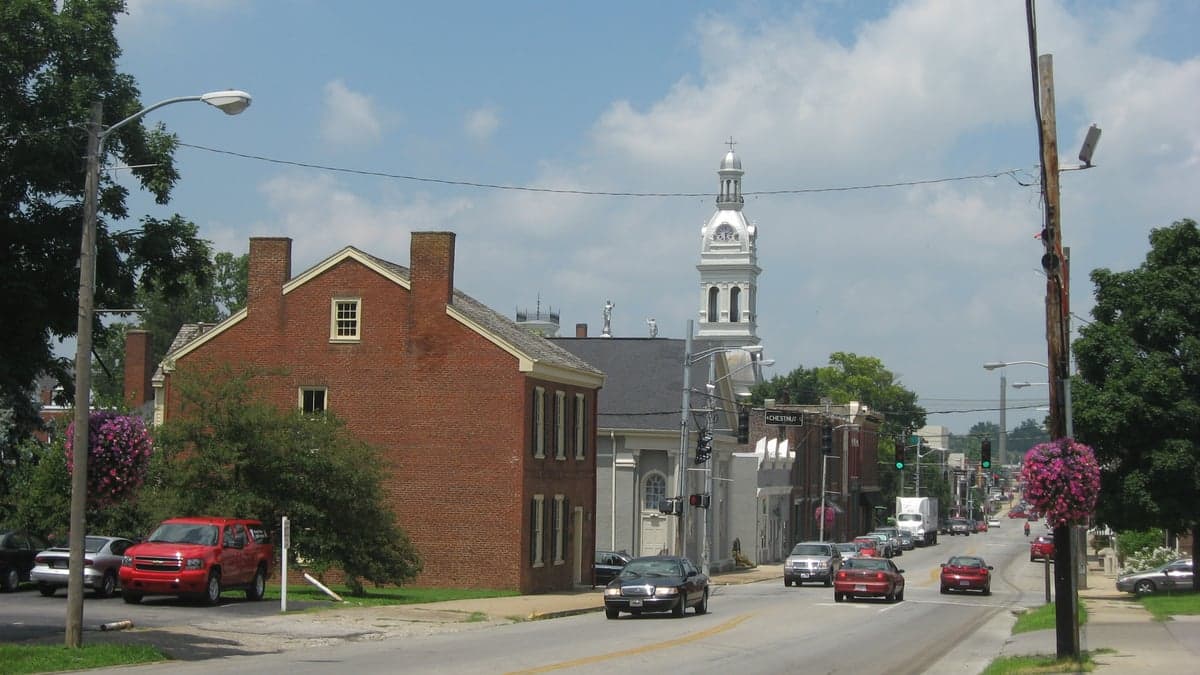
Photo: Wikipedia
Political ClimatePolitical Climate in Nicholasville, KY
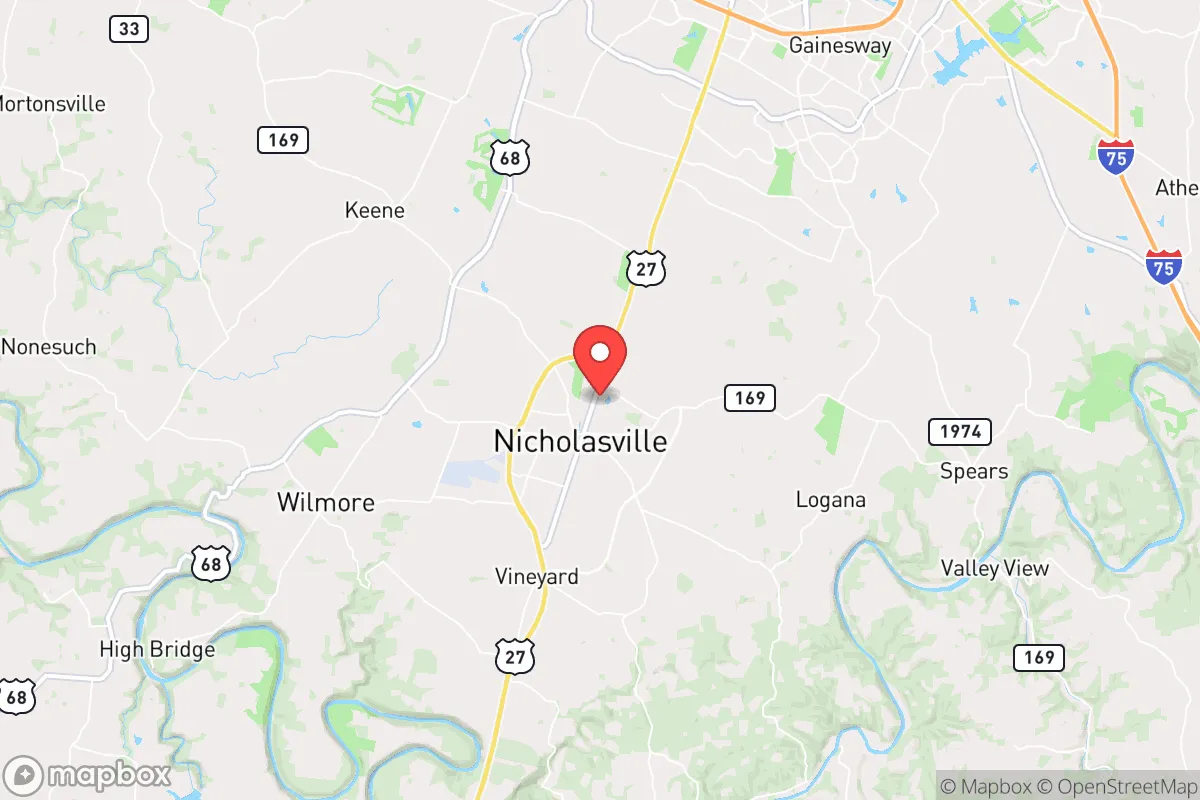
District shown is the primary district for this city’s centroid. Cities may span multiple districts.
Local Political AnalysisPolitical Analysis of Nicholasville, KY
Nicholasville leans solidly conservative, with a Cook PVI of R+7 that reflects a deep-rooted preference for limited government and personal responsibility. This isn't a new trend—it's been the bedrock here for decades, but you can feel the political winds shifting slightly as Lexington's sprawl creeps south along US-27. The real story isn't just the voting numbers; it's the quiet tension between folks who've been here for generations and the newcomers bringing more progressive ideas from the city. If you're looking for a place where your Second Amendment rights are respected and your tax dollars aren't spent on social experiments, Nicholasville still fits the bill—but you've got to keep an eye on the county commission meetings.
How it compares
Drive ten miles north and you hit Lexington, which votes reliably blue and has a Cook PVI of D+15. That's a 22-point swing in just a few minutes on the road. Jessamine County, where Nicholasville sits, has historically been a Republican stronghold, but the 2020 and 2024 elections showed some erosion—Biden and Harris both pulled closer margins here than Obama ever did. Compare that to nearby Wilmore, which is even more conservative thanks to Asbury University's influence, or to Danville, which leans slightly left due to Centre College. The contrast is stark: Nicholasville still feels like the old Kentucky—church on Sunday, trucks in the driveway, and a general distrust of Frankfort telling us how to live. But I've watched subdivisions pop up with folks who bring their Lexington voting habits with them, and that's a slow-moving concern for anyone who values local control over federal mandates.
What this means for residents
For now, life here means lower taxes, fewer regulations, and a school board that hasn't gone full progressive. The county has resisted mask mandates, vaccine passports, and the kind of overreach you see in Louisville or Lexington. Property taxes stay reasonable because the commission isn't eager to fund pet projects. But the long-term worry is that as Nicholasville grows—and it is growing, fast—the political center of gravity shifts. You'll see more zoning battles, more pressure to adopt "equity" policies in schools, and more candidates running on platforms that sound like they were written in a D.C. think tank. If you're the type who values freedom over safety nets, you'll want to get involved locally before the transplants turn this into another bedroom community for progressive ideals.
Culturally, Nicholasville still holds onto distinctions that matter: the Jessamine County Fair, the 4-H programs, and a strong network of independent churches. There's no city-wide noise ordinance, no ban on gas-powered leaf blowers, and the sheriff's office doesn't play games with constitutional carry. But I've seen the first "Black Lives Matter" yard signs pop up in the newer subdivisions, and the local Democratic Party chapter has gotten more organized. The next five to ten years will tell the story—whether Nicholasville stays a refuge for common-sense conservatism or slowly drifts toward the Lexington model. If you're considering a move here, come with your eyes open: the foundation is solid, but the foundation needs defending.

State Political ClimatePolitical Climate in Kentucky
State Political AnalysisPolitical Environment in the State
Kentucky has been a reliably red state for decades, but its conservatism is of a distinct, populist, and culturally traditionalist stripe rather than the free-market, libertarian-leaning conservatism seen in places like Texas or Florida. The state has voted for the Republican presidential candidate in every election since 2000, with margins growing from a narrow 0.4% in 1996 to a commanding 26-point victory for Donald Trump in 2024. However, the state’s political engine is not a monolithic bloc; it’s a coalition of rural, small-town, and Appalachian voters who have shifted hard right, combined with a shrinking but still potent Democratic presence in Louisville and Lexington. Over the past 20 years, the state has undergone a dramatic realignment, with ancestrally Democratic counties in the eastern coalfields flipping to the GOP by 40-50 points, while the urban cores of Jefferson and Fayette counties have become increasingly blue.
Urban vs. rural divide
The political map of Kentucky is a textbook study in the urban-rural chasm. The state’s two major population centers, Louisville (Jefferson County) and Lexington (Fayette County), are the only reliably Democratic strongholds, delivering margins of 15-20 points for Democratic candidates in recent cycles. Louisville, home to the state’s largest university and a more diverse economy anchored by UPS Worldport and healthcare, has a sizable African American population and a growing professional class that votes blue. Lexington, dominated by the University of Kentucky and a burgeoning tech and equine sector, follows suit. Outside these two islands, the state is overwhelmingly red. The Northern Kentucky suburbs of Covington and Florence (Boone, Kenton, Campbell counties) have shifted from swing to solidly Republican, driven by white working-class voters and commuters to Cincinnati. The Bowling Green area (Warren County), home to a growing manufacturing base and a large refugee community, is a fascinating microcosm: the county went +25 for Trump in 2024, but the city itself has a visible Democratic presence. The Appalachian counties in the east—like Pike, Floyd, and Letcher— were once the bedrock of the state’s Democratic Party, but they have flipped violently to the GOP, often voting 70-80% Republican, driven by cultural issues and a deep distrust of the national Democratic Party’s environmental and social policies. The Purchase region in the far west, around Paducah and Murray, is deeply conservative, with Murray State University providing a small, moderate-liberal enclave.
Policy environment
Kentucky’s policy environment is a mixed bag for a conservative. On the positive side, the state is a right-to-work state (since 2017) and has a flat income tax that is being phased down from 5% to 4% by 2026, with a goal of eventual elimination. The state legislature, under supermajority Republican control since 2017, has passed a slew of conservative priorities: permitless carry of firearms (2021), a near-total abortion ban (trigger law effective 2022, with no exceptions for rape or incest), and a school choice program (the "Education Opportunity Account Act" of 2022, though it was struck down by the state Supreme Court in 2023). However, the state’s sales tax is high at 6%, and local option sales taxes are prohibited, meaning no county-level tax relief. Property taxes are low, but the state’s pension crisis for public employees is a ticking time bomb, with the state’s unfunded liabilities exceeding $40 billion. On education, the state has a robust charter school law (passed 2017) but only one charter school has opened, in Louisville. The state’s election laws are moderately restrictive: voter ID is required, early voting is limited to three days (including a Saturday), and no-excuse absentee voting was eliminated after the pandemic. The state has not expanded Medicaid under the Affordable Care Act, though it operates a managed-care system for its existing Medicaid population.
Trajectory & freedom
Kentucky is on a trajectory of expanding personal freedom in some areas while contracting it in others. On the plus side for conservatives, the state has aggressively expanded Second Amendment rights: the 2021 permitless carry law (HB 40) was a major victory, and the state has a strong "Stand Your Ground" law. In 2023, the legislature passed a parental rights bill (HB 177) requiring schools to notify parents of any changes to a student’s services or mental health, and prohibiting instruction on sexual orientation or gender identity in K-5. The state also passed a medical freedom bill (SB 9) in 2022 prohibiting vaccine mandates by private employers and government entities. However, the state’s tax burden remains high for a red state, and the flat tax phase-down is slow. The state’s medical marijuana program, legalized in 2023, is heavily restricted and won’t be operational until 2025, a sign of the legislature’s cautious, culturally conservative approach. The state’s property rights are strong, with no statewide zoning mandates, but local governments in Louisville and Lexington have imposed stricter land-use regulations. The biggest concern for freedom-minded residents is the state’s massive public pension debt, which could lead to future tax hikes or service cuts, effectively reducing economic freedom.
Civil unrest & political movements
Kentucky has seen its share of political flashpoints, but they are more localized and less dramatic than in coastal states. The 2020 Breonna Taylor protests in Louisville were the most significant, with months of demonstrations, property damage, and a heavy police and National Guard presence. This event galvanized a progressive movement in Louisville, leading to the election of a Democratic mayor and a push for police reform, but it also hardened conservative sentiment in the rest of the state. The rural-urban cultural divide is palpable: you’ll see "Let’s Go Brandon" flags and Trump banners in rural areas, while Louisville and Lexington have visible "Black Lives Matter" and "Pride" signage. The state has a small but vocal secessionist movement in Eastern Kentucky, with some residents advocating for the creation of a separate state called "East Kentucky" or "Appalachia," driven by a sense of neglect from Frankfort. Immigration politics are less heated than in border states, but the refugee resettlement program in Bowling Green (home to a large Iraqi and Congolese community) has been a local flashpoint, with some residents expressing concerns about cultural change. Election integrity is a hot topic: the 2020 election in Kentucky was secure and uncontroversial, but the state legislature has since passed laws tightening voter ID and limiting absentee voting, driven by base concerns about fraud.
Projection
Over the next 5-10 years, Kentucky is likely to remain solidly red, but with a growing urban-liberal counterweight. The in-migration pattern is modest compared to Sun Belt states, but the state is attracting some retirees and remote workers from the Midwest and Northeast, particularly to the Lexington and Bowling Green areas. These newcomers tend to be more moderate or even libertarian-leaning, which could slightly soften the state’s hard-right edge. The Appalachian region will continue to lose population, reducing its political clout, while the Louisville and Lexington metros will grow, potentially making statewide elections more competitive for Democrats in the long run. The state’s pension crisis will force tough choices—either tax increases or benefit cuts—which could alienate voters. The flat tax phase-down will continue, but the state’s reliance on sales tax and a narrow base means it will struggle to fund services. The cultural wars will intensify, with likely battles over school choice (after the 2023 court ruling), transgender rights, and library content. A new resident should expect a state that is culturally conservative and stable, but with a growing urban-liberal tension that will make state politics more interesting but not fundamentally change the partisan balance.
Bottom line for a new resident: If you’re a conservative looking for a low-cost, culturally traditional state with strong gun rights and a growing economy in its mid-sized cities, Kentucky is a solid choice. But be aware of the high sales tax, the pension debt overhang, and the fact that the state’s brand of conservatism is more populist and culturally focused than economically libertarian. You’ll find a welcoming community in the suburbs of Bowling Green, Richmond, or the Northern Kentucky suburbs, but you’ll need to accept that the state’s two major cities are increasingly liberal and that the political battles over education, taxes, and social issues will continue. It’s a state that values tradition and personal freedom in many areas, but it’s not a free-market paradise—it’s a place where community and culture often trump pure economic liberty.
* Values derived from national, state, county, city and local statistics and may differ in a specific area. Last updated: 2026-04-21T17:17:31.000Z
Narrative content on this page is AI-generated and may contain mistakes. Verify any details that matter before acting on them.
ReloMaps may earn a commission from affiliate links at no extra cost to you.

