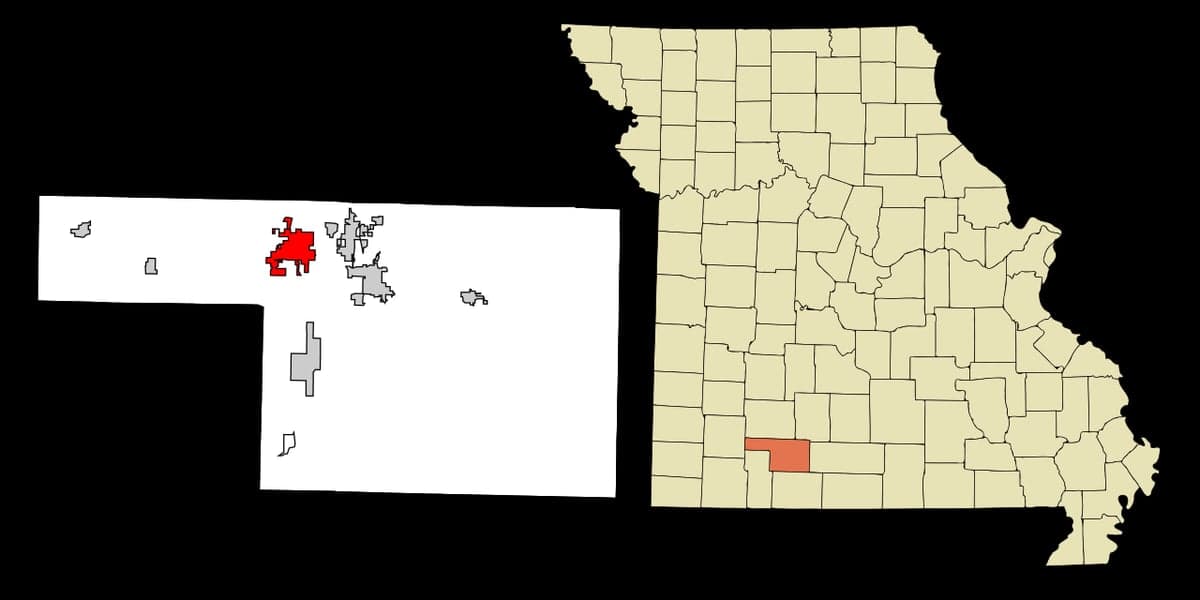
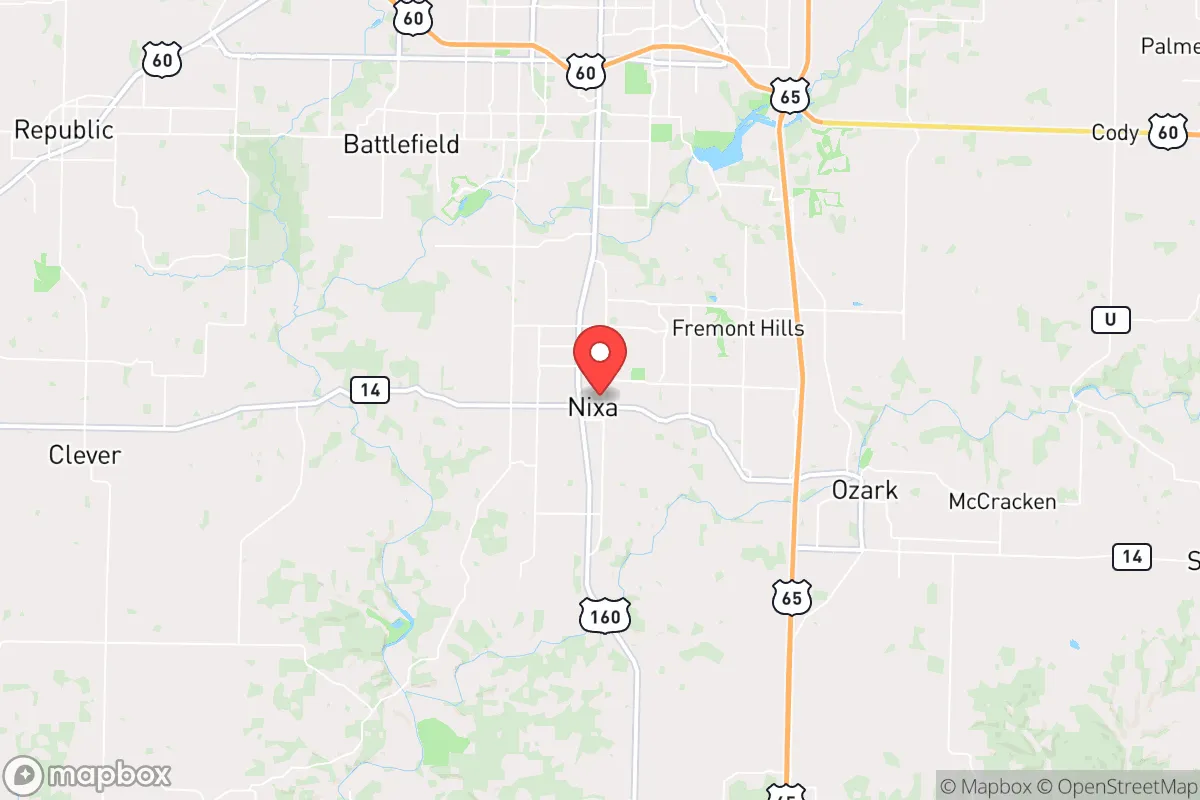
Photo: Wikipedia
Demographics of Nixa, MO
Affluence Level in Nixa, MO
A middle-class area roughly in line with national averages across income, home values, education, and employment.
People of Nixa, MO
The people of Nixa, Missouri today number 24,131, forming a predominantly white (87.6%) and politically conservative community that blends small-town roots with suburban growth. The city’s identity is shaped by a strong sense of local independence, a high rate of homeownership, and a population that is notably less diverse than the national average, with a foreign-born share of just 2.9%. Residents are concentrated in family-oriented subdivisions and established neighborhoods, with a college-educated rate of 34.8% that reflects a growing professional class drawn by affordable housing and proximity to Springfield.
How the city was settled and grew
Nixa was founded in the 1870s as a railroad stop on the St. Louis–San Francisco Railway, originally named “Nicholas” after a local landowner. The first permanent settlers were predominantly Anglo-American farmers from the Upper South—Kentucky, Tennessee, and the Ozark region—who were drawn by cheap land and the promise of rail access for shipping timber and livestock. The town was officially platted in 1886, and its early population clustered around the rail depot in what is now Old Town Nixa, the historic core along Main Street. By 1900, the population hovered around 300, with a handful of German and Irish families joining the original stock. The McCormick Addition, platted in the 1910s, became the first residential expansion beyond the depot, housing railroad workers and merchants. Through the 1940s, Nixa remained a quiet agricultural service center, with no significant non-white population recorded in census data until after World War II.
Modern era (post-1965)
The post-1965 era brought two major shifts: the gradual suburbanization of Springfield’s workforce and a modest diversification driven by domestic migration. The 1965 Immigration Act had little direct effect on Nixa—foreign-born residents remain at 2.9% today—but the city’s population exploded from roughly 1,500 in 1970 to over 19,000 by 2010, almost entirely from white domestic in-migration. The Rivercut development, a master-planned golf-course community launched in the 1990s, absorbed many of these newcomers—primarily middle-class families from California, Texas, and the Midwest seeking lower taxes and a slower pace. The Woodlands subdivision, built in the 2000s, attracted younger families and some retirees, while Century Estates became a hub for professionals commuting to Springfield’s health-care and logistics sectors. Hispanic residents grew from near zero in 1990 to 5.2% by 2020, concentrated in the North Nixa area near Highway 160, where a handful of Mexican-American families have established small landscaping and construction businesses. East/Southeast Asian residents (1.9%) are mostly Vietnamese and Filipino families who arrived in the 2010s, settling in Foxborough and other newer subdivisions. The Black population remains very small at 1.5%, with no distinct neighborhood concentration. Indian-subcontinent residents are statistically absent at 0.0%.
The future
Nixa’s population is projected to reach 30,000–35,000 by 2040, driven by continued white domestic in-migration from higher-cost states and natural increase. The city is not homogenizing into a single bloc but rather tribalizing into distinct enclaves: established Old Town families, newer suburbanites in Rivercut and Woodlands, and a small but growing Hispanic community in North Nixa. The foreign-born share is likely to rise slowly, possibly to 4–5%, as Hispanic families expand and a trickle of East/Southeast Asian professionals arrive for jobs in Springfield’s health-care and manufacturing sectors. The Indian-subcontinent population is expected to remain negligible. The city’s political and cultural character will likely stay conservative, with no major demographic disruption on the horizon. The main tension will be between long-time residents who value Nixa’s rural feel and newcomers pushing for more amenities and infrastructure.
For someone moving in now, Nixa offers a stable, predominantly white, and family-oriented community with strong schools and low crime—but little racial or ethnic diversity. The population is growing steadily but not chaotically, and the city’s future looks like a slightly larger, slightly more diverse version of its present self. New arrivals will find a place where conservative values and suburban convenience coexist, with the most dynamic growth occurring in the newer subdivisions on the city’s southern and western edges.

* Values derived from national, state, county, city and local statistics and may differ in a specific area. Last updated: 2026-04-23T04:20:07.000Z
Narrative content on this page is AI-generated and may contain mistakes. Verify any details that matter before acting on them.
ReloMaps may earn a commission from affiliate links at no extra cost to you.

