Photo: Wikipedia
Demographics of Nogales, AZ
Affluence Level in Nogales, AZ
A below-average socioeconomic profile. Incomes, home values, and educational attainment trail the U.S., with higher poverty and unemployment.
People of Nogales, AZ
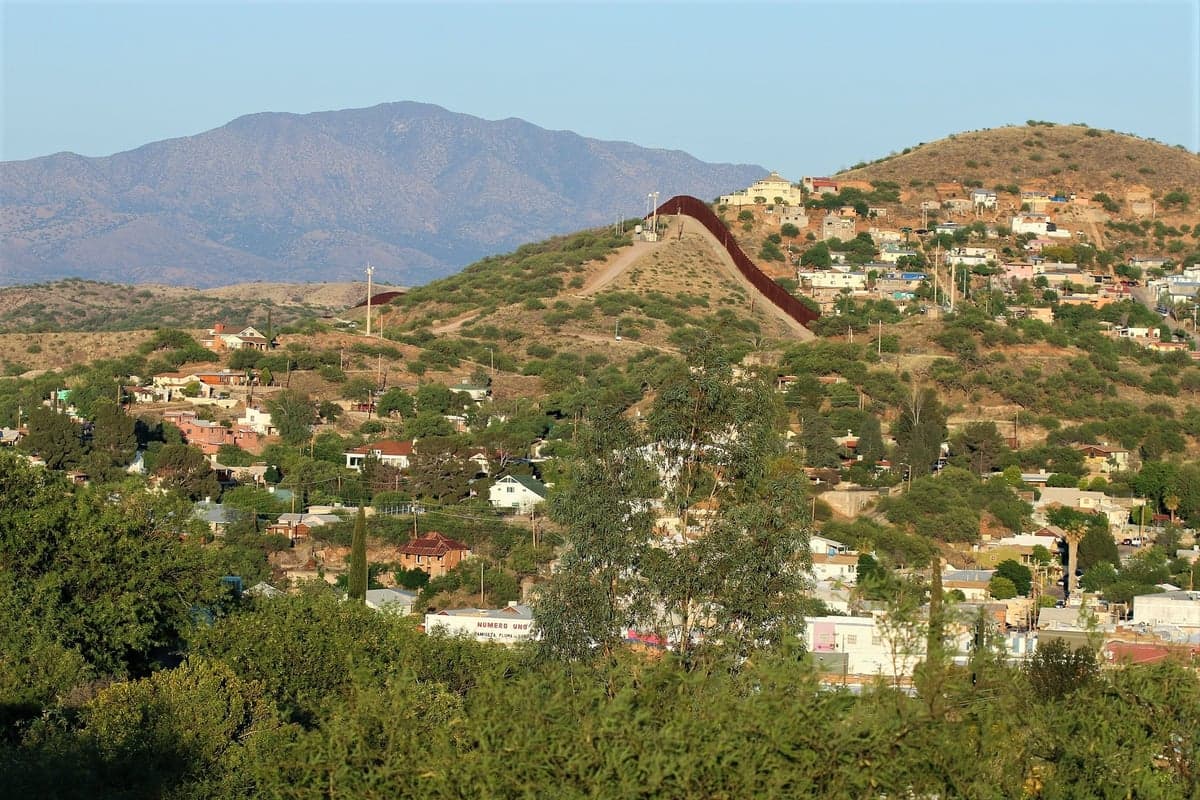
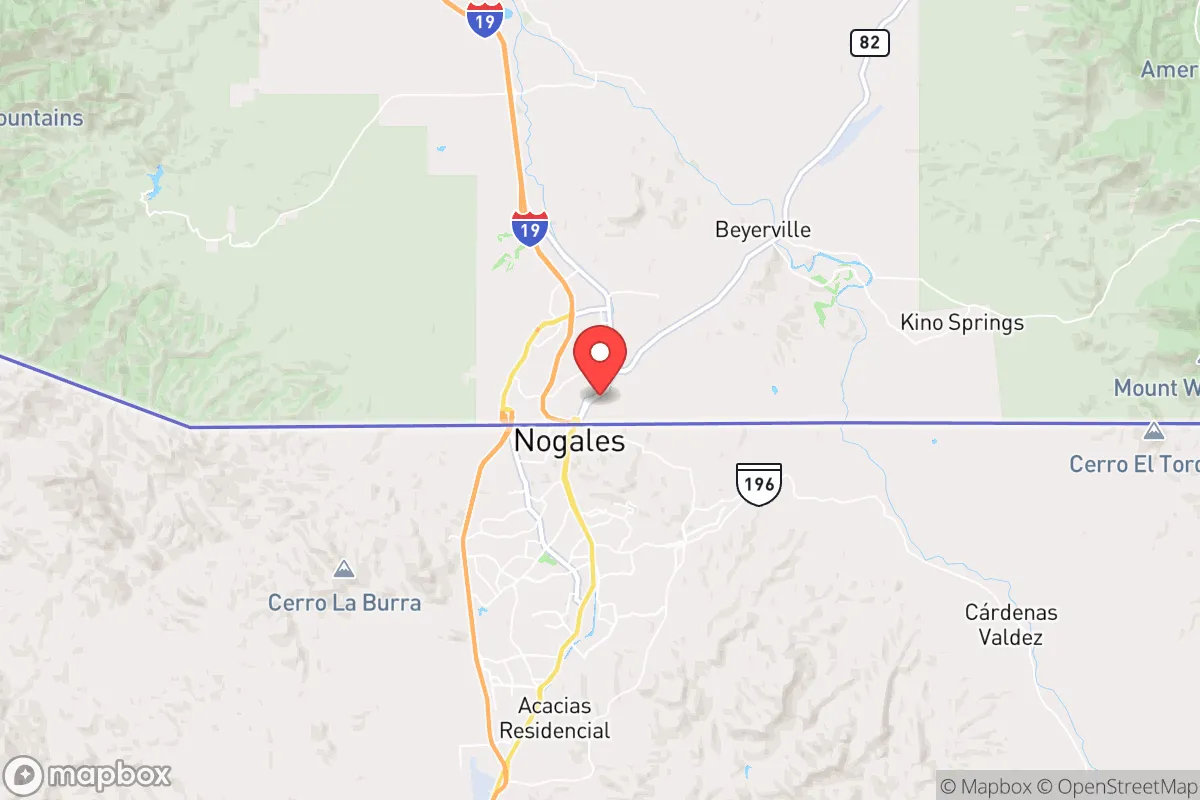
The people of Nogales, Arizona, today form a densely woven, overwhelmingly Hispanic community of 19,753 residents, where 94.4% identify as Hispanic or Latino and only 3.4% as non-Hispanic White. This is a border city with a distinct binational character—20.2% of residents are foreign-born, and daily life flows across the line to Nogales, Sonora. The city’s identity is rooted in a century of cross-border labor, trade, and family ties, producing a population that is younger (median age 35.4) and less college-educated (18.4%) than the national average, but deeply stable in its cultural and economic orientation.
How the city was settled and grew
Nogales was founded in 1880 as a railroad and mining supply point on the U.S.-Mexico border, named after the walnut groves (nogales) that lined the Santa Cruz River. The original population was a mix of Anglo-American railroad workers, merchants, and Mexican laborers who crossed daily from Sonora. The 1880s land grant system and the arrival of the Atchison, Topeka and Santa Fe Railway drew the first permanent settlers, who built homes in the Historic Downtown Nogales district, a compact grid of adobe and brick buildings along Grand Avenue. By 1900, the population was roughly half Anglo and half Mexican, with the Mexican community concentrated in the Chula Vista neighborhood, a hillside barrio east of the railroad tracks. The 1910 Mexican Revolution sent a wave of refugees north, doubling the city’s Hispanic population by 1920 and solidifying Chula Vista as a predominantly Mexican enclave. The 1940s and 1950s brought another surge: the Bracero Program (1942–1964) funneled temporary agricultural workers through Nogales, and many settled permanently in the Mariposa area, a working-class district west of the downtown core that grew around the Mariposa Port of Entry. By 1960, Nogales was 70% Hispanic, with the Anglo minority concentrated in the Western Hills subdivision, a small, higher-elevation neighborhood developed for railroad and customs officials.
Modern era (post-1965)
The 1965 Hart-Cellar Act ended the national-origins quota system, but Nogales’s demographic trajectory was already set. The real post-1965 shift was not a new immigrant wave but the acceleration of cross-border commuting and the decline of the Anglo population. As the maquiladora industry exploded in Nogales, Sonora after 1970, U.S.-side neighborhoods like Meadow Hills (a 1970s subdivision east of the freeway) filled with Mexican-American families who worked in customs, logistics, and retail. The Anglo population, never more than 30% after 1920, shrank steadily as older residents retired to Tucson or Phoenix; by 2000, non-Hispanic Whites made up just 6% of the population. The 1990s and 2000s saw the rise of San Rafael Estates, a newer, slightly more affluent subdivision on the city’s northern edge, home to dual-citizen professionals and business owners who commute daily to Sonora. Today, the city’s 0.2% Black population and 0.1% East/Southeast Asian population are tiny and scattered, with no distinct ethnic enclaves—Nogales remains overwhelmingly a city of Mexican-origin families, many with deep roots on both sides of the border. The foreign-born share (20.2%) is high but stable, reflecting a mature immigrant community where most arrivals are family reunification rather than new labor migration.
The future
Nogales’s population is not homogenizing into a single enclave—it is already nearly homogeneous—but it is slowly aging and suburbanizing. The city lost 2% of its population between 2010 and 2020, as younger families move to Tucson (60 miles north) for better schools and jobs, while older residents stay put in Chula Vista and Mariposa. The Hispanic share is likely to remain above 94% for the foreseeable future, as the small Anglo and Asian populations are not growing. The foreign-born share may decline slightly as second- and third-generation Mexican-Americans outnumber new arrivals. New housing construction is concentrated in San Rafael Estates and the North Nogales corridor along Highway 19, attracting middle-class families who want proximity to the border but newer homes. The city is not tribalizing into distinct ethnic enclaves—it is too small and too culturally unified for that—but economic stratification is visible: older, poorer neighborhoods like Chula Vista contrast with the newer subdivisions. The next 10–20 years will likely see a slow, stable population with a slightly older median age, continued out-migration of college-bound youth, and a persistent binational identity that defines daily life.
For someone moving to Nogales now, the bottom line is that this is a deeply Mexican-American border city with a stable, family-oriented population, low crime relative to similar-sized border towns, and a culture that prizes cross-border ties. It is not a place of rapid demographic change or ethnic diversity—it is a place where the population has been overwhelmingly Hispanic for generations, and will remain so. New residents, whether Anglo or Hispanic, should expect to integrate into a community where Spanish is heard as often as English, and where the border is not a line but a daily reality.

* Values derived from national, state, county, city and local statistics and may differ in a specific area. Last updated: 2026-04-19T11:55:17.000Z
Narrative content on this page is AI-generated and may contain mistakes. Verify any details that matter before acting on them.
ReloMaps may earn a commission from affiliate links at no extra cost to you.

