Photo: Wikipedia
Demographics of Norman, OK
Affluence Level in Norman, OK
A middle-class area roughly in line with national averages across income, home values, education, and employment.
People of Norman, OK
The people of Norman, Oklahoma today number 128,714, forming a university-anchored community that is notably more educated and less diverse than the state average. With 46.2% of adults holding a college degree—driven largely by the University of Oklahoma's presence—the city’s character blends academic liberalism with a conservative-leaning regional culture. The population is 69.9% white, 9.0% Hispanic, 4.8% Black, 3.1% East/Southeast Asian, and 1.1% Indian (subcontinent), while only 4.2% are foreign-born, reflecting a city shaped more by domestic in-migration than international immigration.
How the city was settled and grew
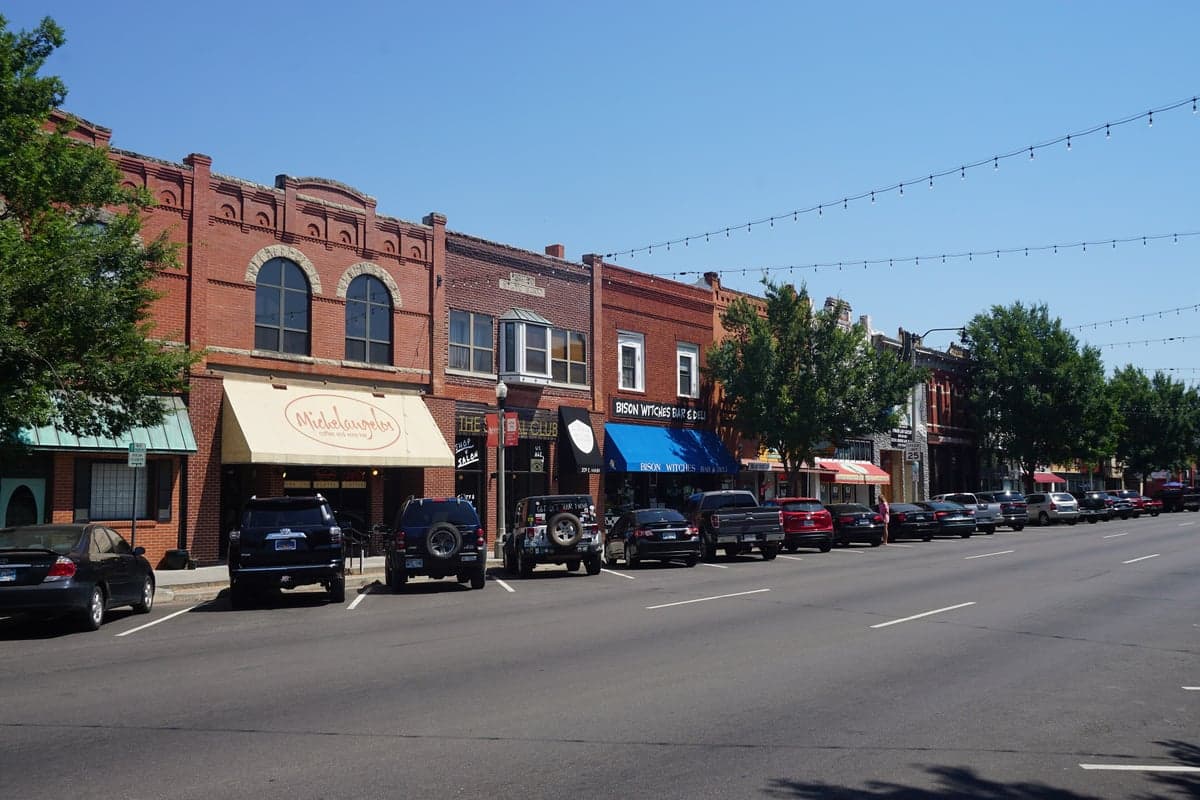
Norman was founded during the Land Run of 1889, when non-Native settlers claimed plots in the Unassigned Lands of Indian Territory. The original population was overwhelmingly white and native-born, drawn by the promise of free land under the Homestead Act. The arrival of the Atchison, Topeka and Santa Fe Railway in 1887—two years before the run—had already established a depot, and the town grew around it. The University of Oklahoma, established in 1890, became the city’s defining institution, attracting faculty, students, and support staff from across the Midwest and South. Early residential development clustered in what is now the Historic Downtown and the University District, where professors and merchants built homes. The oil boom of the 1910s and 1920s brought a second wave of white migrants from Texas and Kansas, settling in neighborhoods like West Norman and Southridge. By 1950, Norman’s population had reached 27,000, still nearly all white, with a small Black community concentrated near the railroad tracks in the Eastside neighborhood.
Modern era (post-1965)
The post-1965 era brought gradual demographic change, though Norman remained predominantly white. The University of Oklahoma’s expansion under presidents like George Lynn Cross attracted faculty and graduate students from outside the region, including a modest number of East/Southeast Asian academics and professionals. These newcomers tended to settle in the Brookhaven and Trails neighborhoods near campus, areas that remain among the most racially diverse in the city. The Hispanic population grew from negligible levels in 1970 to 9.0% today, driven by Mexican-origin migrants working in construction, hospitality, and agriculture in the surrounding Cleveland County. Hispanic households concentrated in the Eastside and North Norman areas, where housing costs are lower. The Black population, at 4.8%, has remained stable since the 1990s, with many families living in the Eastside and Alameda corridors. The Indian-subcontinent community (1.1%) is a recent addition, largely tied to OU’s engineering and medical programs, and clusters near the Research Park and University North Park areas. The foreign-born share of 4.2% is low compared to national averages, reflecting Norman’s limited role as an immigrant destination.
The future
Norman’s population is projected to grow modestly, reaching roughly 140,000 by 2035, driven by university expansion and spillover from Oklahoma City’s southern suburbs. The white share is slowly declining as Hispanic and Asian populations increase, but the city is not tribalizing into distinct ethnic enclaves. Instead, neighborhoods like Brookhaven and Trails are becoming more integrated, while the Eastside remains the most economically and racially mixed area. The Indian-subcontinent community is likely to grow as OU’s STEM programs expand, but will remain small. The foreign-born population may rise to 6-7% as the university recruits internationally, but Norman will not become a major immigrant gateway. The city is homogenizing in terms of education—college attainment is already high and rising—while slowly diversifying in racial terms. For a conservative-leaning mover, this means a stable, safe community where change is gradual and largely contained within the university orbit.
Norman is becoming a more educated, slightly more diverse university town, but its core identity remains white, native-born, and middle-class. The city offers a predictable environment for families and professionals, with demographic shifts that are slow enough to avoid cultural disruption. For someone moving in now, Norman provides a stable, low-crime setting with a strong local economy anchored by OU, where the population trajectory is one of gradual, manageable change rather than rapid transformation.

* Values derived from national, state, county, city and local statistics and may differ in a specific area. Last updated: 2026-04-28T19:56:41.000Z
Narrative content on this page is AI-generated and may contain mistakes. Verify any details that matter before acting on them.
ReloMaps may earn a commission from affiliate links at no extra cost to you.

