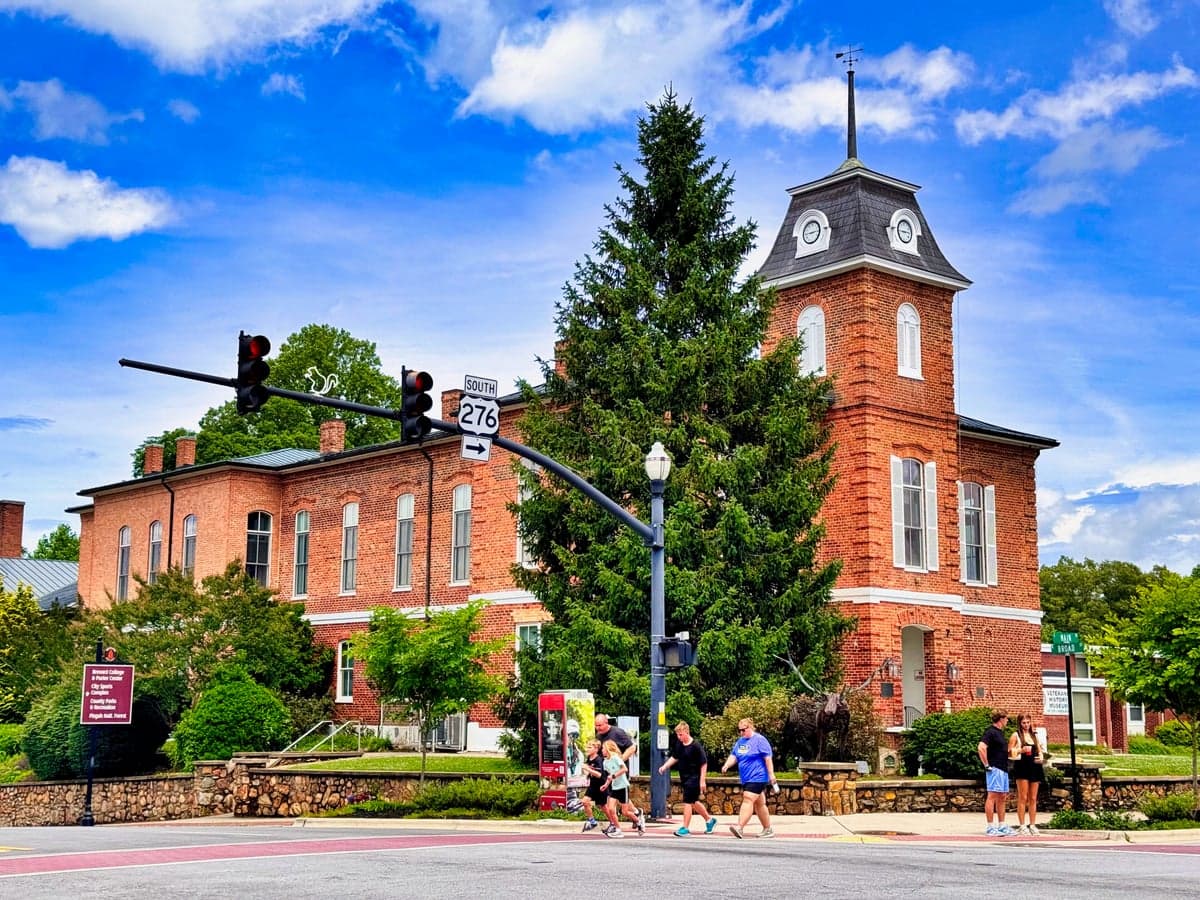
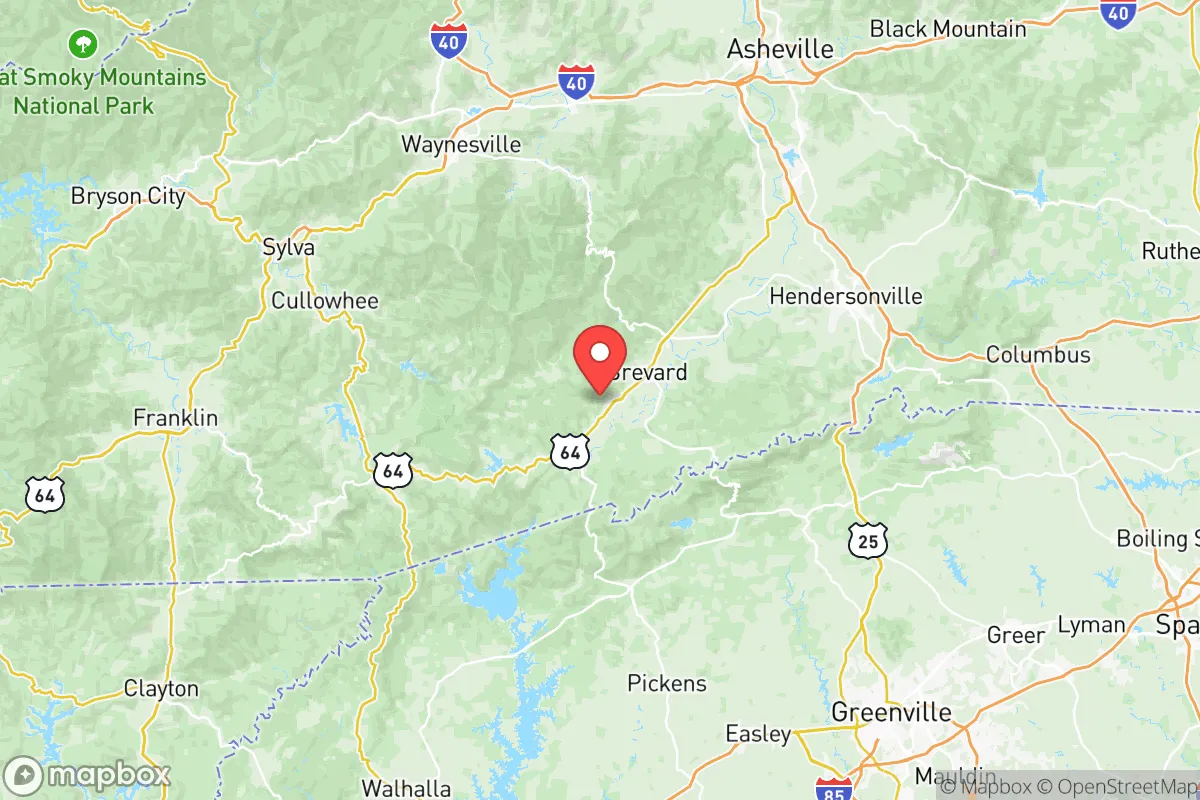
Photo: Wikipedia
Demographics of Transylvania County
Affluence Level in Transylvania County
A middle-class area roughly in line with national averages across income, home values, education, and employment.
People of Transylvania County
Transylvania County, North Carolina, is home to roughly 33,243 residents, a population that remains predominantly white (88.2%) and notably less diverse than the state as a whole, with a foreign-born share of just 2.2%. The county’s character is defined by its deep Appalachian roots, a strong Scots-Irish and German heritage, and a modern identity shaped by retirees, outdoor enthusiasts, and remote workers drawn to the Blue Ridge Mountains. Its population density is low, and its cultural markers—from the annual White Squirrel Festival in Brevard to the county’s strict land-use regulations—reflect a community that values both tradition and natural preservation.
Settlement & growth (pre-1960)
Long before European settlers arrived, the land now known as Transylvania County was part of the vast Cherokee homeland. The Cherokee people, particularly the Lower and Middle Cherokee, used the region’s abundant rivers and valleys for hunting and seasonal settlements. The French Broad River and its tributaries, including the Little River, were central to their way of life. However, the Cherokee were forcibly removed through treaties and the Trail of Tears in the 1830s, leaving the area largely depopulated of its original inhabitants by the time permanent white settlement began in earnest.
The first wave of European settlers arrived in the late 1700s and early 1800s, primarily Scots-Irish and English pioneers pushing westward from the Piedmont and coastal plains. These families—names like Allison, Gillespie, and McCall—were drawn by cheap land grants and the promise of self-sufficiency in the isolated mountain coves. They established small farming communities in what would become Brevard, the county seat, and in the rural areas around Pisgah Forest and Rosman. The terrain was rugged, and subsistence farming, hunting, and timber were the early economic engines.
The county was officially formed in 1861 from parts of Henderson and Jackson counties, named "Transylvania" (Latin for "across the woods") by a state legislator. The Civil War and Reconstruction era saw little population change, as the area remained poor and isolated. The real demographic shift began in the late 19th and early 20th centuries with the arrival of the railroad and the timber industry. The logging boom brought a second wave of settlers—mostly native-born white laborers from other parts of Appalachia and the Deep South—who worked in the vast forests owned by companies like the Carr Lumber Company. The company town of Rosman grew around a major sawmill, and the village of Penrose became a hub for railroad workers and their families.
Simultaneously, the region’s natural beauty began attracting wealthy outsiders. In the 1910s and 1920s, industrialists from the Northeast—most notably Joseph Silversteen, a Jewish immigrant from Russia who founded the Toxaway Tanning Company—established summer estates and resorts. Silversteen’s tannery in Rosman employed hundreds of local white workers and a small number of Black laborers, though the county’s Black population never exceeded a few hundred due to the lack of industrial-scale agriculture and the area’s geographic isolation. The construction of the Pisgah National Forest in 1916 and the establishment of the Brevard Music Center in 1936 (originally a summer camp for classical musicians) began to shift the local economy from extraction to tourism and the arts.
By 1960, Transylvania County’s population stood at roughly 15,000, overwhelmingly white, native-born, and rural. The county had no significant immigrant communities, and its Black population had declined further as younger residents left for urban centers in the North and South. The dominant cultural identity was Scots-Irish Appalachian, with a strong emphasis on self-reliance, Protestant Christianity, and conservative social values.
Modern era (post-1965)
The post-1965 period brought no large-scale immigration wave to Transylvania County, unlike many parts of the Sun Belt. The county’s foreign-born population remains minuscule at 2.2%, and the 1965 Hart-Cellar Act had little direct effect here. Instead, the demographic story of the last 60 years is one of domestic in-migration—primarily retirees, second-home buyers, and, more recently, remote workers from the Northeast, Midwest, and Florida.
Beginning in the 1970s and accelerating through the 1990s, the county became a destination for affluent retirees and vacation-home owners drawn to the cool mountain summers and the scenic beauty of the Blue Ridge Escarpment. Communities like Lake Toxaway and Sapphire (the latter technically straddling the Jackson County line) saw the development of gated golf and lake communities, attracting a predominantly white, upper-income demographic from states like Florida, Ohio, and New York. This wave brought new wealth and a more politically moderate influence, though the county’s overall voting patterns have remained reliably Republican.
The Hispanic population, while still small at 4.9%, has grown modestly since the 1990s, driven by labor demand in construction, landscaping, and the hospitality industry. Most Hispanic residents are of Mexican origin and live in and around Brevard and Rosman, where they work in the service sector and in the region’s growing retirement-home construction industry. There is no distinct ethnic enclave, and the community is dispersed throughout the county.
The Black population remains low at 3.7%, a figure that has held steady for decades. Historically concentrated in a small neighborhood in Brevard known as "The Hill," the Black community has not grown significantly due to limited economic opportunities and the county’s lack of urban amenities. East and Southeast Asian residents make up just 0.5% of the population, and Indian-subcontinent residents account for 0.1%, reflecting the county’s minimal draw for high-skilled immigrant workers who typically cluster in metropolitan areas with tech and research sectors.
Suburbanization has been limited. The county has no major highways, and development is constrained by the Pisgah National Forest, DuPont State Forest, and Gorges State Park, which together cover a large portion of the land area. New housing construction has concentrated in the Brevard area and along the U.S. 64 corridor toward Pisgah Forest, but the county has resisted large-scale subdivision development, maintaining its rural character.
The future
Transylvania County is likely to become slightly more diverse over the next 10-20 years, but the change will be gradual. The Hispanic share of the population is expected to continue its slow increase, driven by natural growth and continued labor demand in construction and services. The county’s white population share, currently 88.2%, will edge downward, but the county will remain overwhelmingly white and native-born compared to the national average.
The biggest demographic force will be continued domestic in-migration of retirees and remote workers, particularly from the Northeast and Florida. The county’s appeal as a lower-cost, high-amenity mountain destination will sustain this trend, especially as climate concerns push people away from hotter and more hurricane-prone regions. New arrivals are likely to concentrate in Brevard and the Lake Toxaway area, with some spillover into Rosman and Penrose. This will bring more political diversity—the county has already shifted slightly toward competitive races in local elections—but the overall conservative character will persist.
The county’s cultural identity is evolving from a purely Scots-Irish Appalachian heritage toward a blend of traditional mountain culture and an outdoor-recreation, arts-oriented lifestyle. The Brevard Music Center, the county’s extensive trail network, and the growing number of craft breweries and farm-to-table restaurants are attracting a younger, more educated demographic (38.6% of adults now hold a college degree). This group is less tied to the county’s historical industries and more focused on quality of life, which may create tensions over growth management and land use.
For someone moving in now, Transylvania County offers a stable, safe, and scenic environment with a strong sense of community, but it is not a place of rapid demographic change or urban diversity. The population is aging, with a median age well above the national average, and the county’s future depends on its ability to attract younger families and workers to sustain its economy and schools. The kind of person who will thrive here is someone who values natural beauty, quiet living, and a slower pace, and who is comfortable in a community that is culturally homogeneous but welcoming to newcomers who respect its traditions.

* Values derived from national, state, county, city and local statistics and may differ in a specific area. Last updated: 2026-08-08T12:55:44.000Z
Narrative content on this page is AI-generated and may contain mistakes. Verify any details that matter before acting on them.
ReloMaps may earn a commission from affiliate links at no extra cost to you.

