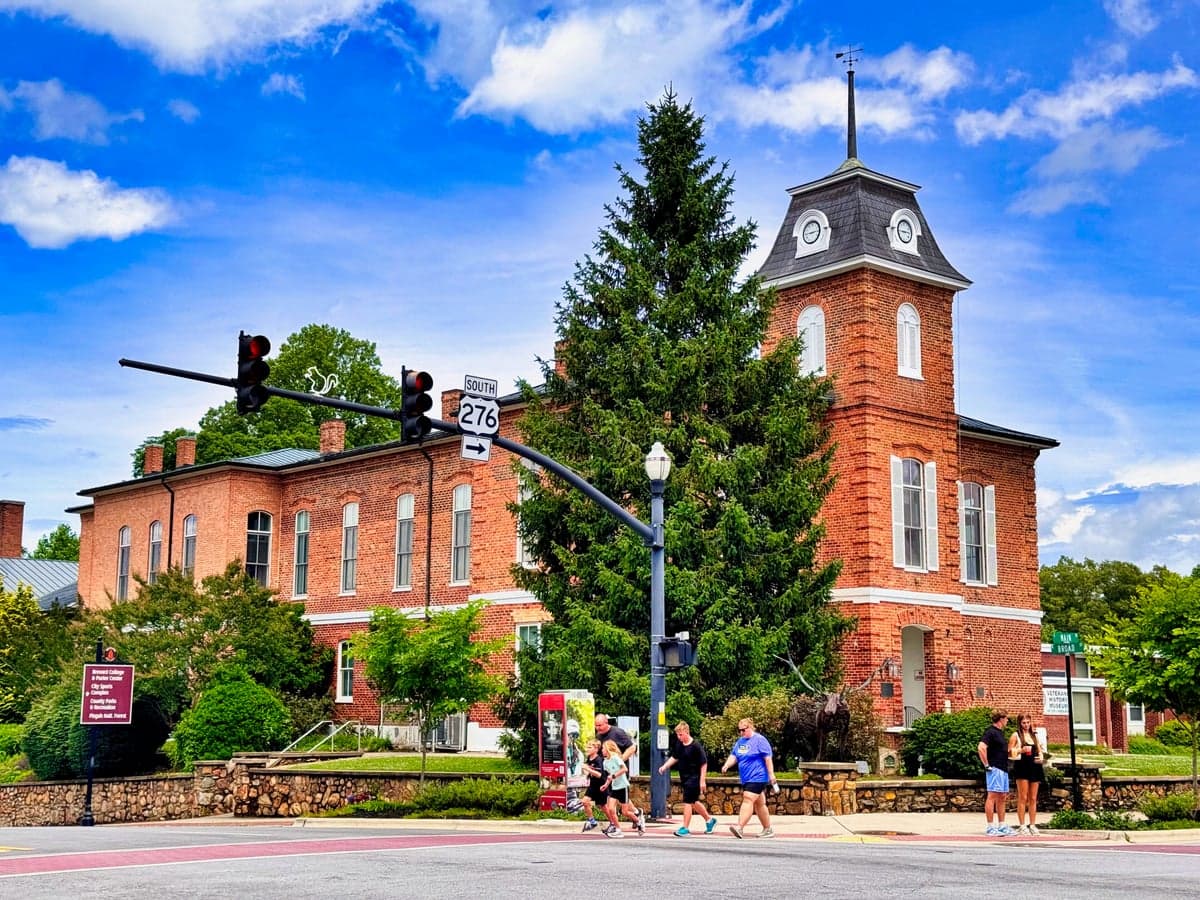
Photo: Wikipedia
Personal Sovereignty in Transylvania County
Viable for self-reliance. Generally workable, though some barriers may limit total independence.
What does Personal Sovereignty tell us?
Personal Sovereignty measures your capacity for self-reliance and independence with minimal government friction. Higher scores mean fewer barriers between you and the way you want to live... but it assumes you have the space you need and good neighbors.
What does this tell us?
Personal Sovereignty measures your capacity for self-reliance and independence with minimal government friction. Higher scores mean fewer barriers between you and the way you want to live... but it assumes you have the space you need and good neighbors.
State Policy
Energy independence: Importer (15% of energy produced in-state)
Personal Liberty
Homesteading

Personal Liberty Analysis
Transylvania County, North Carolina, offers a notably high degree of personal sovereignty relative to many urban and suburban areas in the Southeast, driven by a combination of low property taxes, permissive self-defense laws, and a regulatory environment that generally favors individual autonomy over collective mandates. While the county is not a libertarian free-for-all—state and local building codes, environmental regulations in the Pisgah National Forest buffer zone, and school district policies do impose constraints—the overall posture is one of light-touch governance. For a conservative-leaning individual or family prioritizing independence, the area presents a compelling balance of rural freedom and access to modern infrastructure, with distinct differences between the more regulated town of Brevard and the looser unincorporated areas like Penrose, Rosman, and Balsam Grove.
Tax burden and regulatory posture: How property taxes and zoning compare
Transylvania County’s tax burden is among the lighter in western North Carolina, with a county property tax rate of approximately $0.50 per $100 of assessed value as of 2025, plus a modest municipal rate of about $0.40 for properties within Brevard. This combined rate of roughly $0.90 is significantly lower than comparable mountain counties like Buncombe (Asheville area) or Henderson, where combined rates often exceed $1.10. The county does not levy a local sales tax beyond the state’s 4.75% rate, and there is no county-level income tax—North Carolina’s flat state income tax of 4.5% applies uniformly. Regulatory posture is generally permissive outside of Brevard’s town limits, where zoning ordinances are more prescriptive regarding setbacks, lot coverage, and historic district restrictions. In unincorporated areas like Rosman, Penrose, and the rural stretches along Highway 215 toward Balsam Grove, there are no county-wide zoning codes for most residential uses, meaning a landowner can place a manufactured home, build a workshop, or keep livestock on a standard 1- to 5-acre parcel without seeking a variance. However, the county does enforce a minimum lot size of 1 acre for septic-based development in most rural areas, which effectively prevents dense subdivision but also preserves the autonomy of larger landowners. The overall regulatory environment is best described as "rural permissive with urban exceptions"—a posture that strongly favors self-reliant individuals who choose to live outside Brevard’s municipal footprint.
Self-defense and gun law specifics: What the Second Amendment landscape looks like
North Carolina is a shall-issue state for concealed carry permits, and Transylvania County’s sheriff’s office processes applications with typical rural efficiency—wait times for a permit are generally under 30 days, and the county has no history of administrative delays or restrictive interpretations. The state permits open carry of handguns and long guns without a license for anyone legally allowed to possess a firearm, and no state or county-level red flag law exists as of 2026, meaning there is no mechanism for temporary firearm seizure based on behavioral risk reports. Stand-your-ground and castle-doctrine statutes are fully in effect, with no duty to retreat in any place where the individual is lawfully present. Transylvania County’s gun culture is deeply embedded: the Brevard Gun Club operates a 400-yard rifle range, and the local chapter of the North Carolina Rifle and Pistol Association holds regular matches. The county’s sheriff, as of the 2024 election, publicly opposes any additional firearm restrictions and has stated he will not enforce potential future federal magazine bans. For a reader prioritizing self-defense sovereignty, the practical reality is that Transylvania County is one of the most firearm-friendly jurisdictions in the state, with no local ordinances restricting magazine capacity, firearm storage, or carry locations beyond the state’s statutory prohibitions (e.g., schools, courthouses, and certain government buildings). The only notable nuance is that Brevard’s city parks technically prohibit firearms under a local ordinance, though enforcement is inconsistent and the state’s preemption law likely supersedes it—a point worth noting for those who plan to carry in municipal green spaces.
Self-reliance and homesteading viability: Lot sizes, zoning, and off-grid feasibility
Homesteading and off-grid living are genuinely viable in Transylvania County, but feasibility varies sharply by location. In unincorporated areas like Penrose, Balsam Grove, and the rural corridors along Highway 276 and 215, parcels of 2 to 10 acres are common and affordable, with raw land prices ranging from $8,000 to $20,000 per acre depending on road access and topography. The county does not require building permits for structures under 200 square feet that are not used as primary dwellings, meaning a small cabin, tool shed, or greenhouse can be erected without county oversight. For primary residences, the county enforces the North Carolina State Building Code, which includes septic system requirements—a perk test and a septic permit are mandatory for any dwelling with plumbing, typically costing $1,500 to $3,000. Off-grid solar is explicitly permitted, and Duke Energy’s net metering program allows grid-tied systems, but there is no county-level prohibition on fully off-grid setups as long as the dwelling meets basic health and safety codes. Rainwater collection is legal and encouraged, with no permit required for cisterns under 10,000 gallons. Zoning in the unincorporated county does not restrict livestock—chickens, goats, and even cattle are common on 3+ acre parcels—but the county does enforce a 100-foot setback for animal shelters from neighboring dwellings. The town of Brevard, by contrast, limits livestock to chickens only (hens, no roosters) and requires a minimum 0.5-acre lot. For a homesteader, the clear choice is to locate outside Brevard’s extraterritorial jurisdiction—areas like Rosman, Lake Toxaway, and the Sapphire Valley region offer the most permissive environment for self-reliant living.
Personal liberties: Parental rights, medical autonomy, speech, and property
Transylvania County’s school board, as of the 2025 election cycle, is majority conservative and has adopted policies emphasizing parental notification for any health or counseling services provided to students, as well as a curriculum transparency policy that allows parents to review all instructional materials. The county does not have a local health department mandate for childhood vaccinations—state law requires them for school attendance, but medical and religious exemptions are available and processed without significant friction. Medical autonomy is further supported by the county’s lack of any local mask or vaccine mandates; the county commission voted in 2023 to prohibit any future county-level public health orders that restrict individual medical choice, a symbolic but meaningful stance. Property rights are robust: the county does not enforce a tree ordinance or vegetation height restrictions on private land, and there is no county-level rental registration or landlord licensing requirement. However, the Pisgah National Forest and Gorges State Park impose federal and state restrictions on adjacent private land use, including limitations on timber harvesting near designated wilderness areas and restrictions on motorized vehicle access on forest service roads. Free speech is fully protected under state and federal law, and the county has no history of local ordinances restricting political signage, leafleting, or public assembly. The overall posture is one of deference to individual and family decision-making, with the notable exception of environmental regulations tied to the county’s extensive public lands—a trade-off that most residents accept in exchange for the area’s natural amenities.
Compared to other parts of western North Carolina, Transylvania County offers a stronger-than-average sovereignty profile, particularly in its tax burden, gun laws, and homesteading permissiveness. It is less regulated than Buncombe County (Asheville) and more affordable than Watauga County (Boone), while offering a similar level of rural autonomy to neighboring Jackson County. The primary constraint is the county’s extensive federal landholdings—roughly 40% of the county is national forest or state park—which limits private land availability and imposes some environmental restrictions, but also ensures a low population density and a culture of self-reliance. For a conservative-leaning individual or family seeking a balance of personal freedom, low taxes, and a firearm-friendly legal environment, Transylvania County ranks among the top choices in the region, with the caveat that Brevard itself is more regulated than the surrounding unincorporated areas.

* Values derived from national, state, county, city and local statistics and may differ in a specific area. Last updated: 2026-08-08T12:55:44.000Z
Narrative content on this page is AI-generated and may contain mistakes. Verify any details that matter before acting on them.
ReloMaps may earn a commission from affiliate links at no extra cost to you.

