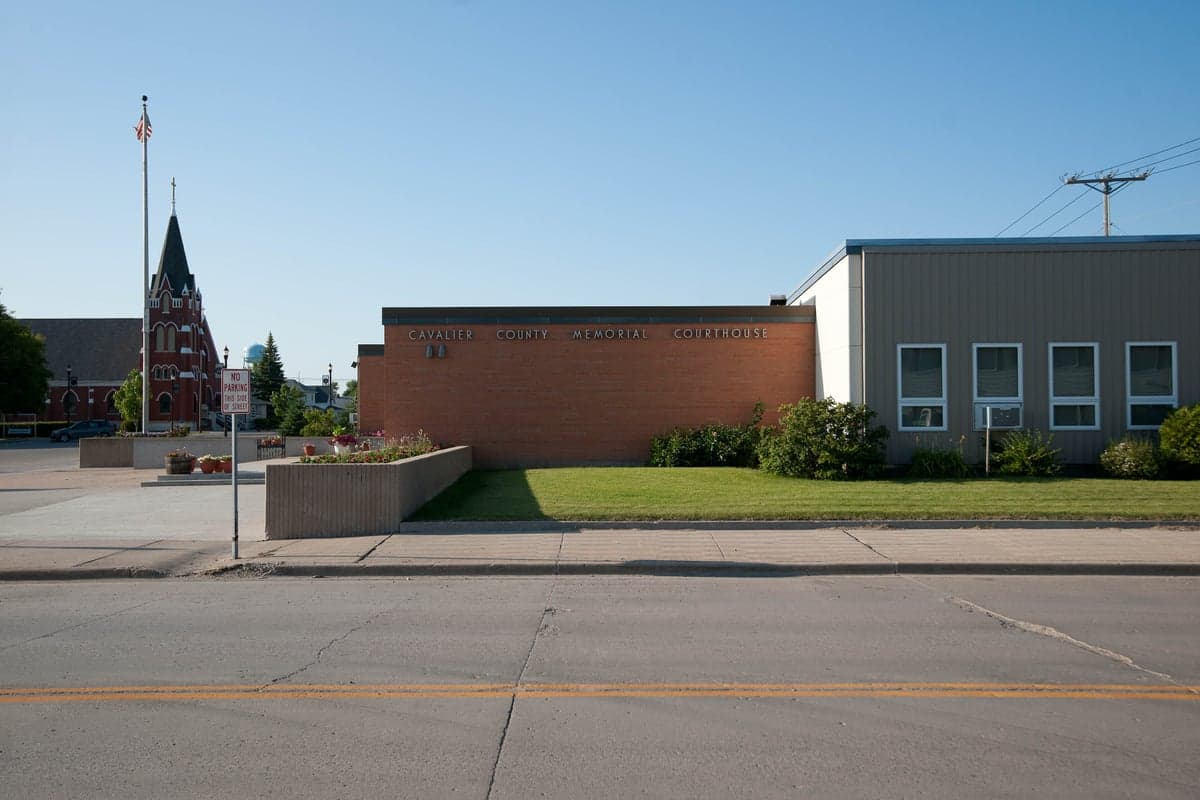
Photo: Wikipedia
Demographics of Cavalier County
Affluence Level in Cavalier County
A middle-class area roughly in line with national averages across income, home values, education, and employment.
People of Cavalier County
Cavalier County, North Dakota, is home to roughly 3,663 residents, making it one of the state's most sparsely populated counties. The population is overwhelmingly white (92.8%) and native-born (99.0% U.S.-born), with a distinctive character shaped by generations of Scandinavian and German-Russian settlement. The county's identity is rooted in its agricultural heritage, small-town resilience, and a conservative, self-reliant ethos that persists despite decades of population decline.
Settlement & growth (pre-1960)
Before European settlement, the area that is now Cavalier County was part of the traditional territory of the Dakota (Sioux) and Ojibwe (Chippewa) peoples. The land was used for seasonal hunting and gathering, particularly along the Pembina River and the Tongue River. The first European presence came with French-Canadian fur traders in the late 18th century, but no permanent settlements were established until the 1870s.
The first major wave of American settlement began after the 1862 Homestead Act and the arrival of the railroad. The St. Paul, Minneapolis & Manitoba Railway (later the Great Northern) pushed through the region in the 1880s, opening the land to homesteaders. The county was officially organized in 1884, and the town of Langdon was platted in 1885 as the county seat. Langdon quickly became the commercial and social hub, attracting farmers from the Midwest and Eastern states.
The defining demographic wave came between 1880 and 1910, when large numbers of Norwegian, Swedish, and German-Russian immigrants arrived. The German-Russians—ethnic Germans who had lived in Russia's Volga region for generations—were particularly significant. They brought expertise in dryland wheat farming, which proved essential in Cavalier County's semi-arid climate. These immigrants established tight-knit rural communities, often centered around Lutheran and Catholic churches. Towns like Osnabrock (founded 1887), Milton (1887), and Wales (1899) were founded by these groups, with distinct Scandinavian and German-Russian cultural markers that persist today.
A smaller but notable wave came from Polish and Czech immigrants in the 1890s and early 1900s, who settled primarily around Calio and Loma. These communities were drawn by the promise of cheap land and the opportunity to farm independently. By 1910, the county's population peaked at over 12,000 residents, nearly all of whom were engaged in agriculture or related services.
The period from 1910 to 1960 saw gradual population decline as farm consolidation reduced the need for labor. The Dust Bowl and Great Depression of the 1930s hit the region hard, but the county's reliance on wheat and small grains—rather than the more vulnerable corn and cotton—helped it weather the worst. World War II brought a temporary economic boost, but the post-war mechanization of farming accelerated out-migration. By 1960, the population had fallen to about 7,000, with many young people leaving for cities in the Upper Midwest and the West Coast.
Modern era (post-1965)
The 1965 Hart-Cellar Act, which dramatically reshaped U.S. immigration, had almost no impact on Cavalier County. The county's foreign-born population today stands at just 1.0%, and there are no significant immigrant enclaves. The demographic story of the modern era is one of continued domestic out-migration and aging.
Since 1965, the county has lost roughly half its population. The primary driver is the departure of young adults seeking education and employment outside agriculture. The county's economy remains heavily dependent on wheat, barley, and canola farming, with some oil-related activity from the Bakken shale formation to the west. However, the Bakken boom (2008-2014) largely bypassed Cavalier County, as the county sits east of the main oil-producing areas. Some workers commuted to Williston and other boomtowns, but few settled permanently.
The county's racial composition has remained remarkably stable. The white population is 92.8%, with the largest minority group being Hispanic or Latino at 2.6%. There are virtually no Black (0.0%), East/Southeast Asian (0.1%), or Indian subcontinent (0.0%) residents. The small Hispanic population is concentrated in Langdon and Milton, where some families work in meatpacking or agricultural processing. These are primarily second- and third-generation Mexican-Americans, not recent immigrants.
Suburbanization, a major force in many rural counties, has been minimal here. The county's largest town, Langdon, has a population of about 1,800 and serves as a regional service center. Other towns like Munich (population ~200) and Sarles (~100) have seen steady decline. The county's population density is just 2.3 people per square mile, making it one of the least densely populated counties in the nation.
The future
The demographic trajectory of Cavalier County is one of continued contraction and homogenization. The county's population is projected to decline further, possibly falling below 3,000 by 2040. The median age is already above 50, and the school-age population has been shrinking for decades. Without significant in-migration, the county will continue to age and depopulate.
There are no signs of a reversal. The county lacks the economic drivers—large employers, universities, or natural amenities—that attract new residents. The small Hispanic population is likely to remain stable or grow slightly, as some families fill labor gaps in agriculture and food processing. However, the county's cultural identity will remain overwhelmingly Scandinavian and German-Russian, with a strong conservative and agrarian ethos.
One potential wildcard is the expansion of carbon capture and storage projects in the region, which could bring temporary construction workers and some permanent technical staff. Another is the growing interest in rural "homesteading" among remote workers and retirees seeking low-cost land. However, these trends are unlikely to offset the broader decline. The county's future is one of small, stable communities rather than growth or diversification.
For someone moving in now, Cavalier County offers a deeply rooted, culturally homogeneous community with low crime, strong social ties, and a pace of life tied to the land. It is not a place of demographic change or diversity, but of continuity—a place where the descendants of 19th-century immigrants still farm the same fields, attend the same churches, and vote the same way. The county is becoming quieter and older, but its essential character remains intact.

* Values derived from national, state, county, city and local statistics and may differ in a specific area. Last updated: 2026-05-15T16:40:06.000Z
Narrative content on this page is AI-generated and may contain mistakes. Verify any details that matter before acting on them.
ReloMaps may earn a commission from affiliate links at no extra cost to you.

