
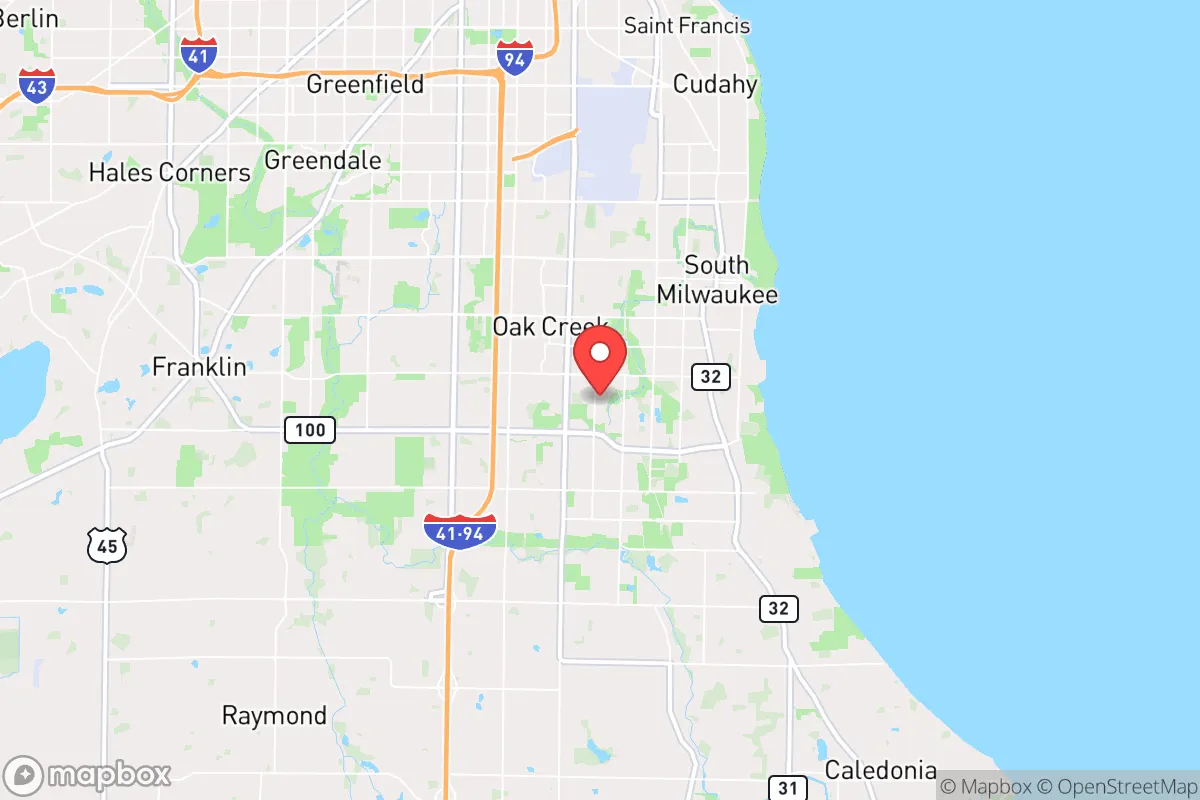
Photo: Wikipedia
Political ClimatePolitical Climate in Oak Creek, WI
District shown is the primary district for this city’s centroid. Cities may span multiple districts.
Local Political AnalysisPolitical Analysis of Oak Creek, WI
Oak Creek has always been a solid, working-class conservative town, and for the most part, it still is, but you can feel the ground shifting under your feet if you’ve been here long enough. The Cook PVI sits at R+2, which means the district leans Republican by a slim margin, but that’s a far cry from the deep-red stronghold it was twenty years ago. Back then, you could count on your neighbors to vote their values without a second thought; now, you’re starting to see more yard signs for candidates who talk a big game about “equity” and “transformation,” and that’s a red flag for anyone who values personal freedom over government-engineered social experiments.
How it compares
Drive ten minutes north into Milwaukee proper, and you’re in a completely different world—a Democratic stronghold where progressive policies on policing, taxes, and school curriculum are the norm. That contrast is important because Oak Creek is increasingly feeling the pressure of that urban spillover. To the south, Franklin and South Milwaukee are still reliably conservative, but they’re not immune either. The real eye-opener is how Oak Creek’s own city council and school board races have gotten tighter. A few years ago, a conservative candidate could coast to victory; now, you’ve got folks running on platforms that sound like they were copy-pasted from Madison or Milwaukee, pushing things like “diversity, equity, and inclusion” initiatives that sound nice but often come with a side of government overreach into how you run your business or what your kids learn.
What this means for residents
For the average Oak Creek family, this political drift means you can’t take your rights for granted anymore. The biggest concern is the slow creep of progressive ideology into local governance—things like zoning changes that make it harder to run a home-based business, or school policies that prioritize “social-emotional learning” over reading and math. It’s not a full-blown takeover yet, but it’s a warning shot. If you’re a gun owner, a small business owner, or just someone who believes the government should stay out of your life, you need to pay attention to school board and city council elections like your freedom depends on it—because it does. The good news is that the conservative base here is still active and vocal; the Oak Creek Republican Party chapter has a strong turnout operation, and local churches and civic groups are pushing back against the narrative that you have to choose between being a good neighbor and being a patriot.
One cultural distinction that still holds is Oak Creek’s strong sense of community self-reliance. We don’t look to the county or state to solve our problems—we handle things ourselves, from snow removal to neighborhood watch. That independent streak is what’s kept the worst of the progressive overreach at bay, but it’s under constant assault from outside money and outside ideas. The long-term outlook depends on whether enough residents wake up to the fact that a vote for a “moderate” who talks about “balance” is often a vote for the same agenda that’s wrecked Milwaukee and Madison. If we stay vigilant, Oak Creek can remain a place where your rights come first and the government is a servant, not a master. If we don’t, well, you’ll see the same story play out here that’s playing out in every other once-conservative suburb in America.

State Political ClimatePolitical Climate in Wisconsin
State Political AnalysisPolitical Environment in the State
Wisconsin has long been a classic swing state, but over the past decade it has shifted from a purple battleground to a state where the political climate is increasingly defined by a sharp urban-rural divide, with the conservative-leaning rural and exurban areas fighting a rearguard action against the progressive strongholds of Madison and Milwaukee. The state’s overall partisan lean is now a razor-thin Republican tilt in statewide elections, but that masks a deep cultural and ideological split. Over the last 20 years, the state has gone from reliably blue in presidential races (voting for Gore, Kerry, and Obama twice) to a state that Trump carried in 2016 and narrowly lost in 2020, while Republicans have held the legislature and governorship for most of that period. The trajectory is one of hardening polarization, with the conservative base concentrated in the WOW counties (Waukesha, Ozaukee, Washington) and the rural north and west, while the liberal vote is packed into Dane County (Madison) and Milwaukee County.
Urban vs. rural divide
The political map of Wisconsin is a textbook case of the urban-rural chasm. The Democratic vote is overwhelmingly driven by two metros: Madison (Dane County) and Milwaukee (Milwaukee County). Dane County alone delivers about 15% of the statewide Democratic vote, with margins exceeding 70-25 in recent elections. Milwaukee County adds another 20% of the Democratic base, though its turnout is lower. The rest of the state—the rural northwoods, the western driftless region, and the central farmlands—votes heavily Republican. The WOW counties (Waukesha, Ozaukee, Washington) are the conservative anchor, routinely delivering 60-65% for GOP candidates. The real battlegrounds are the suburban and exurban counties that have been trending away from the GOP: Brown County (Green Bay) flipped from red to purple, and Racine and Kenosha counties are now competitive. Meanwhile, the rural counties like Marathon (Wausau) and Door County have held steady for Republicans, though Door has shown some drift toward the center due to tourism and second-home owners.
Policy environment
Wisconsin’s policy environment is a mixed bag for conservatives. The state has a flat income tax rate of 4.4% (down from 7.75% in 2011), and property taxes are moderate compared to Illinois or Minnesota. The regulatory posture is generally business-friendly, with a right-to-work law passed in 2015 and a tort reform environment that limits lawsuit abuse. However, the state’s education policy is a flashpoint: Act 10 (2011) effectively ended collective bargaining for most public employees, which was a huge win for fiscal conservatives, but it also triggered a decade of political warfare. School choice programs, including the Milwaukee Parental Choice Program and the statewide voucher program, have expanded significantly, giving parents options outside the public system. On healthcare, Wisconsin did not expand Medicaid under the Affordable Care Act until 2019, and the state maintains a relatively free-market approach to insurance regulation. Election laws are a perennial battleground: the state has voter ID requirements (upheld by courts), but also has widespread absentee voting and same-day registration, which conservatives view as a vulnerability. The legislature passed a series of election integrity bills in 2021-2023, including restrictions on drop boxes and limits on who can return absentee ballots, but many were vetoed by Democratic Governor Tony Evers.
Trajectory & freedom
On the freedom front, Wisconsin is a state of contradictions. On the positive side for conservatives, the state has strong Second Amendment protections: it is a shall-issue state for concealed carry, with no permit required for open carry, and it has preemption laws that prevent local governments from enacting their own gun restrictions. In 2023, the legislature passed a bill allowing permitless carry, though it was vetoed by Governor Evers. Parental rights have been a major battleground: the legislature passed a bill in 2023 requiring schools to notify parents if a child requests a name or pronoun change, but it was also vetoed. On medical autonomy, Wisconsin has a near-total abortion ban from 1849 that was revived after Dobbs, though it is currently blocked by a court challenge. The state has no religious exemption laws for vaccines, and COVID-era mandates were enforced unevenly. The biggest threat to freedom in the eyes of many conservatives is the growing power of the state’s executive branch under Evers, who has used his veto pen to block nearly every piece of conservative legislation passed by the GOP legislature. The state Supreme Court flipped to a 4-3 liberal majority in 2023 after the election of Janet Protasiewicz, which has already led to the overturning of the state’s gerrymandered legislative maps—a move that will likely shift the legislature toward Democrats in 2024.
Civil unrest & political movements
Wisconsin has been a flashpoint for political unrest in recent years. The Kenosha riots of 2020, following the shooting of Jacob Blake, saw widespread arson and looting, and the subsequent trial of Kyle Rittenhouse became a national symbol of the Second Amendment and self-defense rights. The state has seen massive protests on both sides: the 2011 Act 10 protests in Madison drew over 100,000 people to the Capitol, and the 2020 Black Lives Matter protests in Milwaukee and Madison were large and sometimes violent. Immigration politics are relatively quiet compared to border states, but there is a growing concern about illegal immigration in the dairy industry, which relies heavily on immigrant labor. There is no sanctuary city policy in Wisconsin, though Madison and Milwaukee have declared themselves “welcoming cities.” Election integrity remains a hot-button issue: the 2020 election saw widespread use of drop boxes and private funding for election administration (Zuckerberg-funded grants), which led to a conservative backlash and ongoing legislative efforts to tighten rules. The state has a strong tradition of grassroots activism on both sides, with groups like the Wisconsin Institute for Law & Liberty (WILL) fighting for conservative causes in court, and the progressive group A Better Wisconsin Together pushing back.
Projection
Over the next 5-10 years, Wisconsin is likely to become more competitive and more polarized. The demographic trends are working against conservatives: the rural counties are aging and losing population, while Dane County and the Milwaukee suburbs are growing and becoming more diverse. The new legislative maps, drawn by the liberal Supreme Court, will almost certainly give Democrats a path to control the Assembly and Senate by 2026 or 2028. This means that the policy environment will shift leftward: expect higher taxes, expanded Medicaid, more gun control, and a rollback of school choice. The in-migration patterns are mixed: conservatives are moving to the WOW counties and the northwoods, while liberals are flooding into Madison and the Lake Michigan shoreline. The wild card is the 2024 presidential election, which will be a referendum on whether the state’s rural base can still outvote the urban centers. If Trump wins Wisconsin again, the conservative movement will have a few more years to hold the line. If he loses, the state will likely enter a period of Democratic control similar to what Minnesota has experienced. For a new resident, the bottom line is this: if you move to the WOW counties or the rural north, you will find a community that shares your values and a state government that is fighting to preserve your freedoms. If you move to Madison or Milwaukee, you will be in a progressive bubble where your political views will be in the minority. Choose your location carefully, and be prepared for the political climate to become more contentious, not less, in the years ahead.
For a conservative moving to Wisconsin, the practical takeaway is that the state offers a relatively low-tax, business-friendly environment with strong Second Amendment protections, but the political winds are shifting. The best bet is to settle in the WOW counties (Waukesha, Ozaukee, Washington) or in the rural northwoods around Rhinelander or Hayward, where the local culture and governance align with conservative values. Avoid Dane County and Milwaukee unless you are prepared for high taxes, progressive policies, and a constant cultural battle. The next decade will be a fight for the soul of the state, and where you live will determine how much of that fight you have to deal with on a daily basis.
* Values derived from national, state, county, city and local statistics and may differ in a specific area. Last updated: 2026-04-21T10:41:52.000Z
Narrative content on this page is AI-generated and may contain mistakes. Verify any details that matter before acting on them.
ReloMaps may earn a commission from affiliate links at no extra cost to you.

