
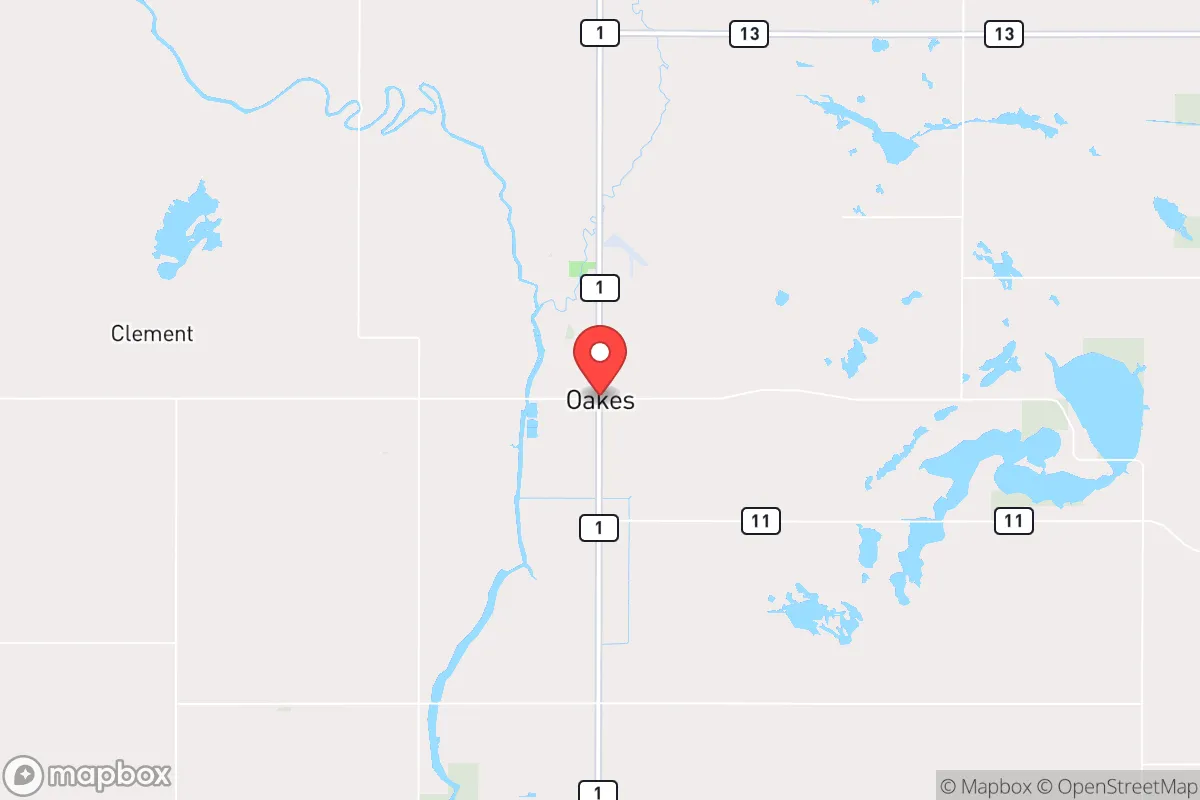
Photo: Wikipedia
Quality of Life in Oakes, ND
A high quality of life with strong walkability, manageable living costs, healthy neighborhood signals, and solid amenity access.
What does Quality of Life tell us?
Quality of Life blends cost of living, nearby amenities, socioeconomic signals, and neighborhood character. City-level scores represent the whole municipality; individual neighborhoods can differ.
What does this tell us?
Quality of Life blends cost of living, nearby amenities, socioeconomic signals, and neighborhood character. City-level scores represent the whole municipality; individual neighborhoods can differ.
Cost of Living
39% below national average
The Real Cost of Living in Oakes, ND for 2026
| Tier | Individual | Family (4) |
|---|---|---|
| Survival | $12k | $22k |
| Comfortable | $31k | $46k |
| Luxury | $117k+ | $181k+ |
| Elite (Top 5%) | $162k+ | $251k+ |
142%
The Area Signal
A metric tracking the socioeconomic signals of the area.


Hobbies
Explore the areaGroceries
2 within 10 miles
Gas
0 within 10 miles
Hospital
2 within 20 miles
Airport
JFK — John F. Kennedy Memorial
Post Office
USPS — Oakes, ND
Critical Amenities
Quality-of-Life Analysis
Oakes, North Dakota, offers a notably affordable quality of life that attracts a mix of agricultural workers, manufacturing employees, and families seeking a low-stress, small-town environment. With a cost of living index of 61—39% below the U.S. average—and a median home value of $160,100, the community stands out as one of the most budget-friendly places in the Upper Midwest. The population skews toward middle-income households, with a strong presence of workers employed at the local Bobcat Company plant and surrounding farms, creating a stable, blue-collar demographic.
How housing costs and daily expenses compare to nearby towns
Oakes’s housing market is a primary draw, with a median home value of $160,100—roughly half the national median—and a median rent of just $740 per month. This makes homeownership accessible even for entry-level workers, especially compared to larger regional hubs like Fargo (median home value ~$280,000) or Wahpeton (~$200,000). The average commute of 18 minutes further reduces transportation costs, as most residents work locally or within a 20-mile radius. Utility and grocery costs also track below state averages, though residents should note that property taxes in Dickey County are moderate (around 1.2% of assessed value), and heating costs in winter can add $150–$200 monthly to expenses. For renters, the $740 median is significantly cheaper than the national average of $1,200, making Oakes a strong option for those prioritizing housing affordability over urban amenities.
What daily life is like for families: schools, shopping, and recreation
Daily life in Oakes revolves around a compact, walkable downtown and a strong sense of community. The Oakes Public School District serves roughly 400 students across an elementary, middle, and high school, with a student-teacher ratio of about 12:1 and above-average test scores in math and reading compared to state benchmarks. For shopping and dining, residents rely on local grocery stores like Oakes Super Valu, a handful of family-owned restaurants, and the nearby Walmart in Ellendale (20 minutes west). Recreation centers on the Oakes Golf Course, the city’s park system with baseball fields and playgrounds, and the James River for fishing and kayaking. The Oakes Community Center hosts youth sports leagues and senior activities, while the Oakes Public Library offers programming for all ages. Healthcare needs are met by the Oakes Community Hospital (a critical-access facility with 25 beds) and a local clinic, though specialist care requires a 45-minute drive to Jamestown or Aberdeen, South Dakota.
This environment suits individuals and families who value low costs, short commutes, and a slower pace over urban nightlife or cultural diversity. Retirees on fixed incomes, young families buying their first home, and workers in manufacturing or agriculture will find Oakes particularly livable. However, those seeking diverse dining, major retail, or robust public transit may feel constrained. For anyone prioritizing financial breathing room and a tight-knit community where neighbors know each other, Oakes delivers a practical, grounded quality of life.

Crime in Oakes, ND
Lower crime rates than 100% of comparable U.S. locations.
Violent CrimeViolent Crime Analysis
Property CrimeProperty Crime Analysis
Crime Analysis
Oakes, North Dakota, is an exceptionally safe community, with a violent crime rate of 0 per 100,000 residents and a property crime rate of just 112.6 per 100,000. These figures place Oakes far below both state and national averages, making it one of the lowest-crime small towns in the Upper Midwest. For comparison, the national violent crime rate hovers around 380 per 100,000, while North Dakota’s state average is roughly 330 per 100,000, meaning Oakes effectively has no reported violent crime. Property crime in Oakes is also a fraction of the national rate of approximately 1,950 per 100,000, reflecting a community where theft, burglary, and vandalism are rare events.
Crime in context
Oakes’s crime statistics are a stark contrast to the broader trends seen in larger metropolitan areas, particularly those with progressive prosecutorial policies. In many urban centers, liberal district attorneys and judges who prioritize offender rehabilitation over public safety have been linked to rising recidivism and increased victimization. Oakes, by contrast, benefits from a conservative legal environment in rural North Dakota, where law enforcement and the judiciary emphasize accountability and community protection. The town’s violent crime rate of zero is not an anomaly but a consistent outcome of tight-knit social structures and a justice system that does not tolerate leniency for repeat offenders. Property crime, while present, is largely opportunistic and non-violent, with rates that are 94% lower than the national average.
What residents experience
Residents of Oakes report a strong sense of security, with most crime limited to minor thefts from unlocked vehicles or outbuildings. The local police department maintains a visible presence, and neighborhood watch programs are active. Because violent crime is virtually nonexistent, daily life in Oakes is free from the fear of assault, robbery, or homicide that plagues larger cities. The town’s low population density and strong social bonds mean that suspicious activity is quickly reported, and offenders are often known to law enforcement. This environment stands in direct opposition to high-crime metro areas where progressive policies have led to reduced police funding, early release of violent offenders, and a normalization of property crime.
Neighborhood-level variation in Oakes is minimal, as the entire town of roughly 1,800 people is uniformly safe. The most significant difference is between the residential core and the agricultural outskirts, where isolated farmsteads may experience occasional rural theft, but violent incidents remain unheard of. For families, retirees, and anyone seeking a community where justice is swift and public safety is prioritized, Oakes offers a rare haven in an era of rising urban crime. The data clearly shows that Oakes’s conservative legal framework and community vigilance produce outcomes that progressive metro areas cannot match.
* Values derived from national, state, county, city and local statistics and may differ in a specific area. Last updated: 2026-04-19T08:16:41.000Z
Narrative content on this page is AI-generated and may contain mistakes. Verify any details that matter before acting on them.
ReloMaps may earn a commission from affiliate links at no extra cost to you.

