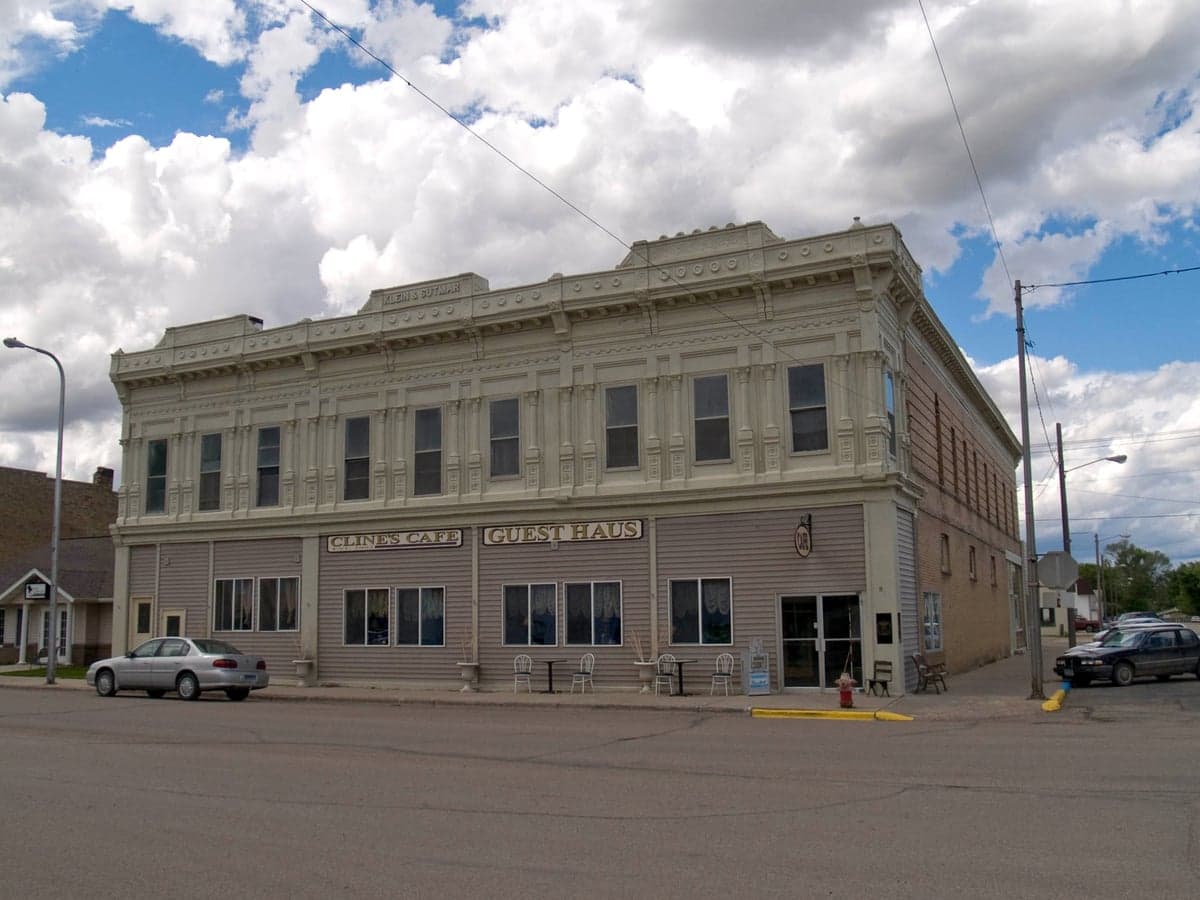
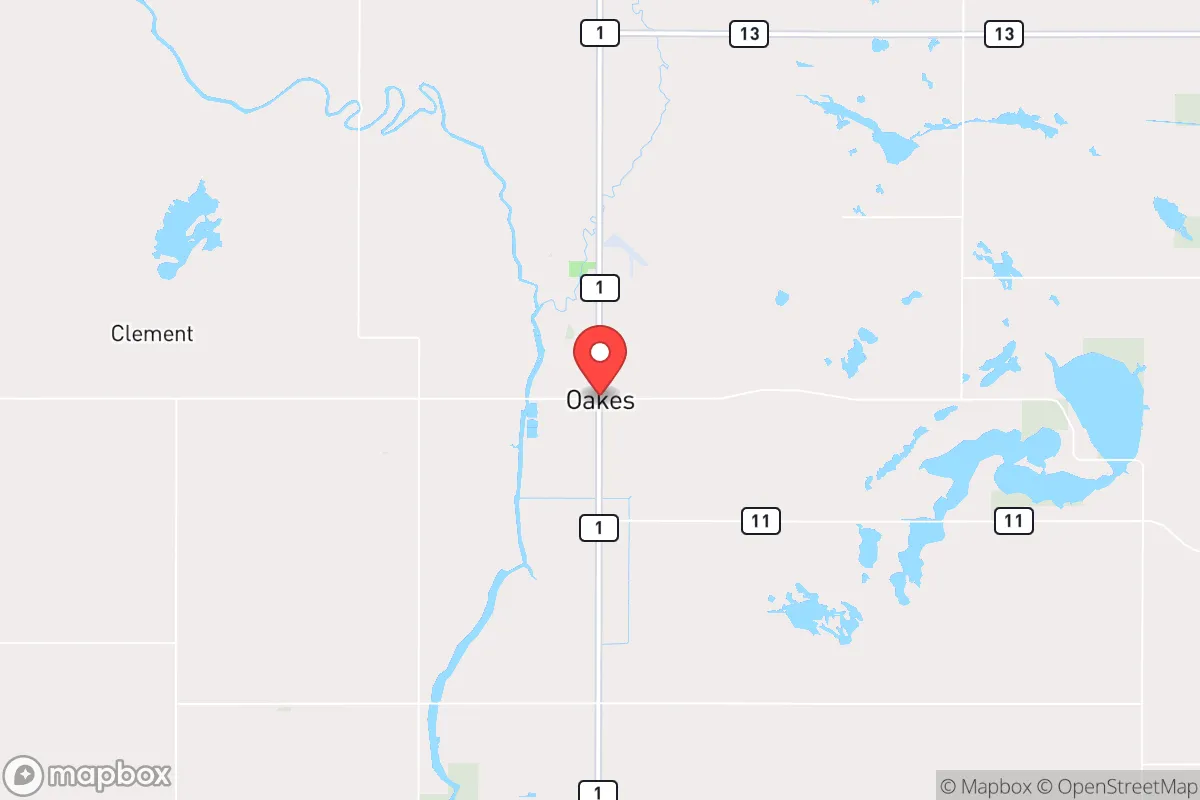
Photo: Wikipedia
Demographics of Oakes, ND
Affluence Level in Oakes, ND
A middle-class area roughly in line with national averages across income, home values, education, and employment.
People of Oakes, ND
The people of Oakes, North Dakota, today form a tight-knit, predominantly white community of 2,046 residents, characterized by a strong agricultural and railroad heritage. With 89.1% of the population identifying as white and a small but notable Hispanic community at 7.0%, the city maintains a homogeneous character typical of rural North Dakota. The foreign-born population sits at just 3.2%, and with 23.6% holding a college degree, Oakes reflects a working-class, family-oriented demographic profile that values stability and local tradition.
How the city was settled and grew
Oakes was founded in 1886 as a railroad town along the Northern Pacific Railway, which drew the first wave of settlers—primarily German-Russian immigrants, Scandinavian homesteaders, and Anglo-American farmers. The federal Homestead Act of 1862 and the subsequent railroad land grants were the primary drivers, offering 160-acre parcels that attracted families seeking agricultural opportunity. The original settlement clustered around the rail depot in what is now Downtown Oakes, where the first general stores, grain elevators, and blacksmith shops were built by German-Russian immigrants who formed the backbone of the early population. By the early 1900s, a second wave of Scandinavian settlers—mostly Norwegians and Swedes—established farms to the north and east, creating the North Oakes Addition neighborhood, which still retains older farmsteads and larger lot sizes. The city’s population peaked at around 1,800 in the 1930s, driven by wheat farming and the expansion of the Oakes branch of the Soo Line Railroad. A third wave arrived during the post-World War II era, when returning veterans and their families moved into the Southside District, a planned residential area developed in the 1950s with modest single-family homes and a new elementary school.
Modern era (post-1965)
After the Immigration and Nationality Act of 1965, Oakes saw minimal demographic change, as the city’s remote location and agricultural economy did not attract the large-scale immigration seen in urban centers. The white population remained dominant, with the Hispanic share—now 7.0%—growing slowly from the 1990s onward, primarily through Mexican-American families drawn to seasonal work in the region’s sugar beet and potato processing plants. These families settled mostly in the West End neighborhood, near the Oakes Farmers Cooperative grain terminal, where affordable rental housing and proximity to agricultural jobs created a small enclave. The East/Southeast Asian population remains at 0.0%, and the Indian subcontinent population is also 0.0%, reflecting the city’s lack of tech or university sectors that typically attract such groups. Domestic in-migration has been limited, with most new residents coming from other parts of North Dakota or neighboring Minnesota, often moving into the Prairie Heights subdivision, a newer development of ranch-style homes built in the 2000s on the city’s eastern edge. The Black population is 0.0%, and the city has no significant Arab or other minority communities, making Oakes one of the most racially homogeneous small cities in the state.
The future
The population of Oakes is projected to remain stable or decline slightly over the next 10–20 years, mirroring broader trends in rural North Dakota. The Hispanic community, currently at 7.0%, is likely to grow modestly as agricultural processing jobs continue to attract immigrant labor, but this growth will be gradual and concentrated in the West End and Southside District, where housing is most affordable. The white population, which makes up 89.1% of residents, is aging, with a median age above the national average, and younger residents often leave for college or jobs in Fargo or Bismarck. The city is not tribalizing into distinct ethnic enclaves—the Hispanic community is too small for that—but rather homogenizing further as the white population ages and out-migration continues. No significant immigrant communities from East/Southeast Asia, the Indian subcontinent, or the Middle East are expected to emerge, given the lack of economic pull factors. The Downtown Oakes area, once the commercial heart, is seeing some reinvestment in local businesses, but population growth will depend on whether the region can attract new industries beyond agriculture.
For someone moving in now, Oakes offers a stable, safe, and culturally uniform environment where community ties are strong and change is slow. The city is becoming quieter and older, but its low cost of living and agricultural roots provide a predictable, family-friendly setting for those seeking a traditional rural lifestyle. New residents will find a welcoming but insular community, where integration requires active participation in local churches, school events, and volunteer organizations.

* Values derived from national, state, county, city and local statistics and may differ in a specific area. Last updated: 2026-04-19T08:16:41.000Z
Narrative content on this page is AI-generated and may contain mistakes. Verify any details that matter before acting on them.
ReloMaps may earn a commission from affiliate links at no extra cost to you.

