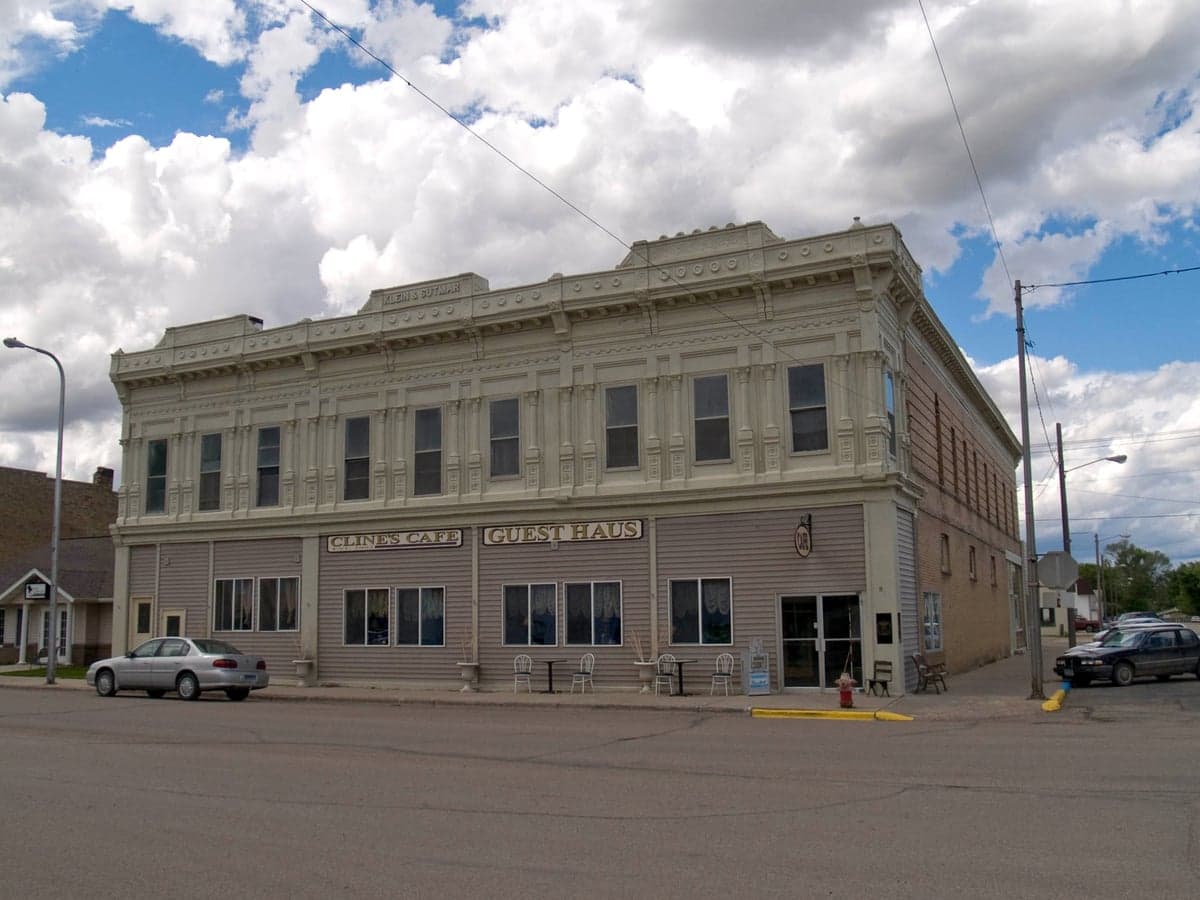
Photo: Wikipedia
Political ClimatePolitical Climate in Oakes, ND
District shown is the primary district for this city’s centroid. Cities may span multiple districts.
Inherited from parent state — no local data available.
Local Political AnalysisPolitical Analysis of Oakes, ND
Oakes, North Dakota, is about as reliably conservative as it gets, with a Cook PVI of R+18 that puts it deep in Republican territory. This isn't a purple town that flips back and forth; it's a place where the local values of self-reliance, limited government, and personal responsibility have held steady for generations. While some of the bigger cities in the state, like Fargo or Grand Forks, have seen a slow drift toward more progressive policies, Oakes has largely stayed the course, and most folks here aim to keep it that way.
How it compares
If you drive an hour north to Jamestown, you'll find a similar conservative vibe, though it's a bit more moderate on some social issues. Head west to Ellendale or south to Britton, South Dakota, and the political landscape is nearly identical—rural, agricultural, and deeply skeptical of federal overreach. The real contrast is with places like Bismarck or Minot, which have grown more diverse economically and, as a result, have seen a slight uptick in progressive-leaning voters, especially among younger transplants. Oakes, by contrast, remains a stronghold where the local county commission and school board are almost uniformly conservative, and the idea of government telling you how to run your farm, your business, or your household is met with a hard "no thanks."
What this means for residents
For someone living in Oakes, the political climate translates into a daily life with fewer regulations and less bureaucratic hassle. You won't see the kind of zoning fights or business mandates that pop up in more liberal areas. Property taxes are kept in check, and the local government generally takes a hands-off approach—if it's not broken, they don't try to fix it. That said, there's a growing concern among long-time residents about outside pressure. State-level pushes for things like carbon capture pipelines or renewable energy mandates have raised eyebrows, as they feel like a backdoor way for the federal government to control land use and energy choices. The general attitude is: we've been managing our own resources just fine for over a century, and we don't need bureaucrats in D.C. or even in the state capital telling us otherwise.
On the cultural side, Oakes is a place where the Second Amendment isn't debated—it's practiced. Hunting and shooting sports are a normal part of life, and any talk of new gun restrictions is seen as a direct attack on a way of life. The same goes for school choice and local control of education; parents here expect to have a say in what their kids are taught, and there's a strong resistance to any curriculum that pushes a progressive agenda. Looking ahead, the biggest threat to this stability isn't a sudden political shift—it's the slow creep of federal funding tied to mandates, or state-level policies that override local decisions. If you value a community where your vote actually counts and your freedoms aren't treated as negotiable, Oakes is still one of the safest bets in the region. But you've got to keep an eye on the horizon, because the pressure to conform to national trends isn't going away anytime soon.

State Political ClimatePolitical Climate in North Dakota
State Political AnalysisPolitical Environment in the State
North Dakota is a deeply red state, but the flavor of that conservatism has shifted noticeably over the past 20 years. The state voted for Donald Trump by +33 points in 2024, down slightly from +36 in 2020, but the real story is the internal realignment: the old-line, farm-subsidy, "good ol' boy" Republicanism that dominated through the 2000s is being slowly replaced by a more assertive, liberty-minded, and culturally conservative coalition. The Bakken oil boom turbocharged this shift, bringing in a wave of out-of-state workers who didn't inherit the old party loyalties, and the result is a state that is still solidly Republican, but with a growing tension between the pragmatic, business-first wing and the more ideologically driven, freedom-focused faction.
Urban vs. rural divide
The political map is stark. The state's two population centers, Fargo and Bismarck, are both Republican-leaning, but they vote differently. Fargo, home to North Dakota State University and a growing tech and healthcare sector, is the most moderate part of the state. Cass County (Fargo) went +11 for Trump in 2024, a full 22 points softer than the statewide margin. Bismarck, the state capital, is more reliably conservative, with Burleigh County voting +27 for Trump. The real engine of the state's red tilt is the vast rural expanse. Williams County (Williston), the epicenter of the oil patch, voted +52 for Trump, while McKenzie County, the heart of the Bakken, hit +68. These western counties have become the new conservative base, fueled by energy workers and a libertarian-leaning culture of "leave us alone." The only blue spot of note is Grand Forks (Grand Forks County), home to the University of North Dakota, which voted +4 for Trump — the closest county in the state, driven by a mix of faculty, students, and a small but vocal progressive activist core. The divide isn't urban vs. rural in the classic sense; it's more oil patch vs. everything else, with the eastern cities acting as a moderating counterweight.
Policy environment
North Dakota's policy environment is a mixed bag for a conservative. On the plus side, there is no state income tax — a huge draw for high earners and business owners. The regulatory climate is generally light, especially in the energy sector, where the state has actively resisted federal overreach on drilling and pipeline permitting. Property taxes, however, are a persistent sore point. They are relatively high compared to other low-tax states, and the state's reliance on oil revenue has created a boom-bust cycle that makes long-term budgeting unpredictable. On education, the state has a robust school choice movement, but it hasn't yet passed a universal voucher program; instead, it offers a limited tax credit for private school donations. Higher education is dominated by the two state universities, which lean left culturally but are not as activist as their coastal counterparts. Healthcare is a bright spot for freedom: North Dakota has some of the least restrictive scope-of-practice laws for nurse practitioners in the nation, and the state has resisted Medicaid expansion for years (though it was eventually adopted in 2013). Election laws are solid — voter ID is required, and the state has no same-day registration, which keeps the system clean and secure. The legislature is firmly Republican, with a supermajority in both chambers, so the policy direction is unlikely to shift left anytime soon.
Trajectory & freedom
North Dakota is becoming more free in several key areas, but there are warning signs. The most significant recent win for liberty was the 2023 passage of HB 1254, which eliminated the requirement for a permit to carry a concealed firearm — constitutional carry is now the law of the land. The state also passed a near-total abortion ban in 2023 (triggered by Dobbs), with exceptions only for rape, incest, and the life of the mother. On parental rights, the legislature passed SB 2231 in 2023, which requires schools to notify parents if their child requests a name or pronoun change — a strong win for family authority. However, there are areas of concern. The state's Property Tax Relief Act of 2023 was a step in the right direction, but it was a one-time rebate, not a structural reform. The state also has a history of using eminent domain aggressively for pipeline projects, which has angered landowners — a flashpoint for property rights advocates. On medical freedom, North Dakota has not passed any broad vaccine mandate bans, though it did ban COVID-19 vaccine mandates for state employees in 2021. The trajectory is positive overall, but the state's reliance on oil revenue creates a temptation for government growth that liberty-minded residents need to watch.
Civil unrest & political movements
North Dakota is not a hotbed of civil unrest, but it has seen its share of political flashpoints. The most famous is the Standing Rock protests (2016-2017), where thousands of activists, including a significant number of out-of-state left-wing organizers, clashed with law enforcement over the Dakota Access Pipeline. That event radicalized a segment of the state's progressive base, particularly in Fargo and Grand Forks, and led to a lasting distrust of law enforcement and the energy industry. On the right, the Prairie Patriots and other local liberty groups have been active in pushing for constitutional carry, property rights, and election integrity. The state saw a small but vocal election integrity movement after 2020, with activists successfully pushing for a forensic audit of the 2020 election in a few counties (no fraud was found, but the process exposed deep distrust of Dominion voting machines). Immigration politics are muted — North Dakota has a very small foreign-born population (about 4%), and the state has no sanctuary policies. The most visible political movement a new resident would notice is the oil patch libertarianism in the west, where the attitude is "we work hard, we pay our taxes, and we want the government to stay out of our way." There is no serious secession or nullification movement, but there is a strong undercurrent of federalism — a belief that Washington should keep its hands off North Dakota's land, energy, and guns.
Projection
Over the next 5-10 years, North Dakota will likely become more conservative, but with a sharper edge. The demographic trends favor the right: the oil patch is attracting young, male, blue-collar workers who are culturally conservative and skeptical of government. The eastern cities, particularly Fargo, are growing faster, but they are also attracting more moderate and even left-leaning professionals from Minnesota and the coasts. The wildcard is the aging farm population — as the old-line, moderate Republicans retire or pass away, their seats in the legislature are being filled by younger, more ideologically driven conservatives. This will likely lead to more aggressive policy pushes on school choice, property tax reform, and further restrictions on abortion. The state's biggest vulnerability is its fiscal dependence on oil — if a green energy transition accelerates or global oil prices collapse, the state could face a budget crisis that forces tax increases or spending cuts, which would test the libertarian ethos. A new resident moving in now should expect a state that is reliably red, but not static — the battles will be internal, between the pragmatic business wing and the liberty wing, rather than between Republicans and Democrats.
For a conservative individual or family moving to North Dakota, the bottom line is this: you will find a state that broadly shares your values on guns, taxes, and family, but you need to be aware of the local dynamics. If you want a quiet, rural life with minimal government interference, the oil patch counties (Williams, McKenzie, Dunn) are your best bet. If you want good schools and a more diverse economy, Fargo is the choice, but you'll be living in the most politically moderate part of the state. Either way, you'll have a state legislature that is firmly on your side, a tax code that rewards work, and a culture that values self-reliance. Just keep an eye on property taxes and the state's addiction to oil money — those are the two cracks in the foundation that could widen if the national winds shift.
* Values derived from national, state, county, city and local statistics and may differ in a specific area. Last updated: 2026-04-19T08:16:41.000Z
Narrative content on this page is AI-generated and may contain mistakes. Verify any details that matter before acting on them.
ReloMaps may earn a commission from affiliate links at no extra cost to you.

