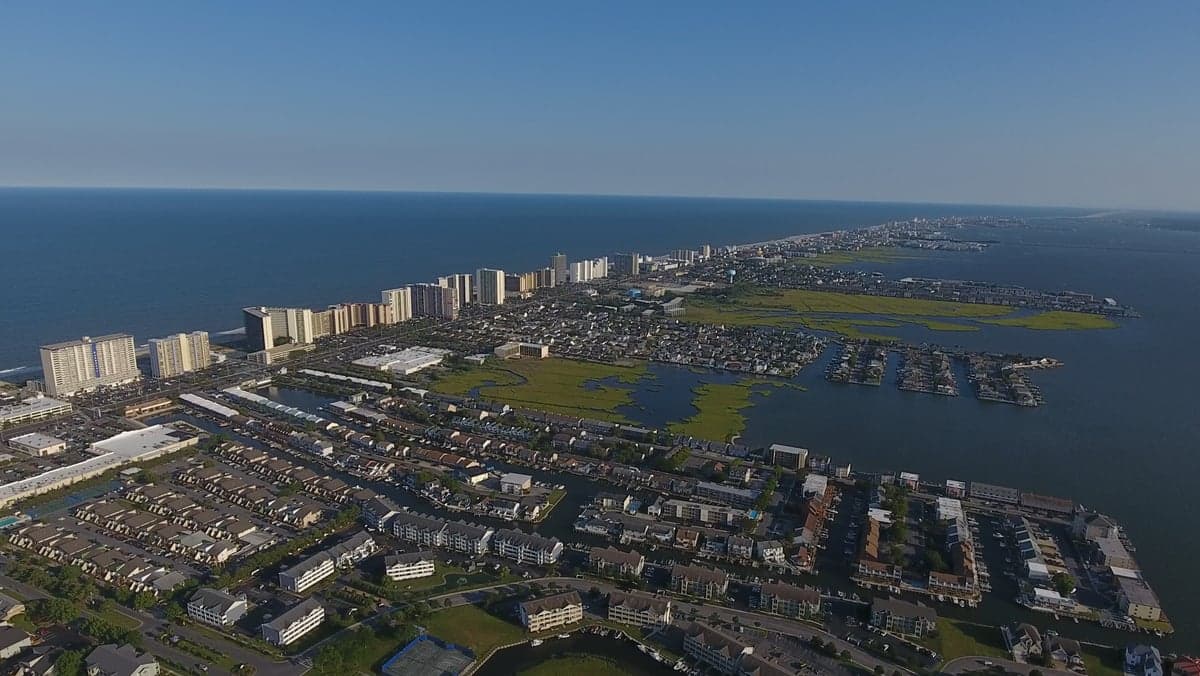
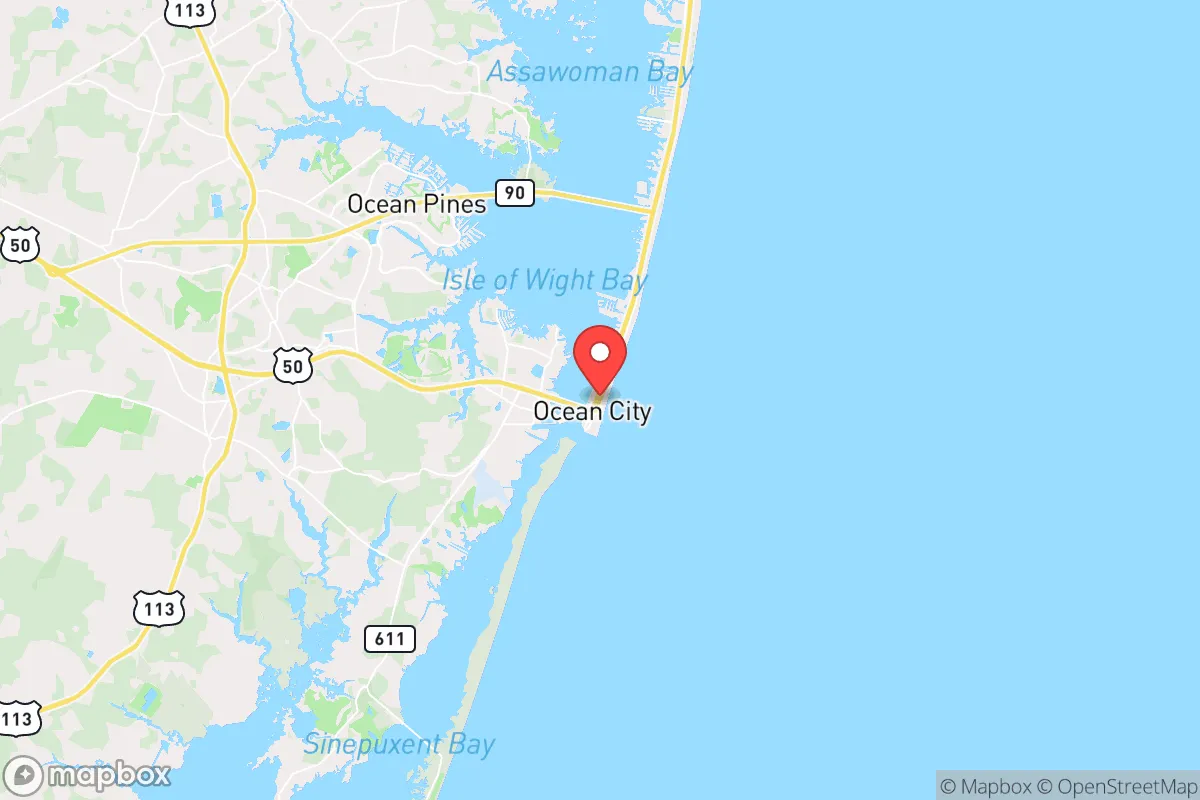
Photo: Wikipedia
Demographics of Ocean City, MD
Affluence Level in Ocean City, MD
An upper-middle-class area. Household wealth, education levels, and homeownership run ahead of national benchmarks.
People of Ocean City, MD
Ocean City, Maryland, is a seasonal resort town of 6,887 year-round residents, overwhelmingly white (86.2%) and notably older than the national median, with a population that swells tenfold during summer months. The city’s permanent character is defined by a mix of retired public-safety workers, hospitality-industry lifers, and second-home owners who tolerate winter isolation for summer prosperity. Its distinctive identity markers include a strong police-and-firefighter presence, a vocal tourism-dependent economy, and a socially conservative tilt that aligns with Worcester County’s broader Republican lean.
How the city was settled and grew
Ocean City’s human history begins not with colonial settlement but with a deliberate 19th-century tourism play. The area was sparsely inhabited by a few fishing families until 1869, when the Atlantic Hotel opened on what is now the Boardwalk, drawing wealthy Baltimore and Washington families by steamboat and later by rail. The original population was almost entirely native-born white Protestants from the Mid-Atlantic, who built seasonal cottages in the South End (south of the Boardwalk’s current terminus) and employed local watermen and domestic workers. A second wave arrived after the 1875 completion of the Wicomico & Pocomoke Railroad, which brought middle-class day-trippers and spurred construction of boarding houses along Caroline Street and Dorchester Street. By 1900, the year-round population hovered around 300, almost all white, with a tiny Black service-worker enclave forming in the West Ocean City area (across the Isle of Wight Bay), where segregated housing persisted into the 1960s. The 1930s saw the first significant Irish and Italian Catholic influx, largely from Baltimore’s working-class neighborhoods, who settled in the Midtown section around 9th to 17th Streets and staffed the growing hotel industry.
Modern era (post-1965)
The post-1965 period transformed Ocean City from a sleepy seasonal town into a high-density resort with a permanent service workforce. The 1964 Chesapeake Bay Bridge and 1965 dualization of Route 50 triggered a building boom that tripled the year-round population between 1960 and 1980. This wave brought retirees from Pennsylvania, New Jersey, and New York, many of them police officers, firefighters, and teachers who bought condos in the North End (above 45th Street) and winterized them for year-round living. The Hispanic population, now 8.5%, began arriving in the 1990s, primarily Mexican and Central American workers filling housekeeping, landscaping, and restaurant jobs; they concentrate in West Ocean City and the Glen Riddle area, where affordable rental housing exists. The East/Southeast Asian community (1.2%) is small and largely Korean-American, with several families operating Boardwalk souvenir shops and restaurants near the Inlet. The Black population remains negligible at 0.6%, a legacy of the town’s historical exclusion and the lack of year-round employment outside hospitality. The Indian-subcontinent population is effectively zero. College-educated residents make up 40.4%, a figure inflated by the many retirees with degrees earned elsewhere; the working-age population skews lower in educational attainment.
The future
Ocean City’s population is slowly homogenizing by age and income. The Hispanic share is growing steadily (up from roughly 5% in 2010 to 8.5% today), driven by continued demand for low-wage service labor, but this community remains largely segregated in West Ocean City and shows limited upward mobility into the white-majority North End. The white population is aging rapidly: the median age exceeds 50, and the city loses young adults to Salisbury and Baltimore after high school. No new immigrant enclaves are forming; the East/Southeast Asian community is plateauing as second-generation families leave for larger job markets. The next decade will likely see a continued bifurcation: a wealthy, older, white permanent population in the North End and a younger, Hispanic service workforce in West Ocean City, with the South End and Boardwalk areas becoming increasingly commercial and depopulated of year-round residents.
For a conservative-leaning mover today, Ocean City offers a stable, safe, and politically familiar environment with low crime and strong property values, but the trade-off is a thin year-round social fabric and a workforce that is quietly diversifying along class and ethnic lines. The city is becoming a retirement enclave with a service underclass, not a place of broad demographic mixing or upward mobility for newcomers outside the hospitality sector.

* Values derived from national, state, county, city and local statistics and may differ in a specific area. Last updated: 2026-04-19T07:46:47.000Z
Narrative content on this page is AI-generated and may contain mistakes. Verify any details that matter before acting on them.
ReloMaps may earn a commission from affiliate links at no extra cost to you.

