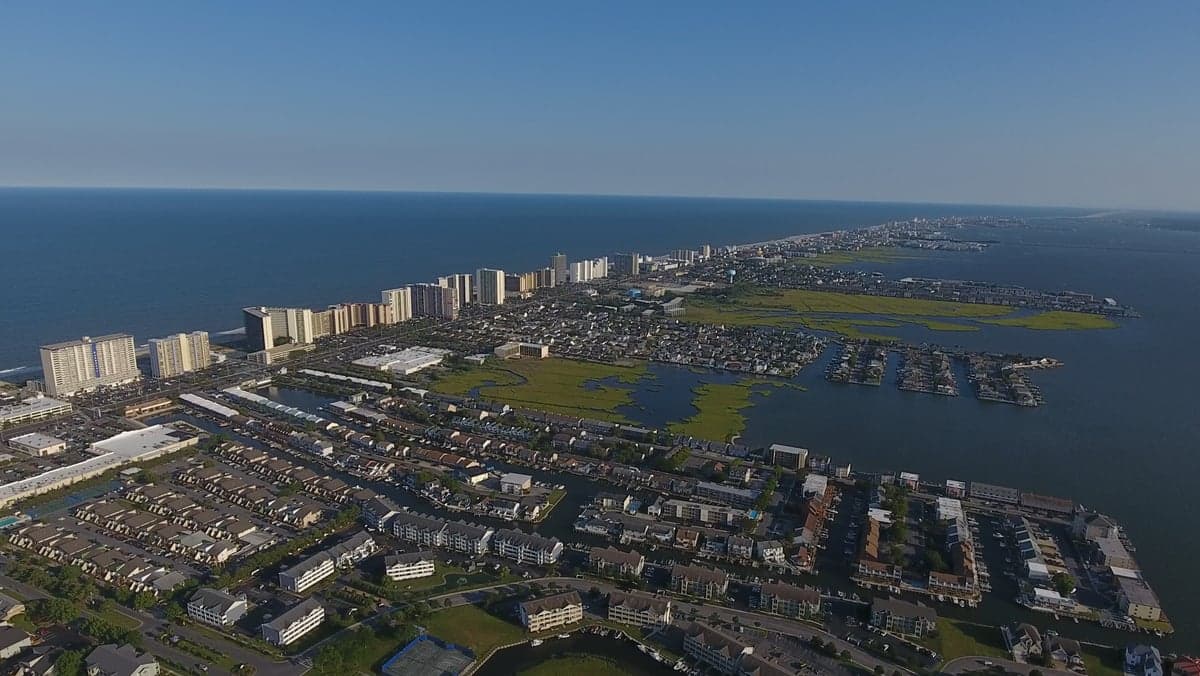
Photo: Wikipedia
Personal Sovereignty in Ocean City, MD
Viable for self-reliance. Generally workable, though some barriers may limit total independence.
What does Personal Sovereignty tell us?
Personal Sovereignty measures your capacity for self-reliance and independence with minimal government friction. Higher scores mean fewer barriers between you and the way you want to live... but it assumes you have the space you need and good neighbors.
What does this tell us?
Personal Sovereignty measures your capacity for self-reliance and independence with minimal government friction. Higher scores mean fewer barriers between you and the way you want to live... but it assumes you have the space you need and good neighbors.
State Policy
Energy independence: Importer (8% of energy produced in-state)
Personal Liberty
Homesteading

Personal Liberty Analysis
Ocean City, Maryland, offers a mixed bag for those prioritizing personal sovereignty, where the state's progressive tilt often clashes with the town's more traditional, tourism-driven culture. For a survivalist or prepper, the immediate takeaway is that while the local community may lean self-reliant, the legal and regulatory framework from Annapolis imposes significant constraints on autonomy. The town's reliance on seasonal visitors creates a unique dynamic—high property costs and transient populations can erode the tight-knit, independent ethos that many conservatives seek, but the coastal geography also provides a natural buffer against some forms of urban overreach. Ultimately, Ocean City is a place where you can carve out a degree of personal freedom, but only if you're willing to navigate a state-level system that increasingly favors centralized control over individual rights.
Tax burden and regulatory posture in a tourism-driven economy
Maryland's tax structure is a heavy anchor on personal sovereignty, and Ocean City residents feel it directly. The state imposes a progressive income tax with rates ranging from 2% to 5.75%, and while Ocean City itself has no local income tax, Worcester County adds a county income tax of 2.25%—bringing the combined top rate to 8%. Property taxes are relatively moderate for the region, with Ocean City's rate around $0.548 per $100 of assessed value, but the assessed values themselves are inflated by beachfront demand, meaning a modest home can carry a $3,000–$5,000 annual bill. Sales tax is 6%, and it applies to most goods, including preparedness supplies like generators and freeze-dried food. The regulatory posture is equally burdensome: Maryland's strict environmental laws, particularly around coastal development and stormwater management, mean that any off-grid or self-sufficient project—like installing solar panels, rainwater catchment, or a septic system—requires multiple permits and inspections. The state's energy policies also mandate a Renewable Portfolio Standard, which can increase utility costs, and the town's zoning codes heavily restrict short-term rentals and property modifications, limiting your ability to generate independent income or adapt your land for self-reliance. For a prepper, this means every step toward autonomy is met with paperwork and fees, eroding the very freedom you're trying to secure.
Self-defense and gun law specifics in a restrictive state
Maryland's gun laws are among the most restrictive in the nation, and Ocean City offers no local exemption. The state requires a Handgun Qualification License (HQL) to purchase a handgun, which involves fingerprinting, a training course, and a 30-day waiting period. Concealed carry is permitted only with a Wear and Carry Permit, which requires demonstrating "good and substantial reason"—a standard that, while eased after the Bruen decision, still involves a rigorous background check, references, and a 16-hour training course. Open carry is effectively banned in most public spaces. Magazine capacity is capped at 10 rounds, and "assault weapons" are defined broadly, banning many popular rifles like the AR-15. Ocean City's local ordinances add further restrictions: firearms are prohibited on the boardwalk, in public parks, and on the beach during summer months, and the town's dense, tourist-heavy environment means you're rarely in a place where carrying is legal without a permit. For a survivalist, this is a critical vulnerability. In a SHTF scenario, the ability to defend your home or family is hamstrung by state law, and even routine self-defense against property crime is complicated by the legal hurdles. The local police are generally pro-2A in attitude, but they must enforce state law, so don't expect any leniency. If gun rights are a non-negotiable pillar of your sovereignty, Ocean City—and Maryland as a whole—is a poor choice.
Self-reliance and homesteading viability in a coastal resort town
Ocean City's geography and zoning make traditional homesteading nearly impossible. The town is built on a narrow barrier island, with most residential lots measuring 30x100 feet or smaller—typically 3,000 to 5,000 square feet. This density leaves little room for gardens, livestock, or even substantial rainwater collection. Zoning codes prohibit keeping chickens, goats, or bees within town limits, and any agricultural activity is restricted to areas west of the bay, like Berlin or Snow Hill. Off-grid feasibility is equally limited: Maryland's building codes require grid connection for new construction, and solar panels must be tied to the grid to qualify for net metering, meaning you can't truly disconnect. The town's water and sewer are municipally provided, and drilling a private well is prohibited in most areas due to saltwater intrusion and environmental regulations. For a prepper focused on self-reliance, Ocean City is a dead end. You can stockpile supplies and maintain a bug-out bag, but you cannot create a sustainable, independent homestead. The best you can do is rent a storage unit west of the bay for bulk supplies and maintain a vehicle ready for evacuation. If your vision of sovereignty involves growing your own food, harvesting rainwater, or living off the grid, look inland—places like Garrett County or the Eastern Shore's rural tracts offer far more room to maneuver.
Personal liberties: parental rights, medical autonomy, speech, and property
Maryland's state-level policies consistently erode personal liberties that conservatives value. On parental rights, the state has passed laws that limit parental notification for certain medical procedures and mandate LGBTQ-inclusive curricula in public schools, which can conflict with traditional family values. Ocean City's school system, Worcester County Public Schools, generally follows state directives, so parents have limited ability to opt out of controversial content. Medical autonomy is similarly constrained: Maryland has strict vaccine mandates for school attendance, and during the COVID-19 pandemic, the state imposed some of the longest-lasting emergency orders in the country, including mask mandates and business closures. While Ocean City's local government pushed back—the mayor and council were vocal about reopening—they ultimately had to comply with state orders. Free speech is protected under the First Amendment, but Maryland's "hate speech" laws and public nuisance ordinances can be used to silence controversial viewpoints, particularly on the boardwalk or in public forums. Property rights are the weakest link: Maryland's "eminent domain" powers are broad, and the state's Critical Area Commission imposes strict land-use restrictions within 1,000 feet of tidal waters—which covers virtually all of Ocean City. This means you cannot modify your property without state approval, and the government can seize land for "public benefit" with minimal compensation. For a survivalist, this is a red flag: your home is not truly your castle when the state can dictate what you build, what you plant, and whether you can keep it.
In the broader landscape of personal sovereignty, Ocean City ranks low compared to states like Texas, Idaho, or New Hampshire. The combination of high taxes, restrictive gun laws, limited homesteading potential, and state-level overreach on parental and property rights creates an environment where individual autonomy is constantly under pressure. The town's best feature is its community—many locals are independent-minded business owners and retirees who value freedom—but they operate within a system that increasingly favors centralized control. For a prepper or conservative looking to relocate, Ocean City might work as a seasonal retreat or a base for coastal operations, but it cannot be a long-term stronghold. If you're serious about sovereignty, you'll need to look west, where the laws are looser and the land is cheaper. Ocean City is a beautiful place to visit, but it's a hard place to live free.

* Values derived from national, state, county, city and local statistics and may differ in a specific area. Last updated: 2026-04-19T07:46:47.000Z
Narrative content on this page is AI-generated and may contain mistakes. Verify any details that matter before acting on them.
ReloMaps may earn a commission from affiliate links at no extra cost to you.

