Photo: Wikipedia
Demographics of Ogallala, NE
Affluence Level in Ogallala, NE
A below-average socioeconomic profile. Incomes, home values, and educational attainment trail the U.S., with higher poverty and unemployment.
People of Ogallala, NE
The people of Ogallala, Nebraska, today number roughly 4,800, forming a predominantly white (80.1%) community with a significant and growing Hispanic minority (13.1%) and small Black (2.0%) and East/Southeast Asian (1.0%) populations. The city’s identity is rooted in its ranching and agricultural heritage, with a notably low foreign-born share of just 1.4% and a college-educated rate of 23.9%, reflecting a working-class, family-oriented character. Ogallala is less diverse than the national average but more so than many neighboring Plains towns, with its demographic story shaped by distinct waves of migration tied to the railroad, the cattle industry, and later, regional economic shifts.
How the city was settled and grew
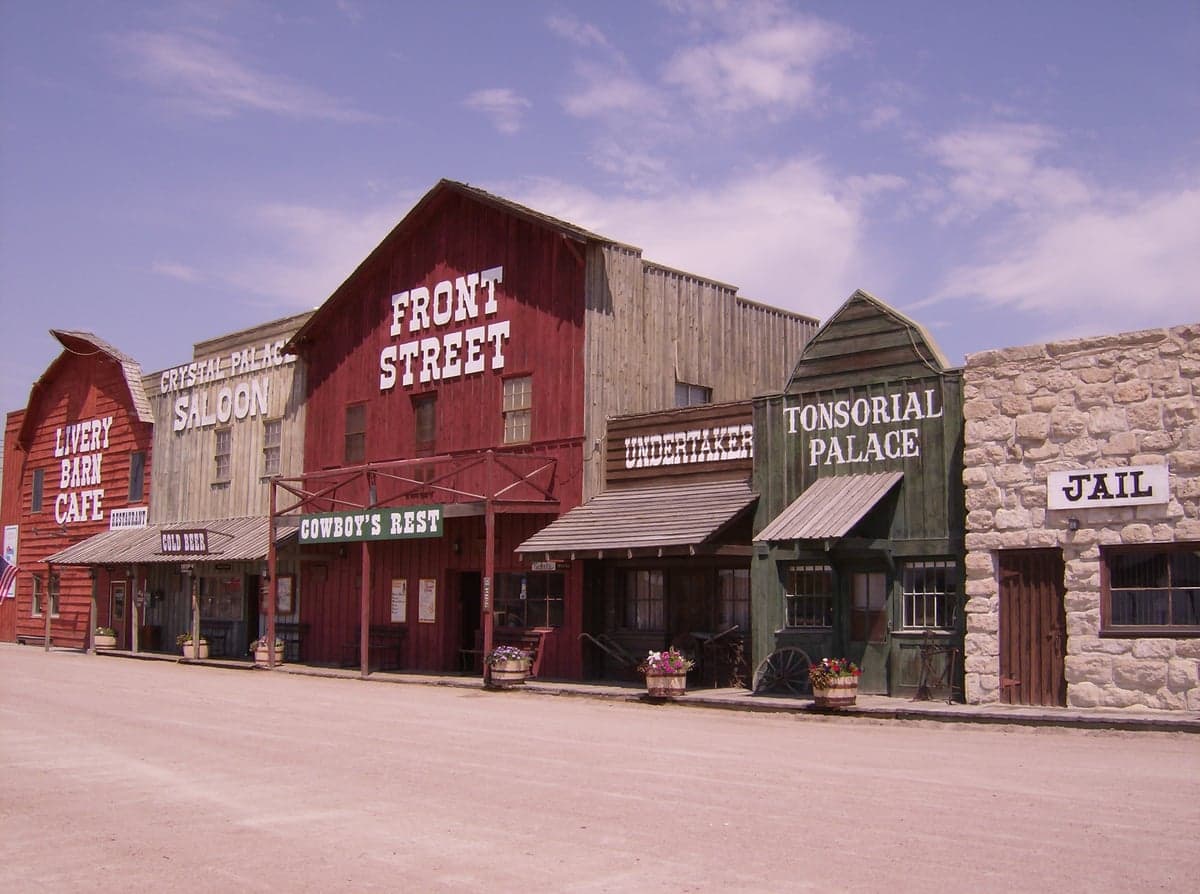
Ogallala’s founding population arrived with the Union Pacific Railroad in the 1860s, when the town was established as a division point on the transcontinental line. The original settlers were predominantly Anglo-American homesteaders and railroad workers, drawn by land grants and the promise of cattle shipping. By the 1870s, Ogallala had become a major cattle-shipping hub on the Texas Trail, earning the nickname “The Cowboy Capital.” The earliest residential area, Old Town Ogallala (centered near the original depot along Spruce Street), housed railroad laborers and cowboys in boarding houses and small frame homes. As the cattle trade boomed, a second wave of settlers—German and Irish immigrants—arrived to work the ranches and stockyards, settling in what became the North Side (roughly north of First Street), where modest bungalows and worker cottages still stand. By 1900, the population had reached about 1,200, with the town’s economy anchored by the Union Pacific shops and the Ogallala Livestock Market. The South Side (south of Highway 30) developed later, in the 1910s-1930s, as a more residential area for merchants and professionals, with larger homes and tree-lined streets. No significant non-white population existed during this period; the 1920 census recorded fewer than 10 Black residents and no Hispanic or Asian residents.
Modern era (post-1965)
After the 1965 Immigration Act, Ogallala saw only modest demographic change, as the city was not a major destination for post-1965 immigration waves. The foreign-born share remained below 2% through 2020. The most notable shift has been the growth of the Hispanic population, which rose from 3.5% in 1990 to 13.1% by 2020, driven by Mexican-American families moving from Texas and the Southwest for work in meatpacking and agriculture. These families concentrated in the West End (west of Highway 61), a newer area of mobile homes and ranch-style houses built in the 1990s and 2000s, and in the Lakeview Addition (near Lake McConaughy), where seasonal tourism jobs and construction work drew younger Hispanic households. The Black population, at 2.0%, is small but stable, with most families living in the East Side (east of the railroad tracks), an older neighborhood of post-war homes. The East/Southeast Asian community (1.0%) is primarily Filipino and Vietnamese, many connected to the regional medical center or the University of Nebraska’s agricultural extension office; they are scattered across the city rather than concentrated in a single neighborhood. The white population has declined slightly in absolute numbers since 2000 (from about 4,200 to 3,850), as younger adults leave for college and jobs in larger cities, but remains the overwhelming majority. The college-educated rate of 23.9% is below the national average of 33%, reflecting the local economy’s reliance on agriculture, retail, and tourism rather than professional services.
The future
Ogallala’s population is projected to remain stable or decline slightly over the next decade, as the city’s remote location and limited job diversity constrain in-migration. The Hispanic share is likely to continue rising, potentially reaching 18-20% by 2040, driven by higher birth rates and continued migration from the Southwest, but the foreign-born share will likely stay below 3%. The white population will continue to age and shrink, with the median age (currently 42) expected to rise. The city is not tribalizing into distinct ethnic enclaves; rather, Hispanic families are integrating into existing neighborhoods like the West End and Lakeview Addition, while white families remain concentrated in the South Side and Old Town. The Black and Asian communities are too small to form distinct enclaves. For a newcomer, Ogallala offers a stable, low-crime, family-oriented environment with a strong sense of local identity, but limited ethnic diversity and few opportunities for college-educated professionals outside of healthcare and education. The city is becoming slightly more diverse but remains fundamentally a white, working-class Plains community with a growing Hispanic minority.
Bottom-line: Ogallala is a slow-changing, family-centric ranching town where the population is gradually diversifying through Hispanic growth while the white majority ages. For a conservative-leaning individual or parent seeking a safe, affordable, and community-oriented place with a strong agricultural heritage, Ogallala offers a predictable and welcoming environment, though those seeking significant ethnic diversity or a dynamic job market should look elsewhere.

* Values derived from national, state, county, city and local statistics and may differ in a specific area. Last updated: 2026-05-03T20:29:58.000Z
Narrative content on this page is AI-generated and may contain mistakes. Verify any details that matter before acting on them.
ReloMaps may earn a commission from affiliate links at no extra cost to you.

