Photo: Wikipedia
Demographics of Fairfield County
Affluence Level in Fairfield County
A middle-class area roughly in line with national averages across income, home values, education, and employment.
People of Fairfield County
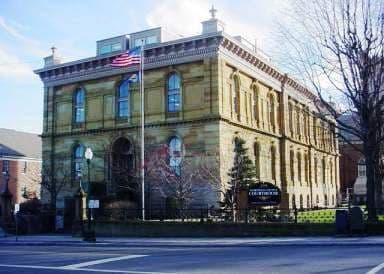
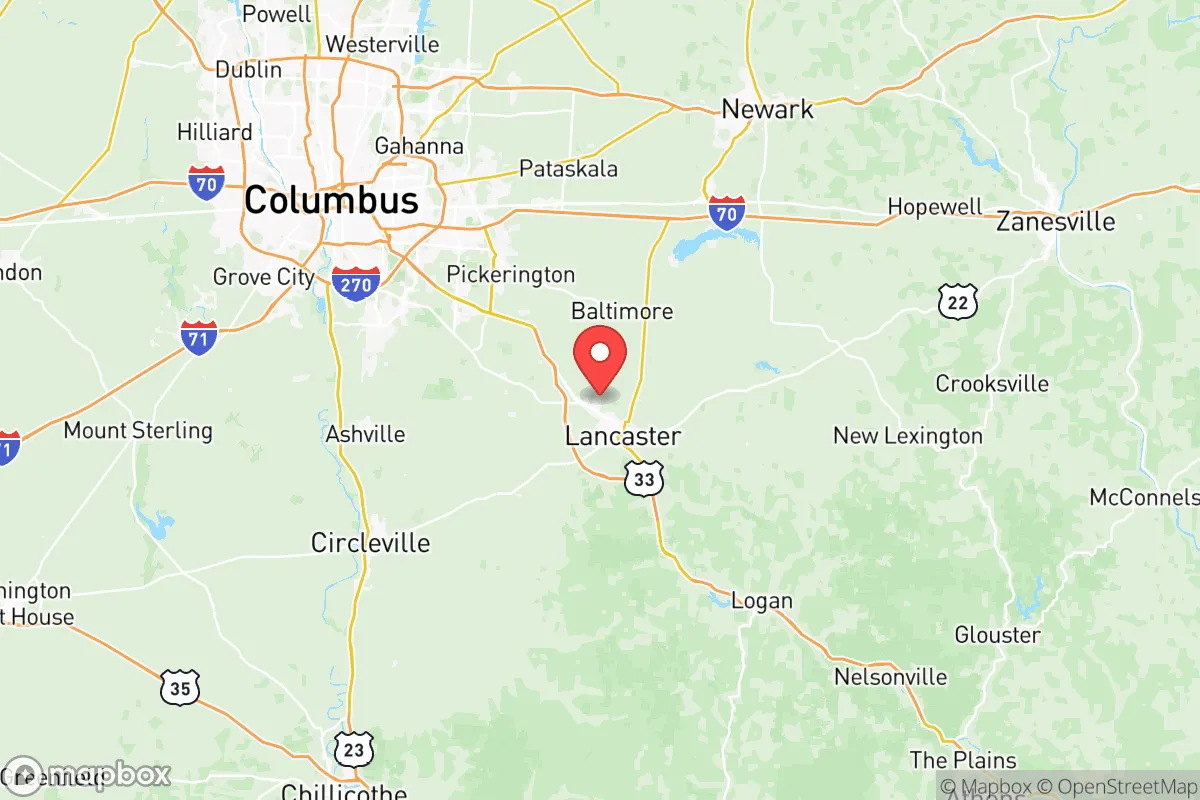
Fairfield County, Ohio, is home to 161,289 residents, a population that is 82% white, 8.9% Black, 2.7% Hispanic, 1.4% Indian (subcontinent), and 1.1% East/Southeast Asian, with only 1.6% foreign-born. The county retains a distinctly Midwestern, small-town character, anchored by the historic county seat of Lancaster and the growing suburban hub of Pickerington, while maintaining a rural agricultural presence in towns like Baltimore and Amanda. Its people are largely native-born, with a strong sense of local identity rooted in early American settlement, and the county is experiencing slow but steady diversification, particularly in its northern suburbs near Columbus. For a conservative-leaning audience, Fairfield County offers a blend of traditional values, stable communities, and manageable growth that preserves its historic character.
Settlement & growth (pre-1960)
Before European settlement, the region that is now Fairfield County was inhabited by the Hopewell and later the Shawnee and Wyandot peoples, who used the Hocking River valley for hunting and trade. The area was part of the Ohio Country, contested by the French and British during the colonial era, but no permanent European settlements existed until after the American Revolution. The 1795 Treaty of Greenville opened southeastern Ohio to American settlers, and Fairfield County was formally established in 1800 from parts of Ross and Washington counties, named for the "fair fields" of the Hocking Valley.
The first major wave of settlers were Americans of English, Scots-Irish, and German descent moving west from Pennsylvania, Virginia, and Maryland. They arrived in the first decades of the 1800s, drawn by the fertile land of the Hocking River valley and the promise of affordable farmland under the Land Act of 1800. Lancaster, founded in 1800 by German-speaking settlers from Pennsylvania, became the county seat and the primary population center, with its distinctive German heritage visible in architecture and street names. The town of Amanda was platted in 1833 by settlers from the Mid-Atlantic states, while Baltimore, founded in 1825, grew as a farming community along the Zane's Trace road. Rushville, settled in the 1810s, became a center for the region's early Quaker and Methodist communities.
The 1830s and 1840s brought a second wave of German immigrants, who bypassed Lancaster to settle directly on farms in the central and southern townships. Stoutsville, platted in 1837, became a German Lutheran stronghold, and Pleasantville, founded in 1838, attracted German Catholic families. These groups established distinct rural communities with their own churches, schools, and social organizations, many of which persist today. The Hocking Canal, completed in 1843, connected the county to the Ohio and Erie Canal system, boosting trade and bringing Irish laborers who settled in Lancaster's canal district and in Carroll, a small village founded in 1835.
The post-Civil War era saw modest industrial growth in Lancaster, which became a center for glass manufacturing and carriage making. The 1870s and 1880s brought a small number of Italian and Polish immigrants to work in Lancaster's factories, but Fairfield County never experienced the heavy industrial immigration seen in Cleveland or Cincinnati. Millersport, founded in 1820, grew as a resort town on Buckeye Lake, attracting seasonal workers and small business owners. By 1900, the county's population was overwhelmingly native-born white, with a small Black population concentrated in Lancaster, descended from free Black families who had settled there before the Civil War and from the post-Reconstruction Great Migration's early waves.
The Great Migration brought a notable increase in Black residents to Lancaster between 1910 and 1950, as families left the rural South for industrial jobs in the city's glass and shoe factories. Lancaster's Black community, though small, established its own churches and businesses along the city's east side. The Dust Bowl and Great Depression had limited impact on Fairfield County, as its agricultural economy remained stable, and the county's population grew slowly but steadily through the mid-20th century, reaching 63,000 by 1950.
Modern era (post-1965)
The 1965 Hart-Cellar Act had minimal direct impact on Fairfield County, as the county's foreign-born population remains just 1.6% today, far below the national average. Instead, the county's modern demographic story is one of domestic migration and suburbanization. The completion of Interstate 70 in the 1960s and the expansion of U.S. Route 33 in the 1970s transformed northern Fairfield County into a commuter shed for Columbus, 30 miles to the northwest. Pickerington, a village of just 1,500 in 1960, exploded to over 20,000 by 2020, becoming the county's second-largest municipality and a classic Columbus bedroom community.
This suburban growth brought a wave of white and Black middle-class families from Columbus, seeking larger homes, better schools, and lower crime rates. Pickerington's school district became a major draw, and the city's population is now roughly 75% white and 15% Black, reflecting the broader diversification of Columbus's suburbs. Lancaster, meanwhile, experienced slower growth, as its older housing stock and more distant commute limited its appeal to Columbus workers. The city's population has remained stable at around 40,000 since 1990, with a slight increase in its Hispanic and Asian populations, now at 2.7% and 1.1% respectively.
The post-1965 era also saw the arrival of small but growing Indian (subcontinent) and East/Southeast Asian communities, concentrated in Pickerington and the northern townships near Columbus. These families are primarily professionals employed in healthcare, technology, and academia at Ohio State University and Columbus-area hospitals. Violet Township, which includes parts of Pickerington, has seen the most significant Asian and Indian growth, with several Indian grocery stores and restaurants opening along Refugee Road. The county's Hispanic population, while still small at 2.7%, has grown steadily since 2000, with families settling in Lancaster and Baltimore for work in agriculture, construction, and food processing.
Domestic migration patterns have shifted in the 2010s and 2020s, with Fairfield County attracting retirees and remote workers from higher-cost states like California and New York, drawn by affordable housing and low property taxes. Buckeye Lake, a resort community that was revitalized after a 2015 dam replacement, has seen an influx of second-home buyers and permanent residents from Columbus and beyond. The county's overall population grew 8.5% between 2010 and 2020, driven entirely by the northern suburbs, while the southern rural townships experienced slight declines.
The future
Fairfield County is projected to continue growing at a moderate pace, reaching approximately 180,000 by 2040, with growth concentrated in the northern corridor along Interstate 70 and U.S. Route 33. The county is becoming more diverse, but slowly: the white share is expected to decline to around 75% by 2040, while the Hispanic, Black, and Asian shares will each increase modestly. The Indian (subcontinent) population, currently 1.4%, is likely to grow fastest, as Columbus's tech and healthcare sectors continue to attract skilled immigrants who choose Fairfield County's suburbs for their schools and housing.
The cultural identity of the county is evolving from a purely rural and small-town character to a more suburban one, particularly in the north. Pickerington and Violet Township will continue to absorb Columbus's spillover growth, while Lancaster will likely remain the conservative, historic anchor of the county, with its German heritage and manufacturing base. The southern townships, including Amanda, Stoutsville, and Pleasantville, will retain their agricultural character, with limited new development. The county's political leanings, which have shifted slightly toward the Republican Party in recent elections, are likely to remain conservative, as new residents from Columbus tend to be moderate rather than progressive.
For someone moving in now, Fairfield County offers a stable, family-oriented environment with good schools, affordable housing, and a strong sense of community. The county is not experiencing the rapid, disruptive change seen in some Sun Belt suburbs, but it is gradually becoming more diverse and connected to the Columbus metropolitan area. The key choice for newcomers is between the suburban convenience of Pickerington and the historic, slower-paced life of Lancaster or the rural townships, each offering a distinct version of Midwestern living.

* Values derived from national, state, county, city and local statistics and may differ in a specific area. Last updated: 2026-08-08T16:54:13.000Z
Narrative content on this page is AI-generated and may contain mistakes. Verify any details that matter before acting on them.
ReloMaps may earn a commission from affiliate links at no extra cost to you.

