
Photo: Wikipedia
Personal Sovereignty in Fairfield County
Viable for self-reliance. Generally workable, though some barriers may limit total independence.
What does Personal Sovereignty tell us?
Personal Sovereignty measures your capacity for self-reliance and independence with minimal government friction. Higher scores mean fewer barriers between you and the way you want to live... but it assumes you have the space you need and good neighbors.
What does this tell us?
Personal Sovereignty measures your capacity for self-reliance and independence with minimal government friction. Higher scores mean fewer barriers between you and the way you want to live... but it assumes you have the space you need and good neighbors.
State Policy
Energy independence: Importer (40% of energy produced in-state)
Personal Liberty
Homesteading

Personal Liberty Analysis
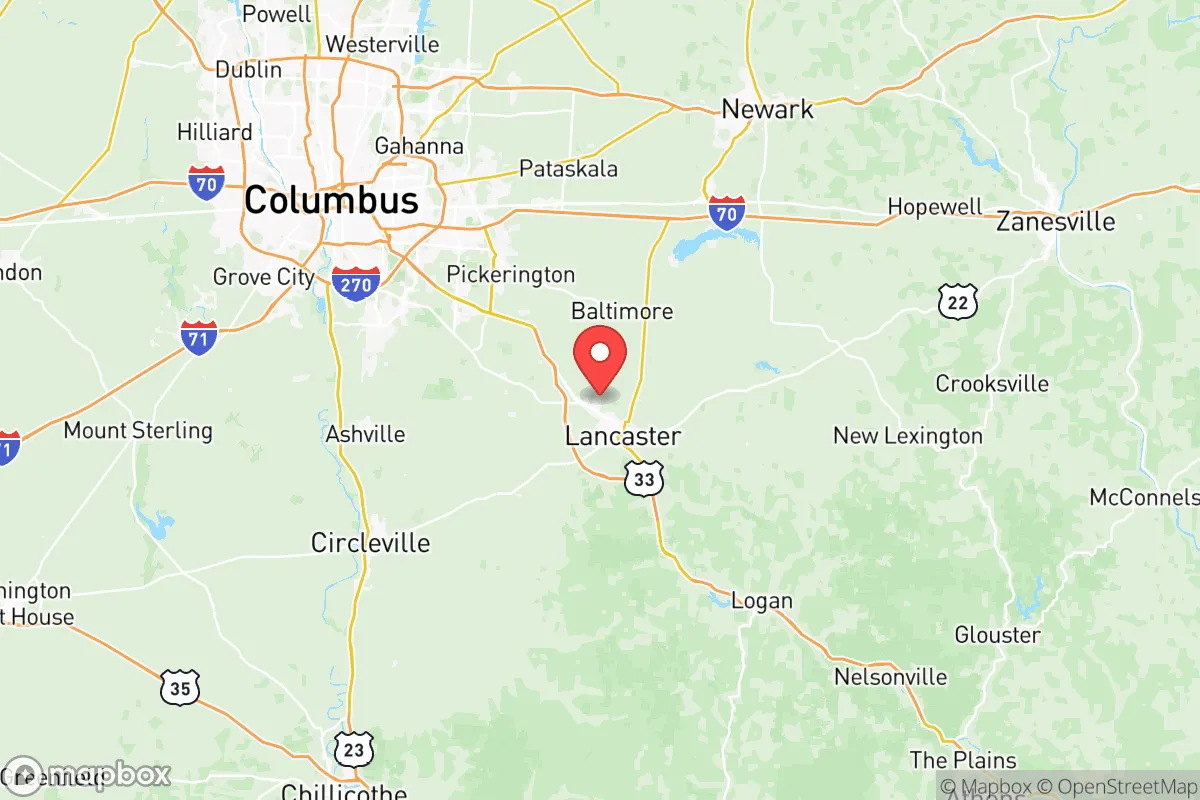
Fairfield County, Ohio, offers a notably high degree of personal sovereignty compared to many Midwestern counties, particularly those closer to the urban cores of Columbus or Cincinnati. The county's regulatory environment is generally light-touch, its tax burden is moderate, and its gun laws are firmly aligned with Ohio's preemptive, permitless carry framework. For single individuals and families who prioritize self-reliance, the area presents a viable balance of rural autonomy and access to the economic opportunities of the Columbus metro, though the degree of freedom varies significantly between the county's townships and its more developed municipalities like Lancaster, Pickerington, and Canal Winchester.
Tax burden and regulatory posture across the county
Fairfield County's tax posture is competitive, especially for those accustomed to high-tax states. Ohio's state income tax is a progressive flat rate (roughly 2.75% on most earned income as of 2026), and Fairfield County's sales tax rate is 7.25% (state + county + transit authority). Property taxes are the primary local revenue source, and they vary by school district. The Bloom-Carroll and Liberty Union-Thurston districts tend to have lower effective millage rates than the Lancaster City School District, making unincorporated areas like Amanda and Stoutsville more attractive for those seeking lower annual tax bills. The county's regulatory posture is generally permissive. There is no county-wide zoning in the unincorporated townships, though townships like Violet, Greenfield, and Liberty have adopted limited zoning for subdivisions and commercial uses. The city of Lancaster has a traditional municipal code with building permits and business licensing, but the process is straightforward and not considered onerous by most small business owners. The county's building department is efficient, and there is no county-level income tax, which is a distinct advantage over neighboring Franklin County (Columbus) which levies a 2.5% municipal income tax on residents. For a family or individual seeking to minimize government overhead, living in a township outside of a city corporation is the clearest path to lower regulatory friction.
Self-defense and gun law specifics in Ohio and Fairfield County
Ohio is a "constitutional carry" state, meaning no permit is required to carry a concealed handgun for anyone legally allowed to possess a firearm. Fairfield County's culture strongly supports this framework. The county sheriff's office, currently under Sheriff Alex Lape, is known for issuing concealed carry permits (now optional but still used for reciprocity) without undue delay or restrictive interpretation. There are no county-specific gun control ordinances; Ohio state law preempts local governments from enacting their own firearm regulations, so cities like Pickerington and Canal Winchester cannot ban carry in parks or impose magazine capacity limits. Stand-your-ground and castle doctrine laws are fully in effect. For a self-defense-minded individual, the legal environment is unambiguous: the right to bear arms is robustly protected. The practical environment is also favorable. Gun ranges and firearms dealers are plentiful in the county, with several shops in Lancaster and along the US-33 corridor. The rural townships around Rushville and Pleasantville offer ample space for private target shooting on one's own property, provided it is done safely and not within city limits where discharge ordinances apply. This is a meaningful distinction: inside Lancaster city limits, discharging a firearm is generally prohibited, whereas in unincorporated areas, it is permitted with reasonable safety precautions.
Self-reliance and homesteading viability: lot sizes, zoning, and off-grid feasibility
Fairfield County is one of the more homestead-friendly areas within commuting distance of Columbus. The unincorporated townships have no minimum lot size for agricultural use, though residential subdivisions typically require one to three acres per lot depending on the township's zoning resolution. In townships like Hocking and Berne, five-acre parcels are common and affordable, often under $15,000 per acre for raw land. Off-grid living is legally feasible but requires attention to the Ohio Revised Code. There is no state law requiring a grid connection for electricity; solar panels with battery storage are permitted. However, the county health department requires a permit for any on-site wastewater system (septic), and a drilled well must meet Ohio EPA standards. Rainwater collection is legal and unregulated for outdoor use, though potable use requires treatment. The county does not have a blanket ban on tiny homes or RVs as permanent dwellings, but they must meet the Ohio Building Code if they are on a permanent foundation. In practice, many residents in Amanda and Stoutsville live in manufactured homes on leased land or their own parcels without issue. Raising livestock—chickens, goats, sheep, and even cattle—is allowed in all unincorporated areas, and there are no county-level restrictions on beekeeping or gardening. The city of Lancaster does have limits on livestock within city limits (typically no roosters, and limits on the number of hens), so those serious about self-sufficiency should target the townships. The soil in the western part of the county (toward Canal Winchester) is heavier clay, while the eastern townships (toward the Hocking Hills region) have more loam, which is better for gardening.
Personal liberties: parental rights, medical autonomy, speech, and property
Ohio law generally supports parental rights in education and healthcare. The state has a robust school choice program, including vouchers (EdChoice) and open enrollment, which is widely used in Fairfield County. Parents can send their children to any public school district in the state that has open enrollment slots, and the county's districts—Lancaster, Bloom-Carroll, Liberty Union, Amanda-Clearcreek, and Fairfield Union—all participate to varying degrees. Homeschooling is straightforward: parents file a simple notification with the local school superintendent and provide an annual assessment. Medical autonomy is a mixed picture. Ohio does not have a state-level vaccine mandate for adults, and COVID-19 mandates were struck down or expired. However, the state does require certain vaccines for school attendance (with philosophical exemptions available only for kindergarten through 12th grade in some districts, though religious exemptions are broadly available). For those seeking alternative medical care, the county has a number of chiropractors, naturopaths, and functional medicine practitioners, particularly in Lancaster. Property rights are strongly protected. Ohio is a "Dillon's Rule" state, meaning local governments only have powers expressly granted by the state, but the state legislature has been active in preempting local overreach on issues like short-term rentals (Airbnb) and pet breed restrictions. In Fairfield County, there are no county-wide bans on specific dog breeds, and short-term rentals are permitted in unincorporated areas without special permits. The county's approach to property is generally "live and let live," provided neighbors are not directly harmed.
Overall, Fairfield County offers a level of personal sovereignty that is above average for Ohio and significantly higher than the urbanized counties to its west. The combination of low taxes, permissive gun laws, minimal zoning in townships, and strong parental rights creates an environment where self-reliant individuals and families can operate with relatively little government interference. The key variable is location: living in the unincorporated townships around Amanda, Stoutsville, or Rushville provides far more autonomy than residing within the city limits of Lancaster or the suburban subdivisions of Pickerington. For a relocation-minded reader who values freedom over convenience, the county's rural townships represent a strong option in the central Ohio region.

* Values derived from national, state, county, city and local statistics and may differ in a specific area. Last updated: 2026-08-08T16:54:13.000Z
Narrative content on this page is AI-generated and may contain mistakes. Verify any details that matter before acting on them.
ReloMaps may earn a commission from affiliate links at no extra cost to you.

