Photo: Wikipedia
Find The Best Places To Live
in Cincinnati
PRO TIP! You can paste a Zillow or Redfin link to get info on that property.
What It's Like Living in Cincinnati, OH
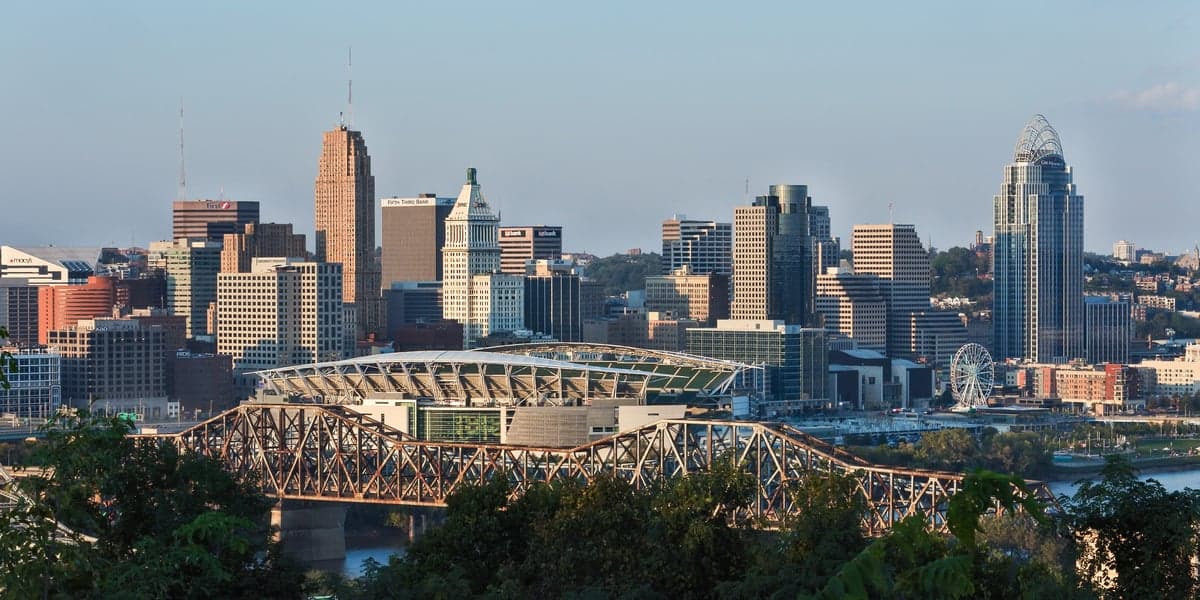
Cincinnati has a way of sneaking up on you. It’s not a city that shouts its charms from the rooftops; instead, it reveals itself slowly—through the chili-spaghetti argument you’ll inevitably have, the sight of the Roebling Suspension Bridge at dusk, and the realization that you can actually afford a nice house here. With about 310,000 people inside city limits and a metro area pushing 2.2 million, it’s big enough to have real city amenities but small enough that you’ll run into someone you know at the Findlay Market on a Saturday morning. The median age is 33, and the median income sits around $51,700—lower than the national average, but so is the cost of living (index of 80), which means your paycheck goes further than it would in Columbus or Chicago.
The Daily Rhythm: Neighborhoods, Commutes, and the Three-Season Porch
Life here is neighborhood-driven. People don’t say they’re from Cincinnati; they say they’re from Hyde Park, Oakley, Mount Lookout, or the West Side. Each pocket has its own main drag—a coffee shop, a pizza joint, a bar where everybody knows the bartender. The average commute is just over 23 minutes, which feels almost luxurious compared to other metros. You can live in a walkable neighborhood like Over-the-Rhine (OTR) and still get to a suburban office park in 20 minutes. The weather is genuinely four-season: humid summers that make you grateful for air conditioning, crisp falls that draw everyone to the parks, and winters that are gray and cold but rarely brutal. Spring is short and glorious, and locals spend as much time as possible on their porches—a near-sacred Cincinnati tradition. Weekends revolve around the Findlay Market (the oldest continuously operated public market in Ohio), hiking in Mount Airy Forest, or grabbing a Graeter’s black raspberry chip cone. The city’s 41% college-educated population means there’s a steady undercurrent of white-collar professionals, but the vibe is more “approachable” than “aspirational.” You don’t feel like you’re competing here; you feel like you’re joining.
Sports, Spirits, and the Cincinnati Identity
If you live here, you will absorb sports fandom, even if you don’t care about sports. The Bengals (NFL) and Reds (MLB) are civic religion. When the Bengals made the Super Bowl in 2022, the entire city shut down for watch parties. The Reds’ Opening Day is an unofficial holiday—schools close, offices empty, and the parade through downtown draws tens of thousands. High school football is a big deal too, especially in the suburbs like St. Xavier and Moeller, where Friday night games pack stands. College sports are less dominant than in Columbus, but Xavier basketball and UC football have passionate followings. Beyond sports, the city’s identity is tied to its German Catholic roots: there are more than 50 parishes within city limits, and the church picnic circuit is real. You’ll also encounter the “Cincinnati chili” debate immediately. Skyline Chili is the standard-bearer—a thin, spiced meat sauce served over spaghetti with cheddar cheese. You either love it or you’re wrong (locals will tell you). The city also has a serious craft beer scene, with breweries like Rhinegeist, MadTree, and Taft’s Ale House filling old factories and churches. Music venues like the Riverbend Music Center and the intimate Memorial Hall OTR draw national acts, while the Cincinnati Symphony Orchestra is one of the oldest and best-regarded in the country.
What Frustrates and What Wins: The Honest Trade-Offs
Let’s be direct about the downsides. The violent crime rate is 774.7 per 100,000—well above the national average, and it’s concentrated in specific neighborhoods. Most of the suburbs and gentrified urban pockets (Hyde Park, OTR, Mount Adams) feel safe, but you need to know where you’re going. The public school system is a mixed bag: Cincinnati Public Schools has some excellent magnet programs (like Walnut Hills High School, consistently ranked among the nation’s best), but the district overall struggles with funding and equity. Many families with means choose private or parochial schools, which are abundant and relatively affordable compared to coastal cities. Traffic is manageable—rush hour on I-71 and I-75 is annoying but not soul-crushing. The biggest frustration for longtimers is the city’s cautious, almost conservative pace of change. Cincinnati is not a boomtown; it’s a steady, slow-growth place where things happen incrementally. That’s a pro for some people (stability, predictability) and a con for others (stale, resistant to new ideas).
On the upside, the median home value is $215,300. You can buy a solid three-bedroom in a nice neighborhood for under $300,000—a reality that feels almost unbelievable to people from the coasts. The cost of living index at 80 means groceries, utilities, and rent all come in well below the national average. The city is also genuinely beautiful, with hills, the Ohio River, and an architectural stock that includes some of the best-preserved 19th-century buildings in the Midwest. The arts scene is robust—the Cincinnati Art Museum is free, the Contemporary Arts Center is world-class, and the annual BLINK light festival turns downtown into a massive outdoor gallery. There’s a strong sense of local pride that borders on stubbornness, but it’s earned. People stay here. They raise families here. They complain about the chili and the crime and the potholes, but they don’t leave. That’s the real measure of a place.

Similar mid-size cities to Cincinnati

* Values derived from national, state, county, city and local statistics and may differ in a specific area. Last updated: 2026-04-21T22:54:56.000Z
Narrative content on this page is AI-generated and may contain mistakes. Verify any details that matter before acting on them.
ReloMaps may earn a commission from affiliate links at no extra cost to you.

