
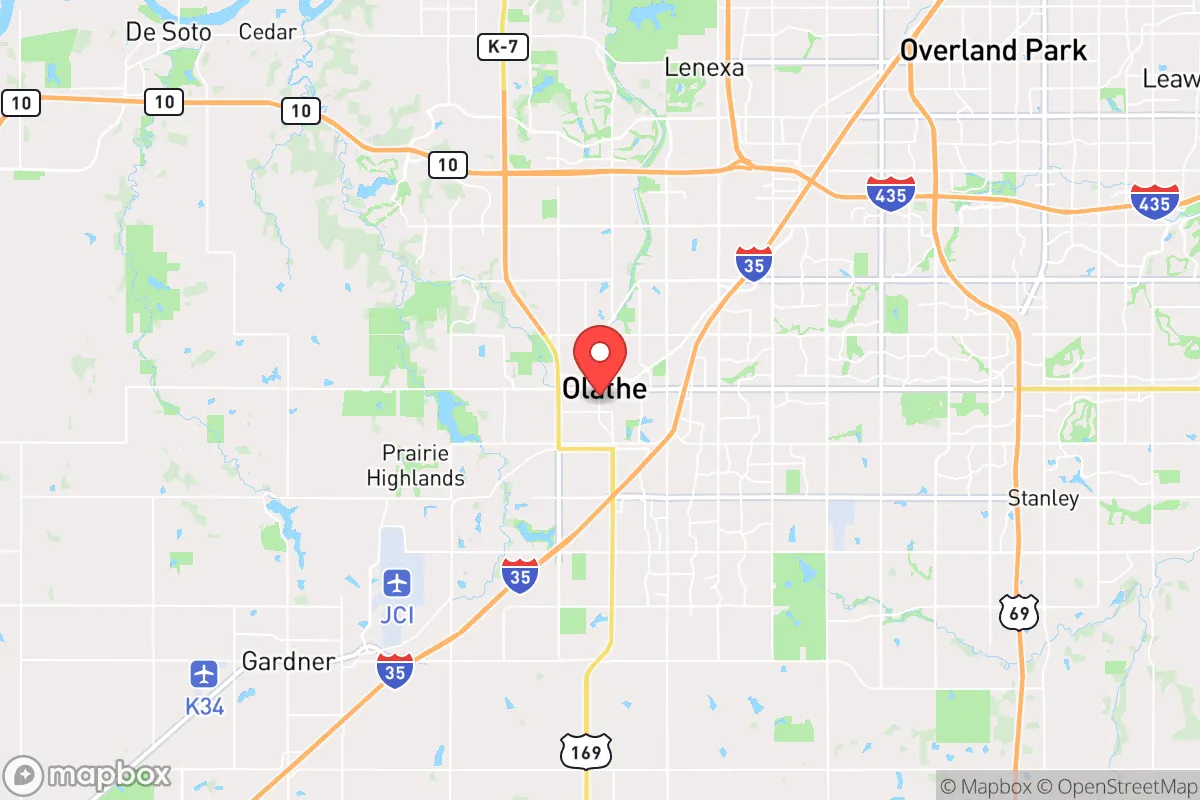
Photo: Wikipedia
Personal Sovereignty in Olathe, KS
Viable for self-reliance. Generally workable, though some barriers may limit total independence.
What does Personal Sovereignty tell us?
Personal Sovereignty measures your capacity for self-reliance and independence with minimal government friction. Higher scores mean fewer barriers between you and the way you want to live... but it assumes you have the space you need and good neighbors.
What does this tell us?
Personal Sovereignty measures your capacity for self-reliance and independence with minimal government friction. Higher scores mean fewer barriers between you and the way you want to live... but it assumes you have the space you need and good neighbors.
State Policy
Energy independence: Self-sufficient (80% of energy produced in-state)
Personal Liberty
Homesteading

Personal Liberty Analysis
Olathe, Kansas, offers a notably high degree of personal sovereignty relative to much of the United States, particularly for those who prioritize autonomy from state overreach. As the fourth-largest city in Kansas and part of the Kansas City metro, Olathe benefits from a state-level legal framework that consistently ranks among the most protective of individual rights in the Midwest. For a single individual or parent operating from a survivalist or prepper mindset, the key question is not whether the government will leave you alone—it’s how much of that independence you can actually exercise within city limits. The answer is nuanced but leans strongly in favor of personal control over your life, property, and decisions, especially when compared to neighboring Missouri or coastal states.
Tax burden and regulatory posture: how Kansas compares to surrounding states
Kansas has undergone significant tax reform in recent years, and Olathe residents benefit directly. The state’s income tax is a flat rate of 5.7% as of 2026, with no progressive brackets—meaning your marginal rate is your effective rate, simplifying planning. Property taxes in Johnson County, where Olathe sits, average around 1.3% of assessed value, which is moderate for the region but higher than rural Kansas counties. However, the real advantage is the lack of a state-level estate or inheritance tax, and no tax on Social Security benefits. For a prepper focused on long-term wealth retention, this is a meaningful buffer against federal erosion. Regulatory posture in Kansas is generally light-touch: occupational licensing is less burdensome than in many states, and there are no state-level rent control laws or broad environmental mandates that would restrict property use. The city of Olathe itself maintains a business-friendly zoning code, though homeowners should note that the city enforces standard suburban covenants—no backyard chicken coops in most platted subdivisions, for example. Compared to Johnson County’s more restrictive cities like Overland Park or Leawood, Olathe is more permissive, but it’s not a free-for-all. For those seeking maximum regulatory freedom, the unincorporated areas of Miami or Franklin County are better bets, but Olathe offers a solid balance of services and autonomy.
Self-defense and gun law specifics: what the Second Amendment looks like in practice
Kansas is a constitutional carry state, meaning no permit is required to carry a concealed firearm for anyone 21 or older who is legally allowed to possess a firearm. Olathe fully respects this—there are no city-level restrictions beyond state law. Open carry is also legal without a permit. The state preempts all local gun ordinances, so you won’t find the kind of patchwork bans common in Colorado or California. Stand-your-ground laws are in effect, with no duty to retreat in any place you are lawfully present. For a survivalist, this is critical: your home, vehicle, and even your front yard are legally defensible spaces. Magazine capacity is unrestricted, and there is no state-level registry or waiting period. The only notable limitation is that concealed carry is prohibited in certain posted areas like K-12 schools and government buildings, but even those have exceptions for locked vehicles. Johnson County’s sheriff is generally pro-Second Amendment, and the local gun culture is robust—there are multiple indoor ranges and gun shops within a 15-minute drive. For parents, this means you can teach your children firearm safety without state interference, and you can store weapons in your home without fear of a “safe storage” mandate like those in Washington or New York. The legal environment here is designed to trust the individual, not the state.
Self-reliance and homesteading viability: lot sizes, zoning, and off-grid feasibility
Olathe’s zoning is primarily suburban, with most residential lots ranging from 0.2 to 0.5 acres in newer subdivisions. This limits large-scale homesteading—you won’t be raising a steer or running a serious vegetable operation on a quarter-acre. However, the city does allow accessory dwelling units (ADUs) on lots of sufficient size, which opens the door for a detached workshop, storage, or even a small rental unit for barter or income. Rainwater collection is legal and unregulated at the state level, though the city’s building code may require permits for cisterns over a certain capacity. Solar panels are permitted without excessive red tape, and net metering is available through Evergy, the local utility. Off-grid living in the strict sense—no grid connection—is not feasible within city limits due to building codes requiring utility hookups for habitable structures. But for a prepper, the practical workaround is to buy a home with a basement or large garage and install a backup generator, battery storage, and a well if you’re on a private lot. The real homesteading opportunity lies just outside Olathe: in unincorporated Johnson County or adjacent Miami County, you can find 1- to 5-acre parcels with fewer restrictions. Many prepper-minded families buy a small acreage within 30 minutes of Olathe for a bug-out or retreat property while keeping a primary residence in town for work and schools. The soil is good for gardening, and the growing season runs April through October—enough for a serious food-production operation.
Personal liberties: parental rights, medical autonomy, speech, and property
Kansas has been a battleground for parental rights, and the current legal landscape is favorable. The state’s “Parents’ Bill of Rights” (enacted in 2023) gives parents explicit authority over their children’s education, healthcare, and upbringing. This means you can opt your child out of any curriculum or activity you find objectionable, and you have the right to access all school records without a fight. Medical autonomy is strong: Kansas does not have a state-level vaccine mandate for adults or children, and there is no forced medical treatment law that would override a parent’s decision for a minor—except in life-threatening emergencies. The state also prohibits mask mandates in schools and government buildings, a legacy of the COVID-era battles. On speech, Kansas has no hate-speech laws that criminalize political or religious expression, and the state constitution’s free-speech protections are robust. Property rights are protected by a strong eminent domain statute that requires “public use” and just compensation, and there is no state-level rent control or landlord licensing scheme that would infringe on your ability to use your property as you see fit. The only real friction point is the city’s enforcement of nuisance ordinances—things like tall grass, inoperable vehicles, and excessive noise—which can be a headache for preppers who want to store equipment or keep a low profile. But these are minor compared to the outright bans on certain property uses found in blue states.
Overall, Olathe offers a high degree of personal sovereignty for a suburban environment, especially when stacked against the regulatory-heavy states of the Northeast or West Coast. The tax burden is moderate, the gun laws are among the most permissive in the nation, and parental rights are legally protected. The trade-off is that you are still inside a city with zoning and code enforcement, so full off-grid independence requires moving to the surrounding rural counties. For a single individual or parent who wants a safe, legally autonomous base of operations with good schools and infrastructure, Olathe is a strong contender. It’s not a libertarian paradise—no city in America is—but it’s a place where the state largely stays out of your way, and that’s increasingly rare.

* Values derived from national, state, county, city and local statistics and may differ in a specific area. Last updated: 2026-04-30T07:07:22.000Z
Narrative content on this page is AI-generated and may contain mistakes. Verify any details that matter before acting on them.
ReloMaps may earn a commission from affiliate links at no extra cost to you.

