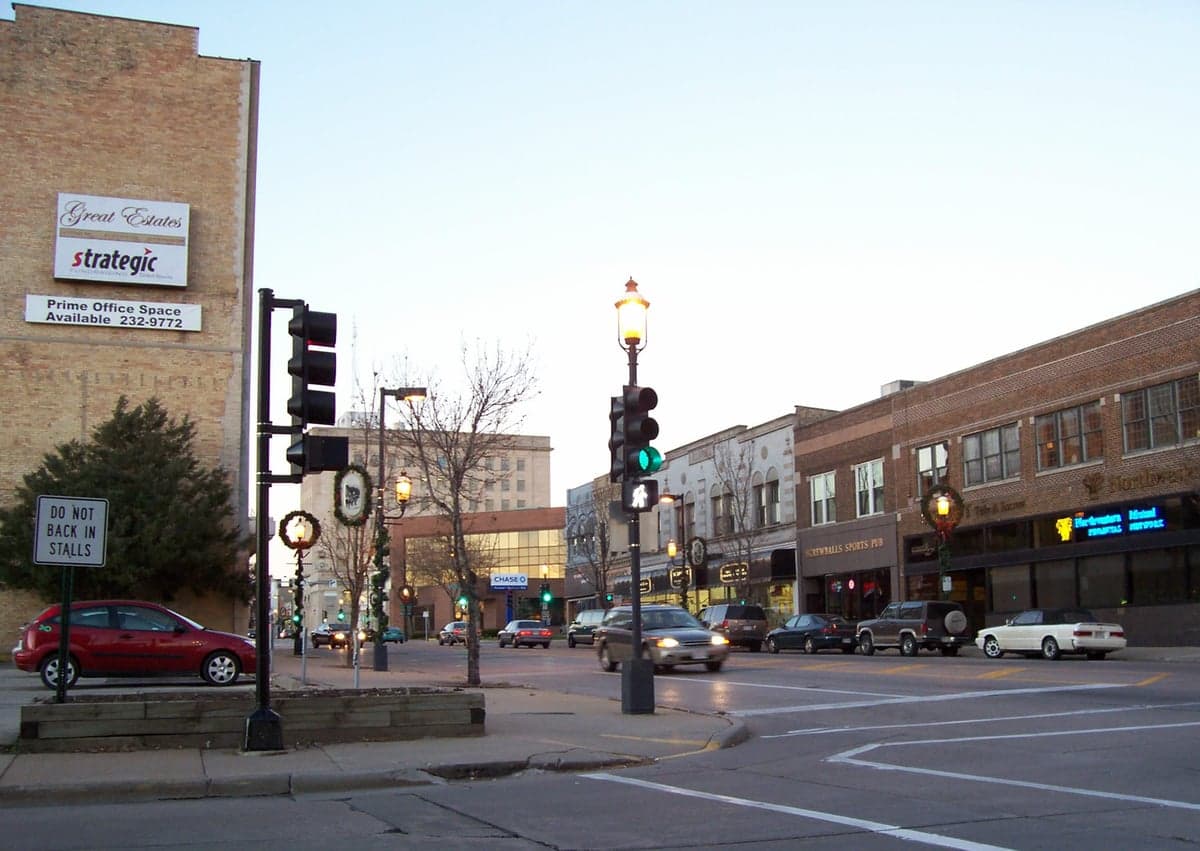
Photo: Wikipedia
Demographics of Oshkosh, WI
Affluence Level in Oshkosh, WI
A middle-class area roughly in line with national averages across income, home values, education, and employment.
People of Oshkosh, WI
The people of Oshkosh, Wisconsin, today number 66,247 and form a predominantly white (82.6%) community with a notably low foreign-born share of just 2.0%, reflecting a population shaped more by domestic migration and generational roots than by international immigration. The city’s character remains tied to its manufacturing and university anchor, with a college-educated rate of 27.3% and a modestly growing Hispanic (4.5%) and East/Southeast Asian (3.9%) presence that is concentrated in specific neighborhoods. Oshkosh is a place where a historic German and Scandinavian working-class identity coexists with newer, smaller enclaves of diversity, creating a community that is stable but slowly diversifying.
How the city was settled and grew
Oshkosh’s population history begins with the Menominee and Ho-Chunk peoples, but the city’s modern settlement was driven by the 1836 Treaty of the Cedars, which opened the area to Euro-American land claims. The first major wave of settlers were Yankee entrepreneurs from New England and New York, who arrived in the 1840s and 1850s to exploit the region’s vast white pine forests. They built the city’s early sawmills and established the Algoma neighborhood along the Fox River as a commercial and residential core for mill owners and managers. By the 1870s, a second wave of German and Irish immigrants arrived to work in the booming lumber industry, settling in the South Park and West Algoma areas, where modest worker cottages and boarding houses still stand. A third wave of Scandinavian immigrants—primarily Norwegians and Swedes—came between 1880 and 1910, drawn by the city’s shift from lumber to woodworking, furniture manufacturing, and the newly established Oshkosh Brewing Company. They concentrated in the North Main Street corridor and the Eighth Avenue district, building Lutheran churches and ethnic social halls that remain community anchors today. By 1920, Oshkosh was a solidly white, working-class city of roughly 33,000, with a population that was overwhelmingly native-born of German and Scandinavian descent.
Modern era (post-1965)
The post-1965 period brought modest demographic change to Oshkosh, largely through domestic in-migration rather than international immigration. The city’s foreign-born share remains at just 2.0%, far below the national average, reflecting limited impact from the Hart-Cellar Act. The most significant population shift was suburbanization: from the 1970s onward, white families moved from older central neighborhoods like Algoma and South Park to newer subdivisions in the West Oshkosh area, near the expanding University of Wisconsin-Oshkosh campus and the Highway 41 corridor. This left the city’s core neighborhoods with an aging, lower-income population while the west side grew younger and more affluent. The Hispanic population (4.5%) began to grow in the 1990s, driven by Mexican and Central American migrants working in manufacturing and agriculture; they have concentrated in the South Park neighborhood, where a small cluster of Latino-owned businesses and a Catholic mission now serve the community. The East/Southeast Asian population (3.9%) is largely Hmong, with families arriving as secondary migrants from larger Wisconsin cities like Appleton and Green Bay after 2000; they have settled primarily in the North Main Street area and near the university. The Black population (4.4%) is a mix of multi-generational families and newer arrivals drawn by jobs at Oshkosh Corporation and local healthcare employers, with no single dominant neighborhood. The Indian-subcontinent population (0.3%) is tiny and consists almost entirely of professionals working at the university or regional medical centers, living scattered across west-side subdivisions.
The future
Oshkosh’s population is heading toward slow, incremental diversification rather than rapid change. The white share (82.6%) is declining gradually as the city’s overall population grows at less than 1% annually, with most growth coming from Hispanic and Hmong families having children at higher rates than the aging white population. The foreign-born share is expected to rise to perhaps 3-4% by 2040, still well below national averages, as Oshkosh remains a secondary destination for immigrants who first settle in larger Wisconsin cities. The city is not tribalizing into distinct ethnic enclaves; rather, Hispanic and Hmong families are dispersing across existing neighborhoods, with only the South Park area showing a modest concentration. The biggest demographic risk is population stagnation or decline, as the city’s manufacturing base—anchored by Oshkosh Corporation—faces automation pressures and the university struggles with enrollment declines. Without a significant increase in international immigration or a new economic driver, Oshkosh will likely remain a predominantly white, aging community with small but stable minority populations.
For someone moving in now, Oshkosh offers a stable, low-crime environment with a strong sense of local identity, but the population is not growing quickly and diversity is limited. The city is becoming slightly more Hispanic and Hmong, but the core character remains German-Scandinavian working class, with a university influence that keeps the west side younger and more educated. It is a place where newcomers will find a welcoming but homogeneous community, with the most demographic change happening slowly in the South Park and North Main Street neighborhoods.

* Values derived from national, state, county, city and local statistics and may differ in a specific area. Last updated: 2026-04-21T10:15:15.000Z
Narrative content on this page is AI-generated and may contain mistakes. Verify any details that matter before acting on them.
ReloMaps may earn a commission from affiliate links at no extra cost to you.

