 Popular
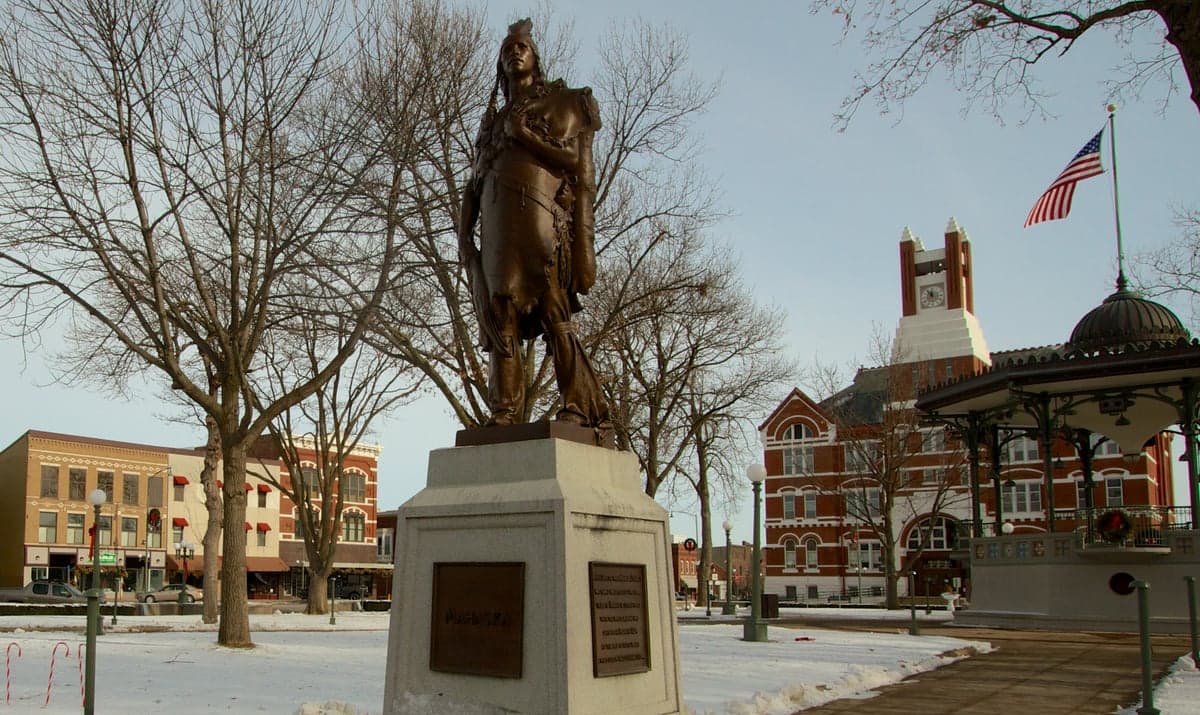
Photo: Wikipedia
Demographics of Oskaloosa, IA
Affluence Level in Oskaloosa, IA
A middle-class area roughly in line with national averages across income, home values, education, and employment.
People of Oskaloosa, IA
The people of Oskaloosa, Iowa, today number 11,492 and form a predominantly white (91.8%) community with a small but growing Hispanic (2.6%) and East/Southeast Asian (1.7%) presence. The city’s character remains rooted in its agricultural and manufacturing heritage, with a lower-than-average college attainment rate of 26.0% and a foreign-born population of just 1.5%. This is a stable, family-oriented community where generational ties run deep, and new arrivals are still a modest share of the whole.
How the city was settled and grew
Oskaloosa was founded in 1844 as the seat of Mahaska County, drawing its first wave of settlers from the Ohio River Valley and New England. These early arrivals were primarily of English, Scottish, and German stock, attracted by the promise of fertile prairie land opened by the 1846 federal land grants and the subsequent arrival of the Burlington and Missouri River Railroad in 1865. The original town plat centered around the square, with the North Ward and South Ward neighborhoods emerging as the first residential districts, housing merchants and tradesmen. By the 1870s, coal mining became a major draw, bringing a second wave of immigrants—primarily Welsh, Irish, and later Italian miners—who settled in the East Side near the mines and the railroad yards. The West End developed as a more affluent area for the city’s professional class, including bankers and mill owners. The city’s population peaked at roughly 13,000 in the 1910s, then stabilized as the coal industry declined and manufacturing—led by the Oskaloosa-based Vermeer Corporation (founded 1948)—became the economic anchor.
Modern era (post-1965)
After the 1965 Hart-Cellar Act, Oskaloosa saw only a trickle of international immigration, unlike larger Iowa cities. The foreign-born share remained below 2% through 2020. The most notable demographic shift has been domestic: a slow, steady out-migration of younger adults to Des Moines (60 miles north) and a simultaneous in-migration of retirees and remote workers seeking lower housing costs. The College Hill neighborhood, near William Penn University, has seen a modest influx of faculty and students, including a small number of East/Southeast Asian and Hispanic families. The South 11th Street corridor has become the primary residential area for Hispanic households, many employed in local food processing and agriculture. The Black population (1.9%) is concentrated in the East Side and North Ward, reflecting historic housing patterns. The Indian-subcontinent population is effectively zero (0.0%), and the Asian community (1.7%) is almost entirely Vietnamese and Korean families, many connected to the university or regional manufacturing plants.
The future
Oskaloosa’s population is projected to remain flat or decline slightly over the next decade, mirroring rural Iowa trends. The white share is slowly shrinking as older residents pass away and younger cohorts are more diverse. The Hispanic share is the fastest-growing segment, likely reaching 4-5% by 2035, driven by births and continued employment in agriculture and manufacturing. The East/Southeast Asian population is stable, sustained by William Penn University’s international recruitment. The city is not tribalizing into distinct ethnic enclaves; rather, new Hispanic and Asian families are dispersing across existing neighborhoods, particularly College Hill and the West End. The biggest risk is continued brain drain: the 26.0% college attainment rate trails the state average (30.5%), and without a major employer expansion, the city will struggle to retain college graduates.
Oskaloosa is becoming a slightly more diverse, but still overwhelmingly white, small city where newcomers are welcomed but assimilation into the existing community fabric is the norm. For a conservative-leaning individual or family moving in now, the city offers a stable, low-crime environment with strong schools and a tight-knit social structure—but limited career opportunities for those without a pre-existing job or remote-work arrangement.

* Values derived from national, state, county, city and local statistics and may differ in a specific area. Last updated: 2026-04-30T04:33:33.000Z
Narrative content on this page is AI-generated and may contain mistakes. Verify any details that matter before acting on them.
ReloMaps may earn a commission from affiliate links at no extra cost to you.

