Photo: Wikipedia
Demographics of Ottumwa, IA
Affluence Level in Ottumwa, IA
A below-average socioeconomic profile. Incomes, home values, and educational attainment trail the U.S., with higher poverty and unemployment.
People of Ottumwa, IA
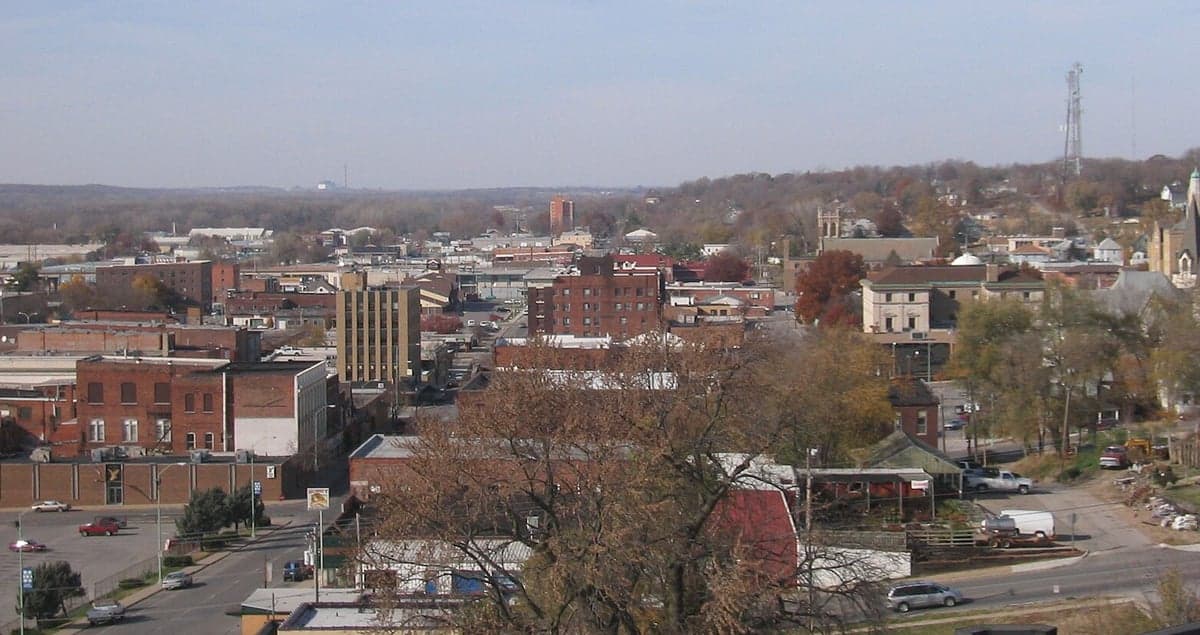
Ottumwa, Iowa, is a city of 25,352 residents that has transitioned from a homogeneous, industrial-era railroad and meatpacking hub into a more diverse, working-class community. Its population is now 71.0% white, with a significant Hispanic minority of 16.4%, a Black population of 4.3%, and smaller East/Southeast Asian (1.7%) and Indian subcontinent (0.1%) communities. The city’s character is defined by its blue-collar roots, a higher-than-average foreign-born share of 7.1%, and a notably low college attainment rate of 20.1%, reflecting a population that values practical trades over four-year degrees.
How the city was settled and grew
Ottumwa’s original population was drawn by the confluence of the Des Moines River and the arrival of the railroad in the 1840s and 1850s. The city’s first major wave of settlers were Yankee and German farmers and merchants who established the downtown core along Main Street and the riverfront. By the late 19th century, the meatpacking industry—anchored by the John Morrell & Co. plant—became the dominant employer, attracting a second wave of European immigrants. Irish and German laborers settled in the North End, building the working-class neighborhoods around Richmond Avenue and the old packing district. A smaller but distinct wave of Italian immigrants arrived around 1900, concentrating in the East End near the river, where they established St. Mary of the Visitation parish. These groups formed the city’s white ethnic backbone through the mid-20th century, with the population peaking at over 33,000 in 1960.
Modern era (post-1965)
The 1965 Hart-Cellar Act and the subsequent decline of the meatpacking industry reshaped Ottumwa’s demographics. As the Morrell plant automated and downsized in the 1970s and 1980s, the city lost thousands of white working-class residents to suburbanization and out-migration. Simultaneously, new immigrant groups arrived to fill remaining packing and manufacturing jobs. Hispanic workers, primarily of Mexican origin, began settling in the South End around Albia Road and the industrial corridor, a trend that accelerated after 2000. Today, the Hispanic population of 16.4% is concentrated in this area, with a growing presence in the West End near the Ottumwa Regional Airport. A smaller East/Southeast Asian community (1.7%), including Vietnamese and Laotian families, arrived in the 1980s and 1990s, clustering in the North End near the former packing plant sites. The Black population (4.3%) is more dispersed but has a notable presence in the East End and central neighborhoods. The Indian subcontinent population (0.1%) is negligible, consisting of a handful of professionals employed at the local hospital or Indian Hills Community College.
The future
Ottumwa’s population is slowly homogenizing in terms of racial composition, but it is tribalizing geographically. The white population is aging and declining, while the Hispanic community is growing through both immigration and higher birth rates. The city’s overall population has stabilized after decades of decline, but the white share has dropped from over 90% in 1990 to 71.0% today. The Hispanic enclave in the South End is expanding northward, while the East/Southeast Asian community is plateauing as younger generations assimilate and move to larger cities like Des Moines or Iowa City. The Black population is stable but not growing significantly. Over the next 10-20 years, Ottumwa will likely become a majority-minority city, with Hispanics potentially reaching 25-30% of the population. The low college attainment rate (20.1%) suggests that economic opportunities in trades and manufacturing will continue to drive in-migration, rather than a shift toward a knowledge-based economy.
For a conservative-leaning individual or family considering relocation, Ottumwa is a place where traditional blue-collar values persist, but the demographic landscape is shifting steadily. The city is becoming more Hispanic and less white, with distinct ethnic neighborhoods that offer cultural variety but also some degree of separation. The low cost of living and availability of manufacturing jobs remain draws, but the declining white population and aging infrastructure mean that newcomers will find a community in transition rather than one with a stable, homogeneous identity.

* Values derived from national, state, county, city and local statistics and may differ in a specific area. Last updated: 2026-04-19T22:34:29.000Z
Narrative content on this page is AI-generated and may contain mistakes. Verify any details that matter before acting on them.
ReloMaps may earn a commission from affiliate links at no extra cost to you.

