
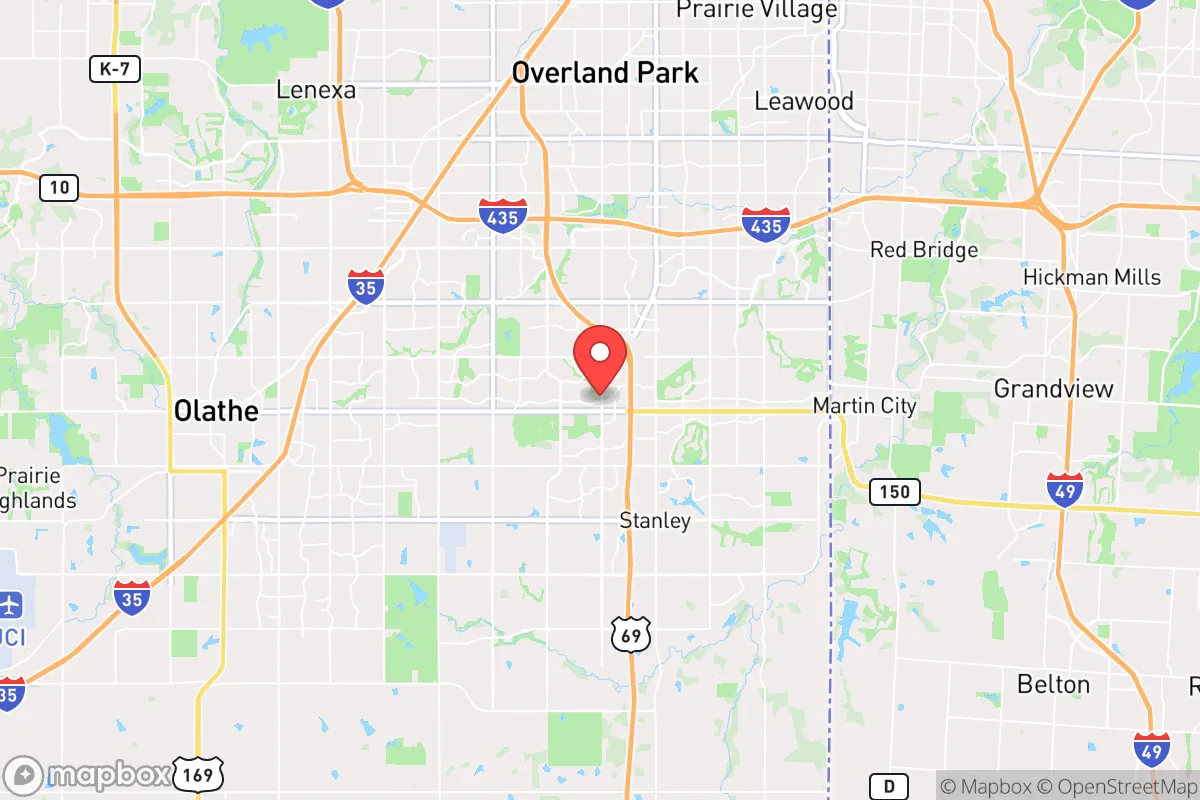
Photo by Mary Hammel on Unsplash
Demographics of Overland Park, KS
Affluence Level in Overland Park, KS
An upper-middle-class area. Household wealth, education levels, and homeownership run ahead of national benchmarks.
People of Overland Park, KS
Overland Park, Kansas, is a predominantly white, highly educated suburban city of 197,199 residents where 62.9% of adults hold a bachelor’s degree or higher. The city’s population is 73.9% white, with a notable and growing Indian subcontinent community (4.6%) that outpaces the East/Southeast Asian population (4.1%), alongside smaller Hispanic (8.1%) and Black (5.3%) shares. Only 5.9% of residents are foreign-born, reflecting a city shaped more by domestic in-migration from other U.S. regions than by international immigration. Overland Park’s identity is one of master-planned affluence, corporate headquarters, and family-oriented neighborhoods, with a political culture that leans conservative relative to the Kansas City metro area.
How the city was settled and grew
Overland Park was not a pioneer-era settlement. It was founded in 1905 as a streetcar suburb of Kansas City, Missouri, when real estate developer William B. Strang Jr. platted the land along the Missouri Pacific Railroad. The original population was almost entirely white, drawn from Kansas City’s growing middle class by the promise of larger lots, cleaner air, and a commuter rail connection. The historic downtown Overland Park district, centered on Santa Fe Drive and 80th Street, retains the early 20th-century commercial core where those first residents shopped and socialized. Growth remained modest through the 1940s, with the city reaching only about 2,500 residents by 1950. The post-World War II boom transformed Overland Park. Returning veterans and their families, aided by the GI Bill and new highway construction (especially U.S. 69 and I-435), flooded into the area. Developers built sprawling subdivisions of single-family homes, and the city annexed aggressively. The Mission Hills neighborhood, though technically a separate city, set the tone for the area’s affluent, white, professional-class character. By 1970, Overland Park’s population had surged past 75,000, almost entirely through domestic white migration from within the Kansas City metro and from other Midwestern states.
Modern era (post-1965)
The 1965 Hart-Cellar Act had a delayed and modest effect on Overland Park compared to coastal suburbs. The city’s foreign-born share remains low at 5.9%, but the composition of that share has shifted markedly since the 1990s. The most significant change has been the growth of the Indian subcontinent community, which now stands at 4.6% of the population — roughly 9,000 residents. This group is heavily concentrated in the Deer Creek and Lackman neighborhoods, drawn by the area’s top-rated Blue Valley School District and the presence of professional jobs in engineering, medicine, and information technology. East/Southeast Asian residents (4.1%) are also present, with smaller clusters in Oak Park and near the Metcalf Avenue corridor. The Hispanic population (8.1%) is more dispersed but has a visible presence in the Shawnee Mission area along the city’s northern edge, often in older, more affordable housing stock. The Black population (5.3%) remains relatively small and is not concentrated in a single neighborhood, reflecting the city’s historically limited appeal to Black homebuyers compared to Kansas City, Missouri, or nearby Grandview. Domestic in-migration continues to be the primary driver of growth, with families moving from other parts of Johnson County, from the coasts for corporate relocations, and from rural Kansas. The city’s white population share has declined from over 90% in 1990 to 73.9% today, but this is driven more by the growth of Asian and Indian communities than by a significant influx of Hispanic or Black residents.
The future
Overland Park is likely to continue its gradual diversification, but the pace will remain moderate. The Indian subcontinent community is the fastest-growing ethnic group, and its concentration in the Blue Valley school district suggests it will continue to expand through both domestic moves and professional immigration (H-1B visa holders and their families). The East/Southeast Asian population is growing more slowly, plateauing as second-generation residents move to other suburbs or out of state. The Hispanic population is growing steadily but from a smaller base, and it is not forming the large ethnic enclaves seen in other Midwestern cities. The white population will continue to decline as a share but will remain the overwhelming majority for the foreseeable future. The city is not tribalizing into distinct ethnic enclaves; rather, it is experiencing a pattern of assimilation where Indian and Asian professionals integrate into predominantly white neighborhoods, particularly in the southern half of the city. The northern neighborhoods, closer to Kansas City, are aging and seeing some reinvestment, but they are not attracting the same volume of new residents. For a conservative-leaning mover, Overland Park offers a stable, low-crime, high-amenity environment where demographic change is gradual and largely driven by upwardly mobile professional families who share similar values around education, safety, and property values.
Overland Park is becoming a more diverse but still predominantly white, highly educated, and affluent suburb where the primary demographic story is the rise of a professional Indian subcontinent middle class rather than broad multicultural transformation. For someone moving in now, the city offers a predictable, family-oriented environment with excellent schools and low crime, where the population is stable in its core character even as it slowly diversifies along class lines.

* Values derived from national, state, county, city and local statistics and may differ in a specific area. Last updated: 2026-04-29T18:33:19.000Z
Narrative content on this page is AI-generated and may contain mistakes. Verify any details that matter before acting on them.
ReloMaps may earn a commission from affiliate links at no extra cost to you.

