Photo: Wikipedia
Demographics of Oxford, MS
Affluence Level in Oxford, MS
A middle-class area roughly in line with national averages across income, home values, education, and employment.
People of Oxford, MS
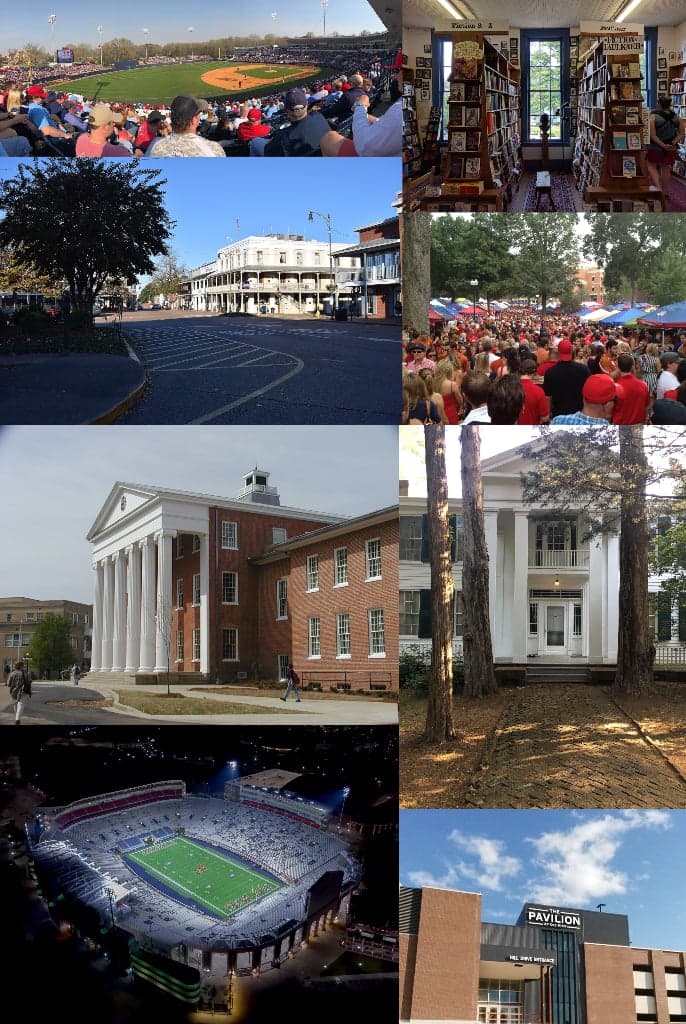
The people of Oxford, Mississippi today number roughly 26,086, forming a college town that is notably more diverse and educated than the surrounding region. With 56.9% of adults holding a bachelor’s degree or higher, the population is driven by the University of Mississippi, which shapes the city’s character as a mix of long-standing Southern families, academic professionals, and a growing number of out-of-state transplants. The city is 66.1% white and 25.7% Black, with small but distinct Asian (1.9%), Indian subcontinent (0.9%), and Hispanic (3.0%) communities, while the foreign-born share sits at just 3.3% — lower than the national average but concentrated among university-affiliated residents.
How the city was settled and grew
Oxford was founded in 1837 on land ceded by the Chickasaw Nation in the 1832 Treaty of Pontotoc Creek. The original white settlers were mostly yeoman farmers and slaveholding planters from the Carolinas, Virginia, and Tennessee, drawn by the fertile Black Prairie soil for cotton cultivation. The town was deliberately sited as the county seat of Lafayette County, and its early population was a mix of Anglo-American landowners, enslaved African Americans (who made up a majority of the county’s population by 1860), and a small number of free people of color. The historic Grove neighborhood, centered around the University of Mississippi’s iconic oak-lined circle, was built by the planter class and remains the city’s most prestigious address. Enslaved and later freed Black families settled in the St. Peter’s Cemetery area and along what is now Bramlett Boulevard, forming the core of Oxford’s historic Black community. After the Civil War, the population stagnated through the early 1900s, with the university providing the only steady economic anchor. The 1930s through 1950s saw modest growth as the university expanded under Chancellor J.D. Williams, drawing faculty and staff into the North Lamar Boulevard corridor and the Deer Creek subdivision, one of the first planned residential areas for white professionals.
Modern era (post-1965)
The post-1965 era brought transformative change. The Civil Rights Movement and the violent 1962 Ole Miss integration crisis — when James Meredith enrolled as the first Black student — reshaped the city’s racial dynamics. White flight to private academies and suburban subdivisions accelerated in the 1970s, with many families moving to Briarwood and Steeplechase, neighborhoods that remain predominantly white and affluent today. Meanwhile, Oxford’s historic Black neighborhoods, such as Pine Grove and the area around Jackson Avenue East, saw population consolidation as younger Black families stayed or returned for university jobs. The 1980s and 1990s brought a new wave: out-of-state retirees and second-home buyers drawn by William Faulkner’s literary legacy and the town’s small-city charm. This group settled heavily in the College Hill Road area and the Taylor community just west of town. The 2000s saw the first significant East/Southeast Asian and Indian subcontinent populations arrive, almost entirely tied to the university’s graduate programs, medical school, and engineering faculty. These groups cluster near campus in the Old Taylor Road and South 13th Street apartment complexes, with little geographic dispersion into older neighborhoods. The Hispanic population, though small at 3.0%, grew from construction and service-sector jobs during the 2000s building boom, settling in mobile home parks and rental units along Highway 6 West.
The future
Oxford’s population is projected to continue growing at 1-2% annually, driven by university enrollment (now over 24,000 students) and the city’s reputation as a regional hub for healthcare and retail. The white share is slowly declining as the university recruits more international graduate students and faculty, while the Black share remains stable at roughly 25-26%. The East/Southeast Asian and Indian subcontinent populations are likely to grow modestly, but will remain small and concentrated near campus unless the city develops affordable family housing outside student-heavy zones. The Hispanic population is plateauing, as construction demand has softened and many workers have moved to larger metro areas. The city is not tribalizing into distinct ethnic enclaves — rather, it is homogenizing around a university-centric, college-educated identity, with the main divide being between long-term residents (both white and Black) and transient students and faculty. For a conservative-leaning newcomer, Oxford offers a stable, family-oriented environment with low crime, strong schools, and a traditional Southern culture, but the political and cultural influence of the university means the city leans more moderate than the surrounding county.
Oxford is becoming a more educated, more transient, and slightly more diverse version of its former self — a place where the university’s gravitational pull overrides most other demographic forces. For someone moving in now, the city offers a tight-knit, safe community with a clear social hierarchy centered on Ole Miss, but the cost of housing and the seasonal student influx are the main trade-offs to consider.

* Values derived from national, state, county, city and local statistics and may differ in a specific area. Last updated: 2026-04-30T03:28:03.000Z
Narrative content on this page is AI-generated and may contain mistakes. Verify any details that matter before acting on them.
ReloMaps may earn a commission from affiliate links at no extra cost to you.

