
Photo: Wikipedia
Political ClimatePolitical Climate in Oxford, MS
District shown is the primary district for this city’s centroid. Cities may span multiple districts.
Local Political AnalysisPolitical Analysis of Oxford, MS
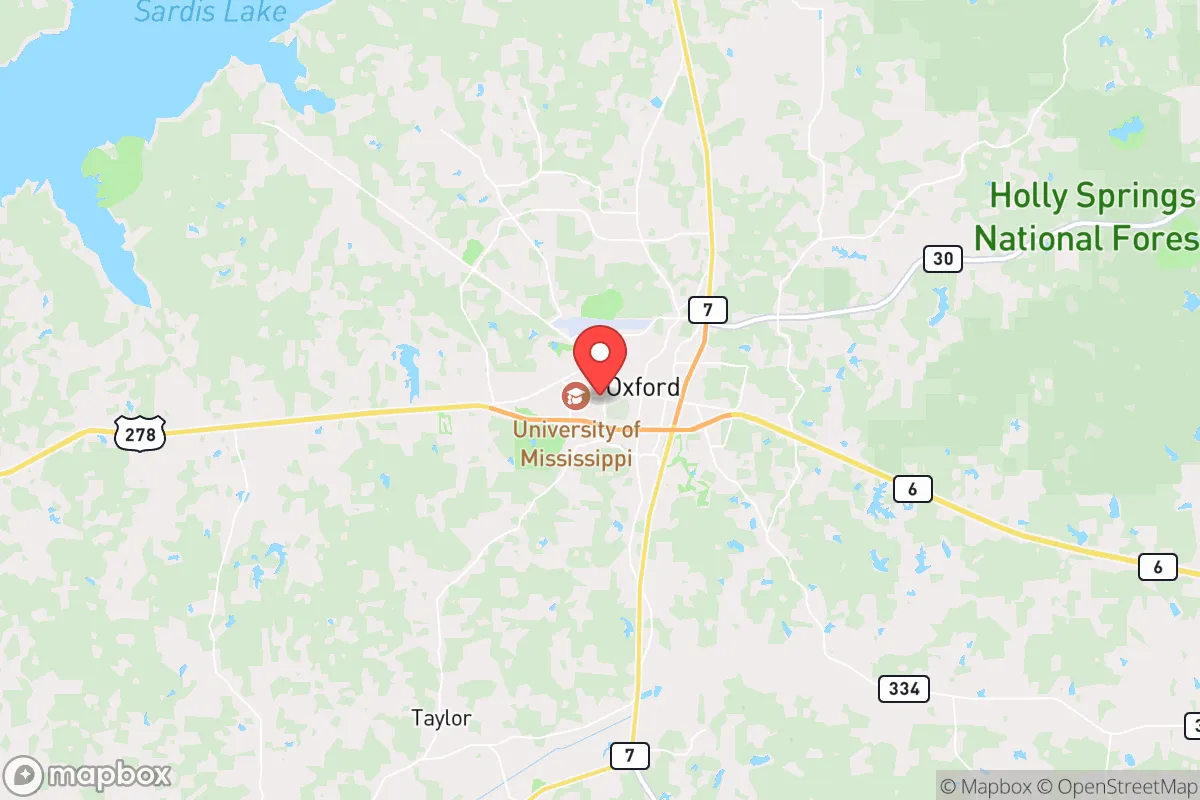
Oxford sits in a solidly conservative corner of Mississippi, with a Cook PVI of R+18 that reflects the broader political reality of Lafayette County. But if you’ve lived here as long as I have, you know the town itself has a more complicated feel than those numbers suggest. The university pulls in folks from all over, and over the past decade, you’ve seen a slow but steady drift toward progressive ideas in city politics—especially around issues like zoning, public spending, and even some local ordinances that feel like they’re testing the limits of personal freedom. The surrounding county, places like Taylor or Abbeville, still votes deep red, but inside the city limits, the conversation has shifted in ways that make a lot of us long-time residents uneasy.
How it compares
Drive ten minutes outside of Oxford and you’re in a different world. Towns like Water Valley and Batesville lean heavily conservative, with a no-nonsense approach to local government that keeps taxes low and regulations light. In Oxford, you’ll find a city council that’s increasingly willing to entertain progressive pet projects—think bike lane expansions that eat up road space, stricter building codes that drive up housing costs, and a general attitude that government knows best. Compared to nearby Tupelo, which has a more business-friendly, hands-off reputation, Oxford feels like it’s caught between its small-town roots and a desire to mimic the policies of college towns like Austin or Chapel Hill. That R+18 rating masks a real divide: the county still leans right, but the city itself is trending in a direction that worries folks who value limited government and personal autonomy.
What this means for residents
For those of us who moved here for the quiet, the hunting land, or the simple freedom to live without a lot of red tape, the changes are real. You’re seeing more local ordinances that nibble at property rights—like stricter short-term rental rules that make it harder to rent out a cabin on your land, or noise ordinances that feel like they’re written for a dormitory, not a town. Property taxes have crept up as the city spends more on amenities that not everyone asked for. The school board and county supervisors still lean conservative, thank goodness, but the city council has become a battleground where every new proposal feels like a test of how much government involvement folks will tolerate. If you value the right to do what you want with your own property without asking permission, you’ll want to keep a close eye on local elections.
One thing that stands out is the cultural tension around public events and public spaces. Oxford has always had a live-and-let-live vibe, but lately there’s been more push to use city resources for causes that divide people rather than bring them together. The university’s influence means you’ll see more progressive signage and activism than you would in, say, Pontotoc or New Albany. For a long-time resident, it feels like the old Oxford—where folks minded their own business and the government stayed out of yours—is slowly giving way to something more managed, more opinionated, and less free. If the trend continues, the next decade could see Oxford become a place where personal freedoms are chipped away in the name of progress, and that’s a real shame for a town that used to pride itself on letting people live their own lives.

State Political ClimatePolitical Climate in Mississippi
State Political AnalysisPolitical Environment in the State
Mississippi is one of the most reliably conservative states in the nation, with a deep-rooted Republican lean that has only solidified over the past two decades. The state hasn’t voted for a Democratic presidential candidate since 1976, and in 2024, Donald Trump carried it by over 16 points. The dominant coalition is a mix of rural, evangelical, and working-class voters, with the GOP holding supermajorities in both chambers of the state legislature. Over the last 10-20 years, the shift has been dramatic: Democrats once controlled the state house well into the 2000s, but after the 2011 redistricting and a wave of conservative activism, Republicans now hold roughly two-thirds of the seats. The trajectory is clear—Mississippi is getting redder, not bluer, and that’s a big part of why many conservative families are looking here.
Urban vs. rural divide
The political map of Mississippi is a textbook case of the urban-rural split. The state’s few population centers—Jackson, Gulfport-Biloxi, and Hattiesburg—are the only real Democratic strongholds. Jackson, the capital and largest city, is overwhelmingly Democratic and majority-Black, consistently voting 80%+ for Democratic candidates. But drive 20 minutes outside the city limits into Rankin or Madison counties, and you’ll find some of the most reliably Republican suburbs in the South. Madison, in particular, is a fast-growing, affluent suburb where GOP candidates routinely win by 30-40 points. The Mississippi Gulf Coast, anchored by Biloxi and Gulfport, leans Republican but is more competitive due to a mix of military retirees, casino workers, and a sizable Vietnamese-American community. The real engine of conservative power, though, is the rural Delta and Pine Belt. Counties like DeSoto (just south of Memphis) and Lamar (outside Hattiesburg) have flipped hard red over the last decade as suburban sprawl brought in families fleeing Memphis and New Orleans. The divide isn’t subtle—if you want a conservative environment, you avoid Jackson proper and stick to the suburbs or the small towns.
Policy environment
Mississippi’s policy environment is aggressively conservative, and it’s been that way for a while. The state has no income tax on Social Security benefits, and in 2022, it began a multi-year phase-out of the state income tax entirely—by 2026, the top rate will drop to 4.0%, with a goal of elimination. Property taxes are among the lowest in the nation, and there’s no estate tax. The regulatory posture is light-touch: Mississippi is a right-to-work state, and permitting for new businesses is streamlined. On education, the state passed the Mississippi Charter Schools Act in 2013, and there’s a robust school choice movement—the state offers Education Scholarship Accounts (ESAs) for students with disabilities and is expanding them. Healthcare is a mixed bag: the state refused Medicaid expansion under Obamacare, keeping the system lean, but rural hospital closures remain a concern. Election laws are strict: voter ID is required, early voting is limited, and absentee voting requires an excuse. The state also passed a 2023 law banning ranked-choice voting and ballot harvesting. For a conservative moving in, the policy environment is about as friendly as it gets—low taxes, limited government, and a strong emphasis on local control.
Trajectory & freedom
Mississippi is trending toward more personal freedom, especially in areas that matter to conservatives. The biggest recent win was the 2022 permitless carry law (HB 1035), which allows any law-abiding adult to carry a concealed firearm without a license. That’s a major expansion of Second Amendment rights. On parental rights, the state passed the “Parents’ Bill of Rights” in 2023 (SB 2395), which requires schools to notify parents of any medical or mental health services offered to their child and bans instruction on sexual orientation or gender identity in K-3. Medical autonomy took a hit with the 2023 ban on gender-affirming care for minors (HB 1125), but that’s seen as a win for parental rights by conservatives. Property rights are strong—Mississippi has no statewide zoning mandates, and counties have broad discretion. The one area where freedom is arguably shrinking is in the realm of taxation: while the income tax is being phased out, sales taxes are creeping up (the state rate is 7%, and local add-ons can push it to 8.5% or more). Still, the overall trajectory is toward less government intrusion in daily life, and that’s a big draw for people fleeing high-tax states like California or Illinois.
Civil unrest & political movements
Mississippi has a relatively low level of visible civil unrest compared to other states, but there are flashpoints. The most notable in recent years was the 2020 protests in Jackson over the death of George Floyd, which saw some property damage and clashes with police, but they were contained to the capital city. The state’s political movements are dominated by grassroots conservative activism: the Mississippi Tea Party is still active, and groups like the Mississippi Parents’ Campaign have been vocal on school curriculum and library books. Immigration politics are less heated here than in border states—Mississippi has a small foreign-born population (about 2.5%), and there are no sanctuary cities. The state did pass a 2023 law (HB 1482) requiring law enforcement to cooperate with federal immigration authorities, but it’s rarely a top issue. Election integrity controversies flared up after 2020, with the state GOP pushing for stricter absentee ballot rules, but there’s been no widespread fraud found. The most visible political flashpoint for a new resident would be the ongoing debate over the state flag (changed in 2020 to remove the Confederate emblem) and the renaming of public buildings—this is a cultural wedge that still stirs emotions, especially in rural areas. Overall, though, political movements here are orderly and focused on legislative action rather than street protests.
Projection
Over the next 5-10 years, Mississippi is likely to get even more conservative. The in-migration patterns are telling: people are moving into the state from California, Illinois, and Louisiana, and they’re overwhelmingly conservative families looking for lower taxes and safer communities. The population is growing fastest in the suburban counties around Jackson (Madison, Rankin) and along the Gulf Coast, while the rural Delta continues to lose people. This demographic shift will further entrench Republican dominance—expect the state legislature to remain supermajority GOP, and the governorship to stay red. The income tax phase-out will likely be completed, making Mississippi even more attractive to remote workers and retirees. The one wild card is the state’s Black population (about 38% of residents), which remains heavily Democratic. If Black voter turnout increases significantly, it could make statewide races more competitive, but that’s a long shot given the current political geography. For a conservative moving in now, expect to find a state that’s becoming more aligned with your values every year—lower taxes, stronger gun rights, and a culture that prioritizes family and faith.
Bottom line for a new resident: Mississippi is a safe bet if you want a state that’s moving in a conservative direction. You’ll find low taxes, strong Second Amendment protections, and a government that’s generally hands-off. The trade-off is that public services—especially in rural areas—are lean, and the infrastructure outside the suburbs can be rough. But if you’re looking for a place where your kids can grow up in a community that shares your values, and where your paycheck goes further, Mississippi is hard to beat. Just stick to the suburbs and small towns, and you’ll be fine.
* Values derived from national, state, county, city and local statistics and may differ in a specific area. Last updated: 2026-04-30T03:28:03.000Z
Narrative content on this page is AI-generated and may contain mistakes. Verify any details that matter before acting on them.
ReloMaps may earn a commission from affiliate links at no extra cost to you.

