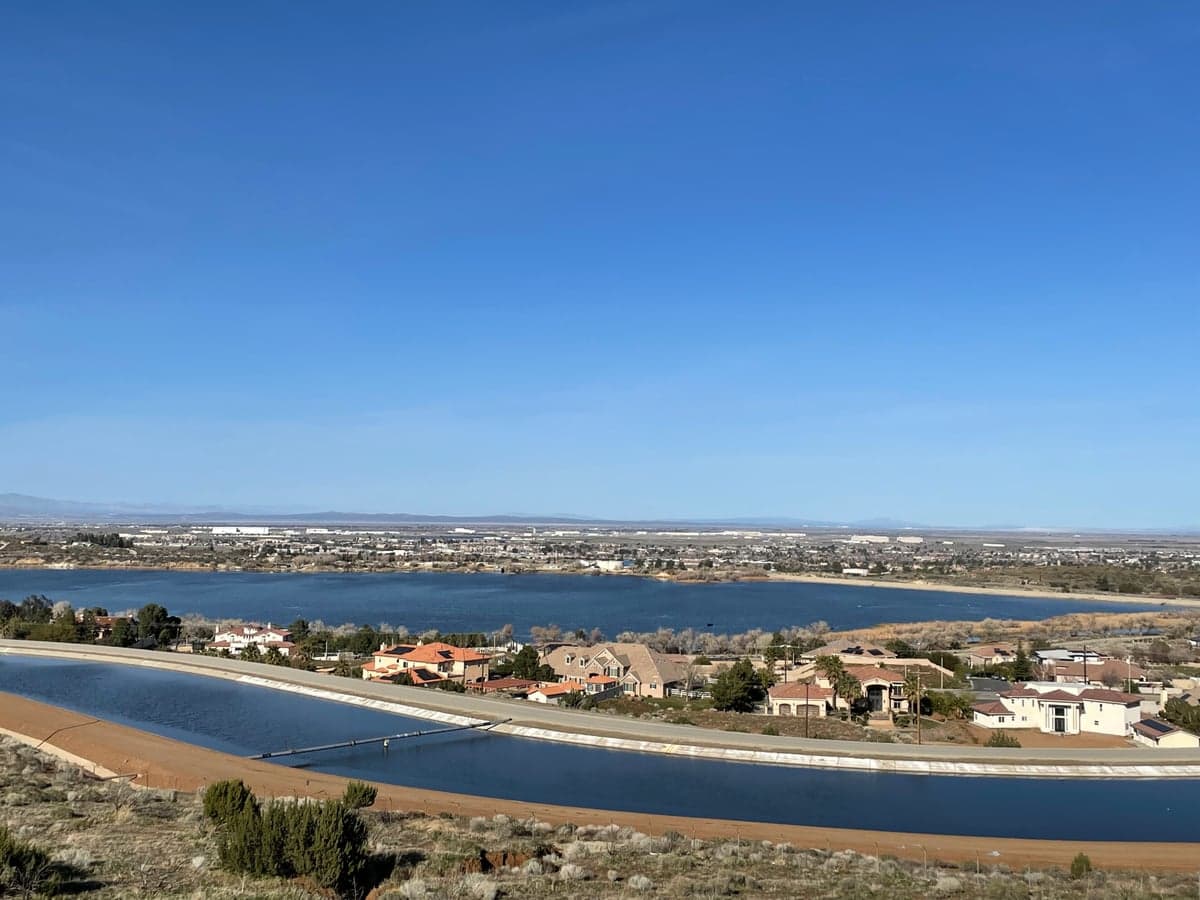
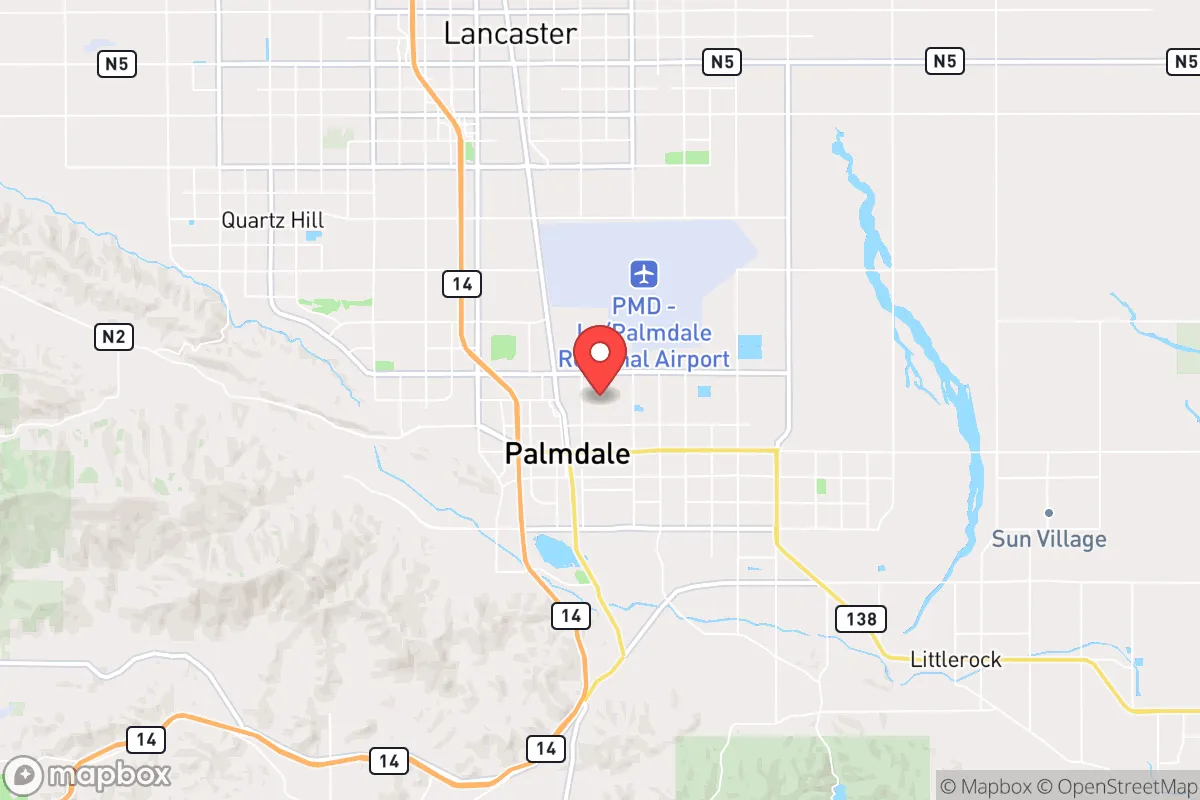
Photo: Wikipedia
Demographics of Palmdale, CA
Affluence Level in Palmdale, CA
A middle-class area roughly in line with national averages across income, home values, education, and employment.
People of Palmdale, CA
Today, Palmdale, California is a majority-Hispanic city of 165,487 residents, defined by its role as an affordable, family-oriented alternative to Los Angeles County’s coastal suburbs. The city’s population is young (median age 31.5) and heavily working-class, with just 16.6% holding a bachelor’s degree or higher, reflecting a blue-collar aerospace and logistics employment base. Palmdale’s character is distinctly suburban and car-dependent, with a strong military and defense contractor presence tied to nearby Air Force Plant 42 and Edwards Air Force Base. The city’s identity is shaped by its rapid late-20th-century growth, its large Hispanic majority (62.8%), and a significant Black community (13.0%) that is among the largest in the Antelope Valley.
How the city was settled and grew
Palmdale was not a Spanish or Mexican land-grant settlement; its modern history begins with the arrival of the Southern Pacific Railroad in the 1870s, which established a station called Palmenthal (later Palmdale) as a stop for wheat and alfalfa farmers. The original Anglo-American settlers were dryland farmers from the Midwest, drawn by cheap land and the railroad’s promise of market access. The first permanent cluster of homes formed around what is now Old Town Palmdale, near the intersection of Palmdale Boulevard and 10th Street West, where a small commercial core served the agricultural community. The city remained a tiny farming hamlet through the 1940s, with fewer than 1,000 residents. The first major population wave came during World War II, when the U.S. Army established Air Force Plant 42 (then a bombing range) and Edwards Air Force Base expanded. This brought a mix of military personnel, defense engineers, and construction workers—overwhelmingly white and native-born—who settled in the Rancho Vista area, a master-planned subdivision built in the 1950s to house aerospace families. By 1960, Palmdale’s population had reached just 11,522, still predominantly white and tied directly to the defense industry.
Modern era (post-1965)
The 1965 Hart-Cellar Act and the subsequent suburbanization of Los Angeles transformed Palmdale’s population. The city’s real boom began in the 1980s and 1990s, as affordable housing prices and the completion of the Antelope Valley Freeway (State Route 14) made it a commuter destination for working-class families priced out of the San Fernando Valley. This wave was overwhelmingly Hispanic, with many families moving directly from Mexico and Central America, as well as from established Latino neighborhoods in East Los Angeles and the San Gabriel Valley. These new residents concentrated in the West Palmdale neighborhoods west of the 14 Freeway, particularly around Avenue P and 30th Street East, where tract homes built in the 1980s and 1990s created dense, family-oriented subdivisions. At the same time, a significant Black population—many from South Los Angeles and Inglewood—moved to Palmdale seeking larger homes and safer streets, settling primarily in the East Palmdale area east of the freeway, around Palmdale Boulevard and 50th Street East. This domestic migration was driven by the same housing affordability calculus that attracted Hispanic families, but it created distinct enclaves: East Palmdale became known as a middle-class Black community, while West Palmdale became heavily Hispanic. The Asian population (3.6%) and Indian population (0.7%) remain small, with most East/Southeast Asian families living in the Quartz Hill area, a semi-rural neighborhood in the city’s southwest corner that has historically attracted a mix of aerospace professionals and small-business owners. The foreign-born share (11.1%) is modest by California standards, indicating that most of Palmdale’s Hispanic growth is now second- and third-generation rather than recent immigration.
The future
Palmdale’s population is likely to continue its trajectory toward an even higher Hispanic majority, driven by natural increase (higher birth rates among Hispanic families) and continued domestic out-migration of white and Black residents to more distant exurbs like Lancaster and Rosamond. The city’s Black population, which peaked at around 15% in the 2000s, has declined slightly to 13.0% as some middle-class Black families have moved to newer subdivisions in the High Desert. The white population (17.0%) is aging and shrinking, concentrated in the older Rancho Vista and Quartz Hill neighborhoods. The East/Southeast Asian and Indian communities are small and stable, with no major immigration wave expected. The city is not tribalizing into hostile enclaves, but it is clearly sorting by income and ethnicity: West Palmdale is increasingly Hispanic and lower-income, East Palmdale remains predominantly Black and middle-class, and Quartz Hill and Rancho Vista retain a whiter, more affluent character. The next decade will likely see Palmdale become a solidly Hispanic-majority city (70% or higher), with a smaller but stable Black minority and a shrinking white population. The city’s future depends on whether it can attract higher-wage aerospace and logistics jobs to retain its middle-class families, or whether it continues to function as a bedroom community for lower-income commuters.
For a conservative-leaning individual or family considering a move, Palmdale offers a straightforward proposition: a low-cost, family-oriented suburb with a strong military and aerospace heritage, a growing Hispanic majority, and a significant Black community that has created distinct, stable neighborhoods. The city is not a melting pot but a collection of enclaves, each with its own character and trajectory. The key question for a newcomer is which neighborhood aligns with their priorities—whether that’s the older, whiter, and more established Rancho Vista, the heavily Hispanic and newer West Palmdale subdivisions, or the middle-class Black community of East Palmdale. The city’s demographic future is clear: it will become more Hispanic, more working-class, and more suburban, with the aerospace industry remaining the economic anchor.

* Values derived from national, state, county, city and local statistics and may differ in a specific area. Last updated: 2026-04-24T12:48:20.000Z
Narrative content on this page is AI-generated and may contain mistakes. Verify any details that matter before acting on them.
ReloMaps may earn a commission from affiliate links at no extra cost to you.

