Photo: Wikipedia
Demographics of Papillion, NE
Affluence Level in Papillion, NE
An upper-middle-class area. Household wealth, education levels, and homeownership run ahead of national benchmarks.
People of Papillion, NE
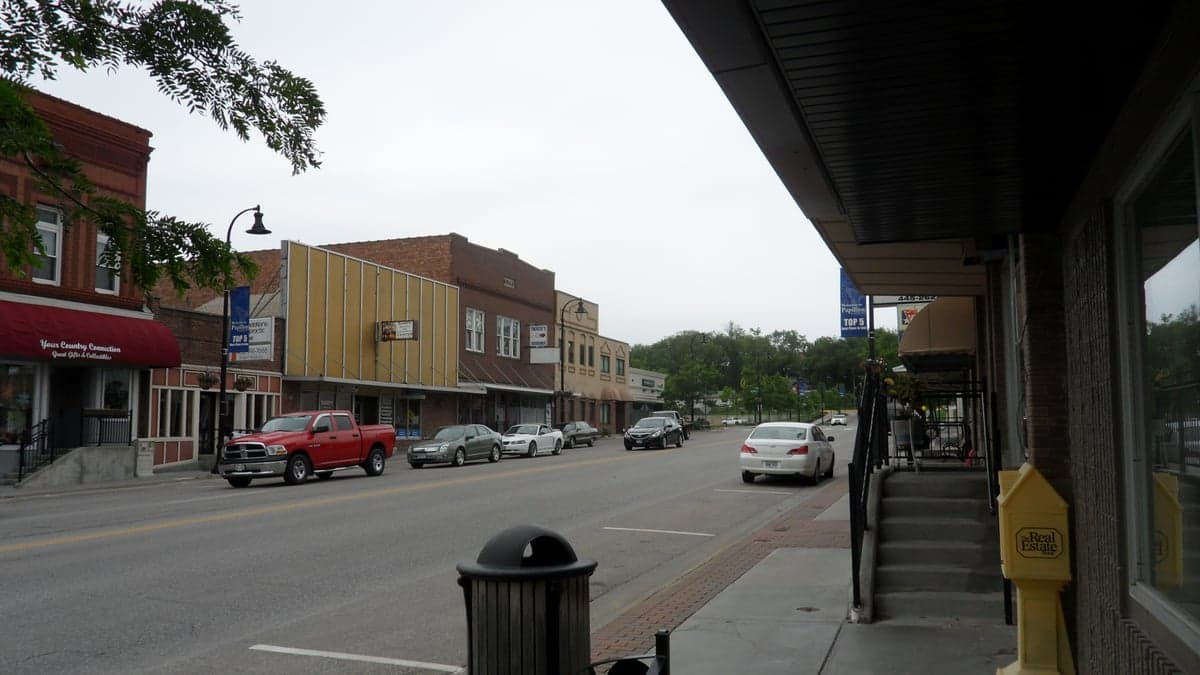
Today, Papillion, Nebraska is a predominantly white, family-oriented suburb of Omaha with a population of 24,063, characterized by a high college attainment rate of 48.1% and a low foreign-born share of just 2.4%. The city's identity is rooted in its history as a railroad and agricultural service center, now reshaped by decades of suburban expansion that has attracted upwardly mobile families seeking good schools and low crime. Despite modest diversification in recent decades, Papillion remains notably less diverse than the Omaha metro as a whole, with 85.3% of residents identifying as white alone.
How the city was settled and grew
Papillion was founded in 1870 along the Union Pacific Railroad, which drew the first wave of settlers: German and Czech immigrant farmers and railroad workers. These early families built homes in what is now the Olde Towne Papillion district, centered around Washington Street, where many original wood-frame houses still stand. The city's name itself comes from the French word for "butterfly," a nod to the area's abundant prairie butterflies that impressed early French-Canadian trappers. By 1900, the population had reached just 500, with the economy revolving around grain elevators, a creamery, and the railroad depot. The Southport area, originally a separate farming hamlet, was annexed in the 1960s and absorbed many of the second-generation Czech and German families who moved out of Olde Towne for larger lots. A notable early non-white presence was a small community of African American railroad porters and their families who settled near the depot in the 1910s, but this group never exceeded a few dozen people and had largely dispersed by the 1950s.
Modern era (post-1965)
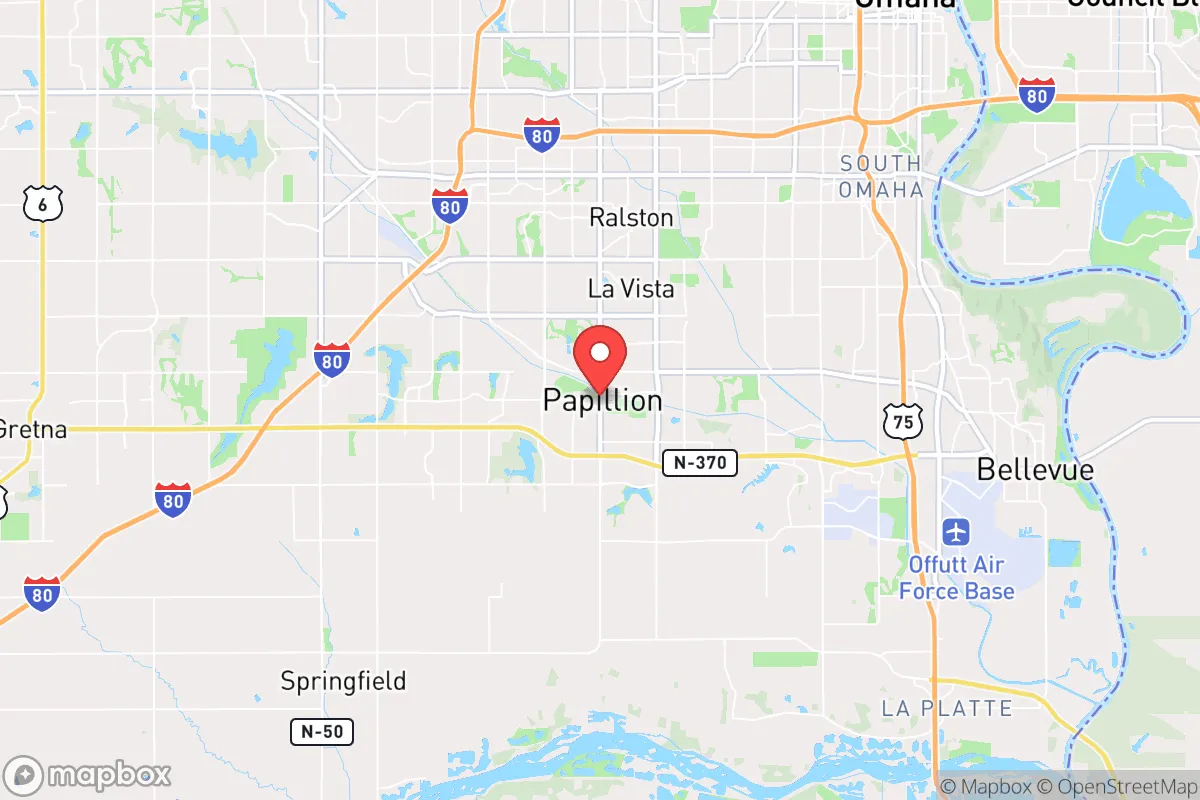
The post-1965 era transformed Papillion from a sleepy farm town into a booming Omaha suburb. The construction of Interstate 80 and the expansion of Offutt Air Force Base in nearby Bellevue drove rapid growth, with the population jumping from 2,500 in 1970 to over 16,000 by 2000. This wave was overwhelmingly white, middle-class families from Nebraska and Iowa moving for new housing developments like Shadow Lake and Walnut Creek, which offered large single-family homes and access to the new Papillion-La Vista school system. The Hispanic population began to grow in the 1990s, concentrated in the Portal neighborhood near 72nd Street, where older, more affordable housing stock attracted service-industry workers. Today, the 7.8% Hispanic share is the largest minority group, but it remains geographically clustered and socially distinct from the white majority. The East/Southeast Asian community (1.2%) is small and largely professional, with many families living in the newer Glenbrooke subdivision near the Papillion-La Vista South High School. The Indian subcontinent population (0.2%) is negligible, consisting mostly of IT professionals working at Omaha-area firms. The Black population (2.5%) is the most dispersed, with no single neighborhood majority, reflecting a pattern of individual rather than chain migration.
The future
Papillion's demographic trajectory points toward slow, incremental diversification rather than rapid change. The foreign-born share has remained flat at 2.4% for over a decade, suggesting that international migration is not a major driver of growth. The Hispanic population is the fastest-growing segment, projected to reach 10-12% by 2035, driven by natural increase and continued in-migration from other Nebraska communities. However, this growth is likely to remain concentrated in the Portal area and the older housing stock near 84th Street, creating a de facto ethnic enclave rather than full integration. The white population, while still dominant, is aging: the median age in Papillion is 36.7, and younger white families are increasingly choosing newer exurban developments in Gretna and Bennington over Papillion's established neighborhoods. The city's high home prices (median $310,000) and strong school reputation will continue to attract college-educated families, but the overall character will remain predominantly white and middle-class. For a conservative-leaning mover, Papillion offers a stable, low-crime environment with minimal demographic disruption, though the gradual Hispanic growth in the Portal area may be a consideration for those seeking maximum homogeneity.
Papillion is becoming a mature, stable suburb where the population is slowly diversifying along class and ethnic lines, but at a pace that preserves its core identity as a safe, family-oriented community. For someone moving in now, the city offers a predictable, low-risk environment where the main demographic story is not rapid change but gradual, manageable evolution.

* Values derived from national, state, county, city and local statistics and may differ in a specific area. Last updated: 2026-05-03T20:29:05.000Z
Narrative content on this page is AI-generated and may contain mistakes. Verify any details that matter before acting on them.
ReloMaps may earn a commission from affiliate links at no extra cost to you.

