
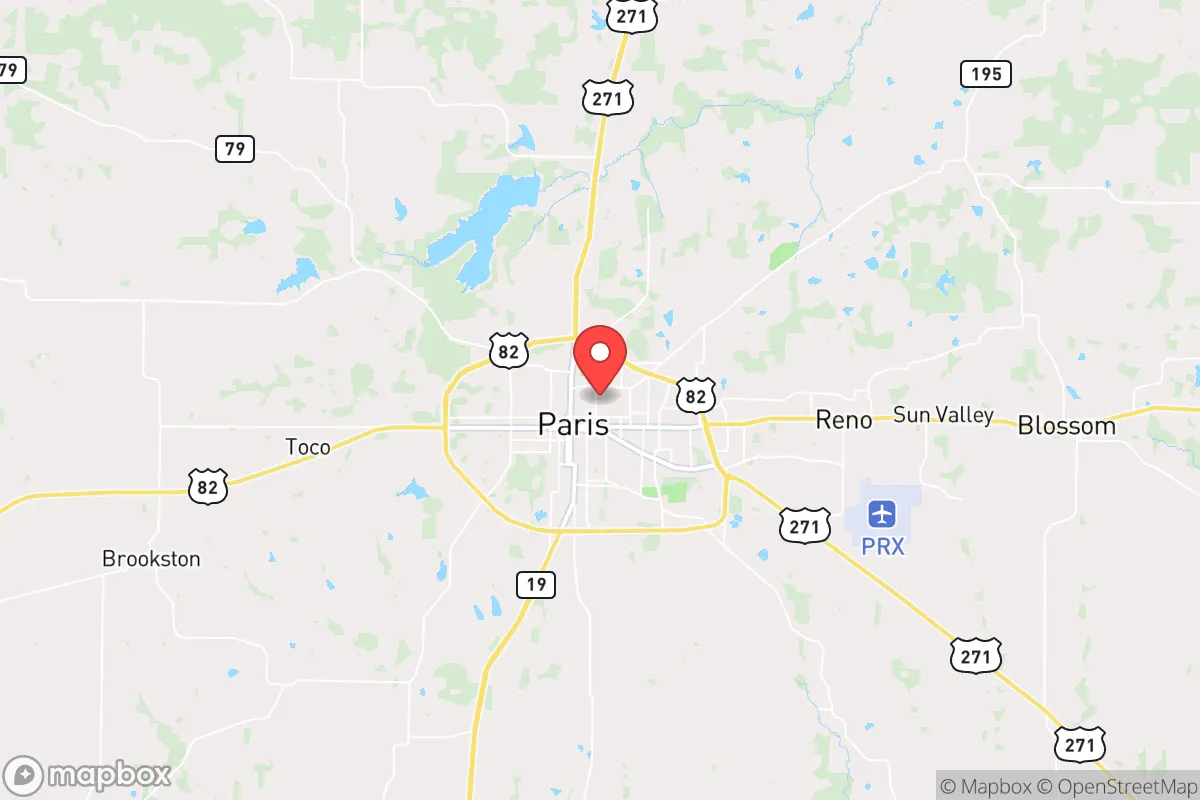

Demographics of Paris, TX
Affluence Level in Paris, TX
A below-average socioeconomic profile. Incomes, home values, and educational attainment trail the U.S., with higher poverty and unemployment.
People of Paris, TX
The people of Paris, Texas, today form a community of roughly 24,678 residents that is notably more diverse than much of rural Northeast Texas, with a distinctive Black population share of 22.5% and a growing Hispanic presence at 11.5%. The city’s character is shaped by its history as a regional trade and manufacturing hub, with a population density of about 1,100 people per square mile that gives it a small-city feel with defined neighborhoods. Only 1.8% of residents are foreign-born, and the college-educated share sits at 20.2%, reflecting a workforce rooted in local industry and agriculture rather than a knowledge-economy influx. The city’s identity markers—a strong sense of local tradition, a visible African American cultural heritage, and a modest but rising Hispanic community—set it apart from the more homogenously white rural counties surrounding it.
How the city was settled and grew
Paris was founded in 1844 by a land grant from the Republic of Texas, drawing Anglo-American settlers from the U.S. South who established cotton plantations and small farms. The arrival of the Texas and Pacific Railway in the 1870s transformed the town into a regional cotton and livestock shipping center, attracting merchants, railroad workers, and a significant number of Black families who came as laborers and sharecroppers. These early Black settlers concentrated in what became known as the East Paris neighborhood, east of the railroad tracks, where they built churches, schools, and a self-sufficient community. By the early 20th century, a wave of European immigrants—primarily German and Czech families—arrived to work in the growing lumber and brick industries, settling in the West Paris area near the industrial yards. The city’s population peaked at around 25,000 in the 1950s, supported by a thriving garment industry and the Campbell Soup plant, which drew additional white and Black workers from the surrounding countryside into neighborhoods like North Park and South Paris.
Modern era (post-1965)
After the 1965 Hart-Cellar Act, Paris saw minimal direct immigration due to its inland location and lack of gateway-city dynamics, but domestic migration reshaped its demographics significantly. The post-civil-rights era saw Black families move from rural Lamar County into Paris proper, strengthening the East Paris and Pecan Gap neighborhoods, while white families suburbanized into newer developments like Sherwood Shores and the Loop 286 corridor. The Hispanic population began a slow, steady increase from the 1990s onward, driven by workers in the poultry processing plants and construction trades, with many settling in the Southwest Paris area near the industrial parks. The Asian population remains very small at 1.2% (East/Southeast Asian communities) and the Indian-subcontinent population at 0.1%, largely composed of professionals in healthcare and education who live scattered across the city rather than in a concentrated enclave. The white share has declined from over 80% in 1970 to 57.9% today, while the Black share has held relatively steady, and the Hispanic share has grown from negligible to 11.5%—a shift that has made Paris more ethnically layered than its peers but still predominantly native-born.
The future
The population of Paris is slowly homogenizing in terms of nativity—the foreign-born share is extremely low and unlikely to rise dramatically given the city’s limited economic pull for immigrants—but is tribalizing along racial lines into distinct residential enclaves. East Paris remains overwhelmingly Black, Southwest Paris is becoming majority Hispanic, and the newer subdivisions along Loop 286 and toward Lake Crook are predominantly white. The Hispanic community is growing through higher birth rates and continued domestic migration from Texas’s Rio Grande Valley, while the Black population is plateauing as younger residents leave for Dallas or Houston. The white population is aging and declining slightly, as young adults move to larger metros. Over the next 10-20 years, Paris will likely become a tri-ethnic city with a white plurality, a stable Black minority, and a Hispanic share approaching 15-18%, but with little growth in Asian or Indian communities. The city is not becoming a melting pot; rather, it is developing parallel communities that coexist but remain geographically and socially distinct.
For someone moving to Paris now, the city offers a low-cost, low-immigration environment where neighborhoods have clear identities and community life is organized around churches, local schools, and civic clubs. The demographic trajectory points toward a more Hispanic-influenced future, but one that remains overwhelmingly native-born and rooted in regional culture. New residents should expect a place where racial and ethnic lines are visible but not volatile, and where the sense of local tradition runs deep across all groups.

* Values derived from national, state, county, city and local statistics and may differ in a specific area. Last updated: 2026-04-21T21:03:49.000Z
Narrative content on this page is AI-generated and may contain mistakes. Verify any details that matter before acting on them.
ReloMaps may earn a commission from affiliate links at no extra cost to you.

