Photo: Wikipedia
Demographics of Parkersburg, WV
Affluence Level in Parkersburg, WV
A below-average socioeconomic profile. Incomes, home values, and educational attainment trail the U.S., with higher poverty and unemployment.
People of Parkersburg, WV
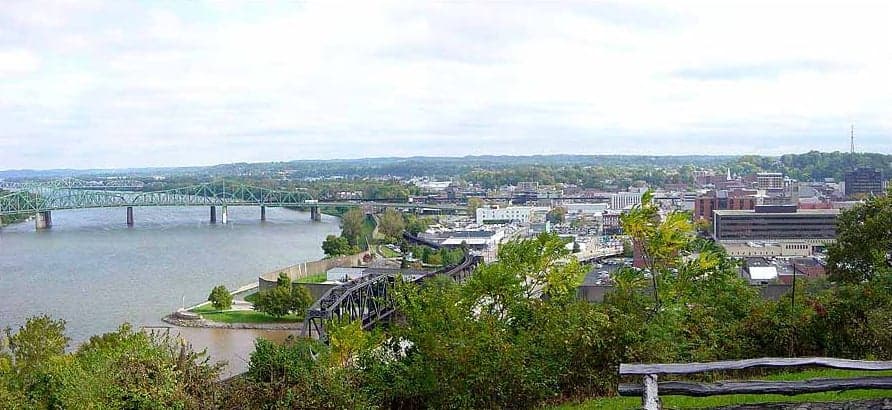
The people of Parkersburg, West Virginia today form a remarkably homogeneous community of 29,461 residents, 92.4% of whom identify as white alone. The city is characterized by a dense, older urban core with a distinctly working-class identity rooted in its industrial past, and a population that is notably less diverse and less college-educated (18.5%) than national averages. With a foreign-born population of just 0.4%, Parkersburg remains one of the least ethnically diverse cities in the Ohio Valley, a place where generational continuity is the dominant cultural marker.
How the city was settled and grew
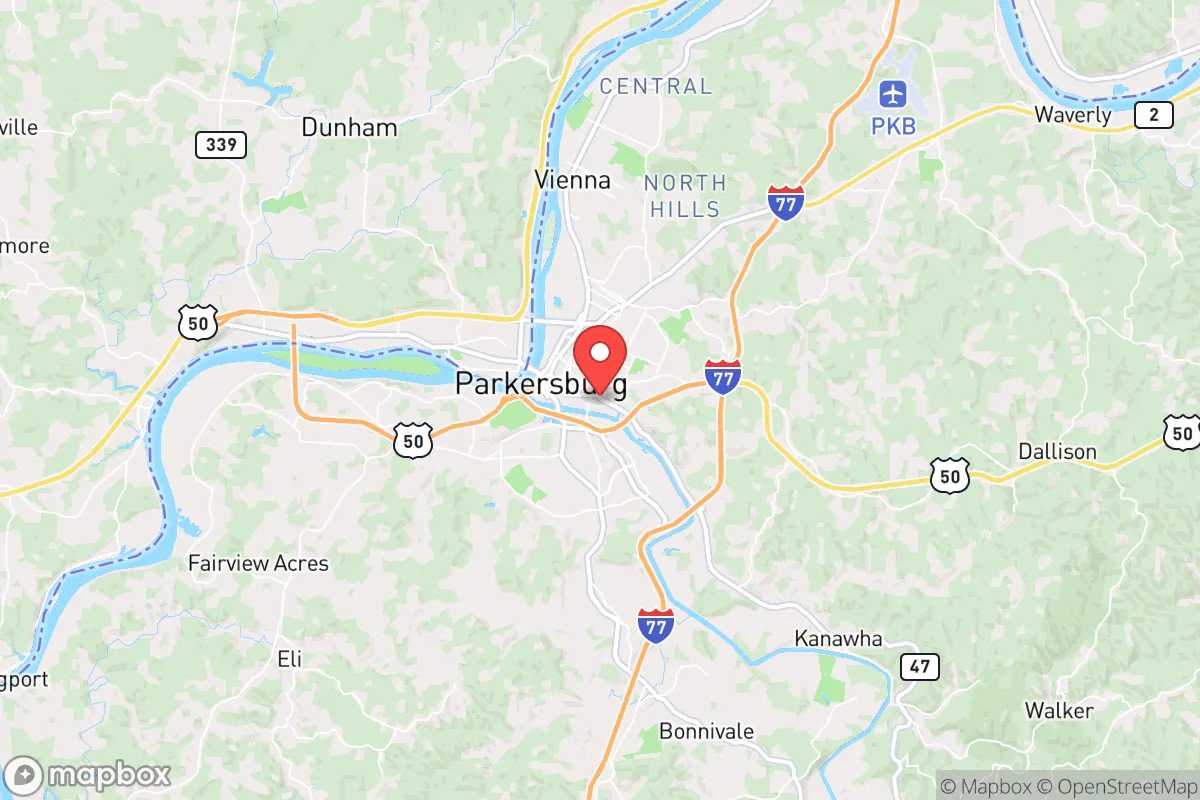
Parkersburg’s original population was drawn by its strategic location at the confluence of the Ohio and Little Kanawha Rivers. Founded in 1810 and incorporated in 1820, the city grew as a transportation and manufacturing hub. The first major wave of settlers were Anglo-American migrants from Virginia and Pennsylvania, who established the original grid of streets in what is now the Downtown district, centered around the historic courthouse square. The arrival of the Baltimore and Ohio Railroad in the 1850s accelerated growth, and by the late 19th century, the city became a center for oil, gas, and glass manufacturing. This industrial boom attracted a second wave: European immigrants, primarily German and Irish laborers, who settled in the Fairview and Lubeck neighborhoods, building modest frame houses near the factories along the river. A smaller wave of Italian and Eastern European workers arrived in the early 1900s, clustering in the South Side district near the rail yards. By 1950, Parkersburg’s population peaked at over 41,000, and the city was almost entirely white, with a small African American community concentrated in the East End neighborhood near the former rail depot.
Modern era (post-1965)
After the 1965 Hart-Cellar Act, Parkersburg saw virtually no new immigration. The foreign-born share has remained below 1% for decades, and the city’s demographic story since 1965 is one of domestic out-migration and suburbanization. The white population began a slow decline as manufacturing jobs—particularly at the DuPont plant and the former Borg-Warner facility—were automated or moved overseas. Many middle-class families left the older urban neighborhoods for newer subdivisions in North Parkersburg and Vienna (a separate municipality just west of the city limits), hollowing out the core. The small Black population, which had been centered in the East End, also declined as younger generations moved to larger cities for opportunity. The Hispanic population, at 1.5%, is the only minority group to show any growth since 2000, driven by a small number of Mexican-origin families working in construction and service industries, but they remain scattered rather than forming a distinct enclave. The East/Southeast Asian population (0.6%) is largely composed of a few dozen families connected to the local medical community at WVU Medicine Camden Clark Medical Center. The Indian-subcontinent population (0.2%) is negligible, typically transient professionals.
The future
Parkersburg’s population is projected to continue its slow decline, falling below 28,000 by 2035 if current trends hold. The city is homogenizing rather than diversifying: the white share is stable at over 92%, and the small minority populations are not growing fast enough to alter the city’s character. The foreign-born share is unlikely to rise significantly, as the region lacks the job growth or immigrant networks that attract newcomers. The most notable demographic shift is the aging of the white population—the median age is over 42—and the out-migration of young adults to Columbus, Pittsburgh, or Charlotte. The Downtown district has seen modest reinvestment in loft apartments and small businesses, attracting a handful of younger professionals, but this is a thin countercurrent to the broader suburbanization of the North Parkersburg and Vienna areas. No new ethnic enclaves are forming; the city is becoming a quieter, older, and more uniformly white place.
For someone moving to Parkersburg now, the city offers a stable, low-cost, and culturally traditional environment where neighbors are likely to be multi-generational locals. The trade-off is a lack of ethnic diversity and a limited pool of college-educated peers. The city is not becoming more tribalized into distinct enclaves—it is simply becoming smaller and more homogeneous, a place where the past weighs heavily on the present.

* Values derived from national, state, county, city and local statistics and may differ in a specific area. Last updated: 2026-05-02T07:01:07.000Z
Narrative content on this page is AI-generated and may contain mistakes. Verify any details that matter before acting on them.
ReloMaps may earn a commission from affiliate links at no extra cost to you.

