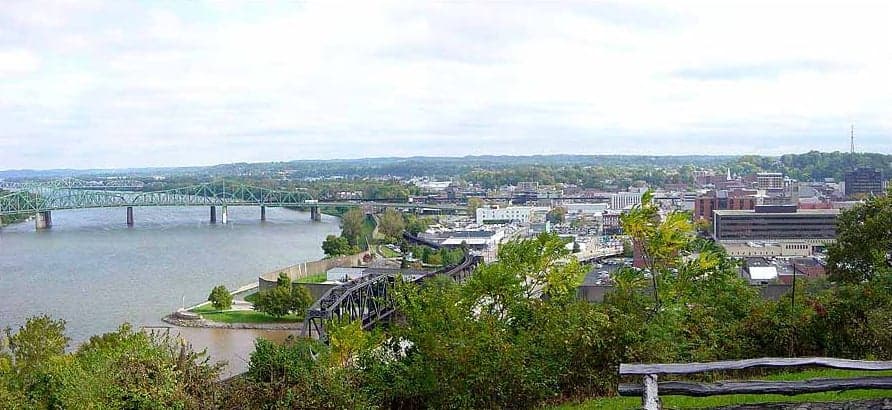
Photo: Wikipedia
Personal Sovereignty in Parkersburg, WV
Strong independent fundamentals that actively favor personal liberty and low regulation.
What does Personal Sovereignty tell us?
Personal Sovereignty measures your capacity for self-reliance and independence with minimal government friction. Higher scores mean fewer barriers between you and the way you want to live... but it assumes you have the space you need and good neighbors.
What does this tell us?
Personal Sovereignty measures your capacity for self-reliance and independence with minimal government friction. Higher scores mean fewer barriers between you and the way you want to live... but it assumes you have the space you need and good neighbors.
State Policy
Energy independence: Net exporter (200% of energy produced in-state)
Personal Liberty
Homesteading

Personal Liberty Analysis
Parkersburg, West Virginia, offers a notably high degree of personal sovereignty compared to most of the United States, functioning as a practical stronghold for those prioritizing autonomy over government convenience. The city sits in a state that consistently ranks among the most libertarian-leaning in the nation on issues of gun rights, property freedom, and tax burden, while the local culture in the Mid-Ohio Valley reinforces a live-and-let-live ethos. For a single individual or parent operating from a survivalist or prepper mindset, the key question isn't whether the government will leave you alone—it's whether you have the resources and will to take advantage of the space you're given. The answer here is largely yes, though with specific caveats around local zoning and economic realities that require strategic navigation.
Tax burden and regulatory posture: how much the state takes and demands
West Virginia's tax structure is a mixed bag that tilts favorably for those who plan ahead. There is no state income tax on Social Security benefits, and the state's personal income tax rates are being phased down—currently topping out at around 4.82% for 2025, with a goal of elimination over time. Property taxes in Wood County, where Parkersburg sits, are among the lowest in the nation: the effective rate hovers around 0.55% of assessed value, meaning a $150,000 home carries an annual tax bill of roughly $825. This is a fraction of what you'd pay in neighboring Ohio or Pennsylvania. Sales tax is a manageable 6.5% (6% state plus 0.5% county), with groceries and prescription drugs fully exempt. The regulatory posture is similarly light. West Virginia is a right-to-work state with minimal business licensing hurdles, and there is no state-level environmental review requirement for most residential construction. For a prepper, this means fewer layers of bureaucracy when building a root cellar, installing a backup generator, or adding a workshop. The trade-off is that local services—road maintenance, snow removal, and code enforcement—are correspondingly thin. You are expected to handle more yourself, which aligns with a self-reliant mindset but requires realistic planning for winter storms and rural infrastructure.
Self-defense and gun law specifics: what you can carry and where
West Virginia is a constitutional carry state, meaning no permit is required to carry a concealed firearm for anyone legally allowed to possess one. Parkersburg's local ordinances do not add restrictions beyond state law, so the city's streets, parks, and businesses (unless posted) are open for lawful carry. The state preempts all local gun regulations, so city council cannot ban magazines, restrict carry in municipal buildings, or impose waiting periods. Stand-your-ground law is fully in effect, with no duty to retreat in any place you are lawfully present. For parents, this extends to vehicle carry: firearms can be stored in a locked glove box or console without a permit, even on school parking lots, as long as they are not carried onto school grounds themselves. The state also has a robust castle doctrine that covers occupied vehicles and places of business. Magazine capacity, barrel length, and suppressor ownership are all unregulated at the state level, subject only to federal law. For a survivalist, this means you can build your defensive arsenal without worrying about state-level bans shifting with the political winds. The nearest gun-friendly ranges and training facilities are within a 20-minute drive, and the local sheriff's office in Wood County is known for issuing permits quickly for those who still want reciprocity with other states.
Self-reliance and homesteading viability: lot sizes, zoning, and off-grid feasibility
Parkersburg itself is an older industrial city with a mix of small lots in the urban core and larger parcels on the outskirts. Inside city limits, standard residential lots range from 0.1 to 0.25 acres, and zoning is relatively permissive for backyard gardens, chicken coops, and small livestock like rabbits or goats—though pigs and cattle are typically restricted. The real opportunity lies in the unincorporated areas of Wood County, where minimum lot sizes for rural residential zoning are often 1 to 3 acres, and many properties come with existing wells and septic systems. Off-grid feasibility is high: West Virginia has no state law prohibiting rainwater collection, solar panel installation, or composting toilets, though you must meet basic septic and well permitting standards. The county health department requires a percolation test for new septic systems, but this is a straightforward process. For a prepper looking to establish a retreat, properties in the surrounding hills—within a 15-minute drive of Parkersburg—can be found for $3,000 to $8,000 per acre, with many parcels having timber, spring water, and road access. The biggest practical limitation is the local job market, which is dominated by healthcare, manufacturing, and retail; remote work or a side business is often necessary to sustain a homesteading lifestyle. Internet access is decent in town but spotty in the deeper rural areas, so satellite or Starlink is a common backup.
Personal liberties: parental rights, medical autonomy, speech, and property
West Virginia has strong statutory protections for parental rights, including a law that requires schools to obtain parental consent before administering any medical or mental health services to minors, and a Parents' Bill of Rights that gives parents access to all instructional materials and the ability to opt their children out of any curriculum they find objectionable. Homeschooling is straightforward: you file a one-time notice with the county superintendent and provide an annual assessment, with no required curriculum approval or home visits. Medical autonomy is more complicated. The state has not expanded Medicaid under the Affordable Care Act in a way that creates a large government healthcare footprint, but it also has not passed any broad medical freedom legislation beyond vaccine exemptions for school attendance (religious and medical exemptions are allowed, but philosophical exemptions are not). Property rights are robust: there is no state-level property tax on business inventory or equipment, and the state's eminent domain laws are among the most restrictive in the country, requiring a clear public use and full market-value compensation. Speech is fully protected under the state constitution, which explicitly guarantees the right to assemble and petition the government. Parkersburg's local government is small and accessible—city council meetings are sparsely attended, and zoning variances can often be obtained with a single hearing. For a conservative concerned about government overreach, the practical reality is that the state and local governments simply lack the resources and inclination to micromanage daily life.
Overall, Parkersburg ranks as a strong contender for personal sovereignty when measured against the national landscape. It is not a libertarian utopia—the state still has income tax, some permitting requirements, and a healthcare system that is not fully deregulated—but it offers a combination of low taxes, permissive gun laws, minimal zoning friction, and strong parental rights that is increasingly rare in the United States. For a single individual or parent operating from a survivalist perspective, the area provides the legal and practical space to build a self-reliant life, provided you are willing to accept the trade-offs of a slower economy and a hands-off local government. Compared to the regulatory density of the Northeast or the West Coast, or even the creeping restrictions in parts of the Midwest, Parkersburg remains a place where the default answer from the government is "yes, unless there's a clear problem." That is a valuable commodity in 2026.

* Values derived from national, state, county, city and local statistics and may differ in a specific area. Last updated: 2026-05-02T07:01:07.000Z
Narrative content on this page is AI-generated and may contain mistakes. Verify any details that matter before acting on them.
ReloMaps may earn a commission from affiliate links at no extra cost to you.

