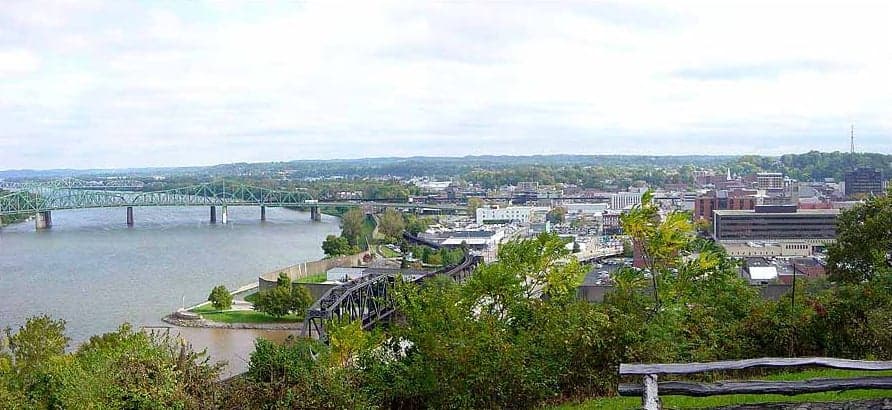
Photo: Wikipedia
Political ClimatePolitical Climate in Parkersburg, WV
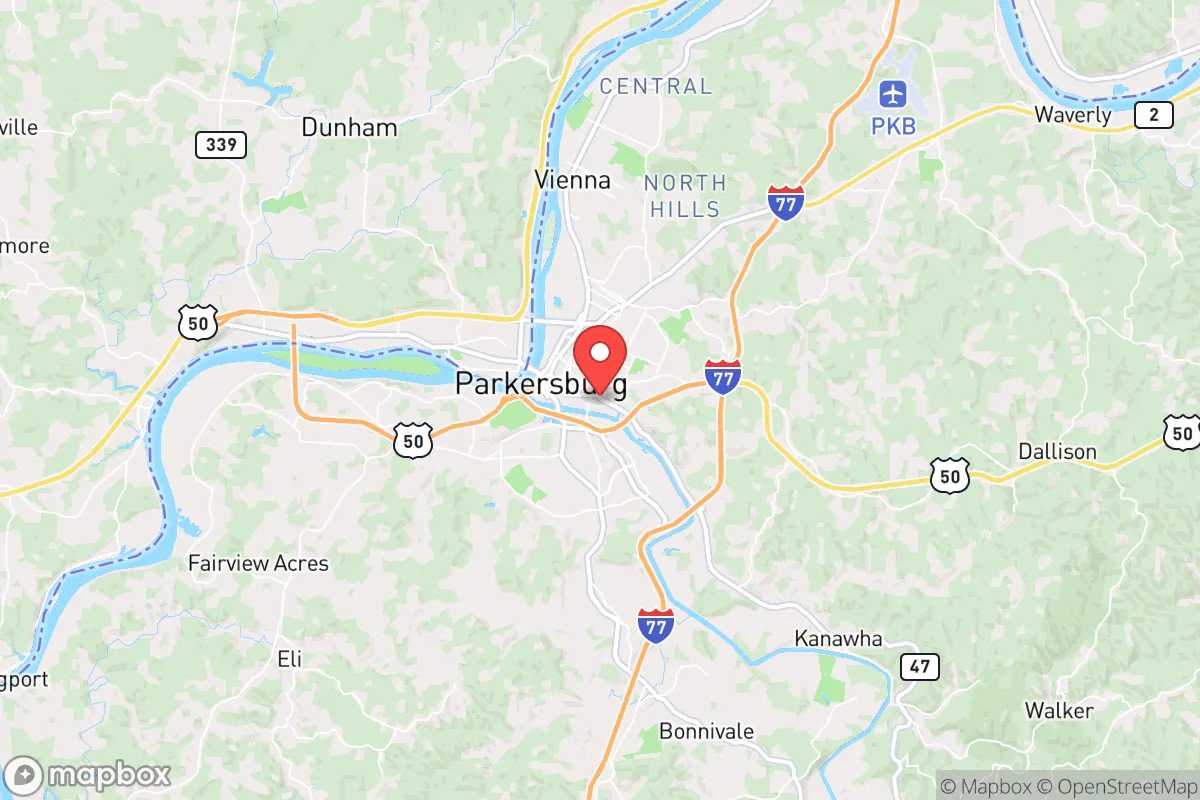
District shown is the primary district for this city’s centroid. Cities may span multiple districts.
Local Political AnalysisPolitical Analysis of Parkersburg, WV
Parkersburg is about as solidly red as they come in West Virginia, and that's been the case for as long as anyone around here can remember. The Cook PVI of R+20 isn't just a number—it's a reflection of a community that values personal responsibility, local control, and a government that stays out of your business. You'll find folks here who remember when the oil and gas boom was the backbone of the region, and they've got a healthy skepticism of any politician who talks about "transforming" the way we live. The trajectory hasn't budged much, and honestly, it's not likely to, because the people here have seen what happens when outside interests try to push progressive policies on a place that just wants to be left alone to work and raise families.
How it compares
Drive thirty minutes south to Charleston, and you'll feel a different political vibe—it's more of a mixed bag, with a stronger Democratic presence in the city proper, though the surrounding counties still lean red. Head north toward Marietta, Ohio, just across the river, and you'll find a similar conservative streak, but Ohio's been shifting a bit more purple in recent years, especially in the suburbs. Parkersburg, though, is the anchor of the conservative corridor in the Mid-Ohio Valley. Places like Vienna and Williamstown are cut from the same cloth, but you won't find the same level of progressive activism you might see in Morgantown or even parts of Huntington. The contrast is stark: in Parkersburg, the talk at the diner is about property taxes, Second Amendment rights, and the cost of living—not about climate pledges or diversity initiatives. That's not an accident; it's a choice the community has made, and it's held firm for decades.
What this means for residents
For the people living here, the political climate translates into a pretty straightforward daily life. You're not going to see a lot of government overreach into how you run your household or your small business. The local school board fights are usually about curriculum and parental rights, not about pushing ideological agendas. Property taxes are relatively low compared to the national average, and there's a general sense that if you work hard, you can keep what you earn. The downside? Some folks worry that as the state's population ages and younger people move away, the political balance could shift if new residents bring different values. But for now, the conservative majority means that policies around gun rights, energy production, and local zoning stay grounded in common sense and personal freedom. You won't find a city council trying to ban gas stoves or impose strict mask mandates here—that kind of thing gets shut down fast.
One thing that sets Parkersburg apart is its cultural resistance to the kind of top-down changes you see in bigger cities. There's a strong sense of community self-reliance, and the local churches and civic groups are still the backbone of social life. You won't hear much talk about "systemic change" or "equity audits" at the county commission meetings—it's more about potholes, water lines, and keeping the local economy humming. That said, there's a quiet concern among long-time residents that if the state legislature ever goes too far in either direction—say, by imposing statewide mandates that ignore local preferences—it could erode the trust that keeps this place stable. For now, though, Parkersburg remains a place where the political climate matches the lifestyle: conservative, practical, and fiercely independent.

State Political ClimatePolitical Climate in West Virginia
State Political AnalysisPolitical Environment in the State
West Virginia has long been one of the most reliably Republican states in the nation, with a partisan lean of roughly +39 points for the GOP in the 2024 presidential election, making it the reddest state in the country by that measure. The dominant coalition is a mix of rural, working-class voters who have shifted hard right over the past two decades, driven by cultural conservatism, energy policy, and a deep distrust of federal authority. The trajectory has been a steady march rightward since the early 2000s, when the state was still a swing state—Al Gore won it in 2000, but by 2024, Donald Trump carried it by nearly 40 points. This transformation is rooted in the collapse of the Democratic Party’s old labor-union base and the rise of a populist, anti-establishment GOP that now controls every lever of state government.
Urban vs. rural divide
The political map of West Virginia is starkly divided between a few small urban centers and the vast rural expanse. The state’s only true metro area, Charleston, leans Democratic but is shrinking—Kanawha County voted for Trump by about 15 points in 2024, down from a 20-point margin in 2020, reflecting a slow but real shift even in the capital. Morgantown, home to West Virginia University, is the most liberal pocket in the state, with Monongalia County voting for Kamala Harris by a narrow margin in 2024, driven by the academic and younger demographic. Huntington and Wheeling are more mixed but trending red, with Cabell and Ohio counties now solidly Republican. The real story is the rural counties: Mingo, Logan, and McDowell in the southern coalfields vote GOP by 60-70 points, while the eastern panhandle counties like Berkeley and Jefferson are more competitive due to commuter spillover from the D.C. suburbs, but still lean Republican. The divide is less about urban vs. rural in the traditional sense and more about the complete absence of a Democratic stronghold outside of Morgantown and a few precincts in Charleston.
Policy environment
West Virginia’s policy environment is aggressively conservative, with a focus on low taxes, deregulation, and cultural traditionalism. The state has no personal income tax on Social Security benefits and a flat 4.12% income tax rate on other income, with a goal of phasing it out entirely—the 2023 tax reform package cut rates by 21% and includes triggers for further reductions. Property taxes are among the lowest in the nation, capped by the state constitution. The regulatory posture is business-friendly, especially for energy extraction, with the state Department of Environmental Protection streamlined under Governor Jim Justice. Education policy includes a robust school choice program—the Hope Scholarship, enacted in 2021, provides up to $4,600 per student for private school or homeschooling expenses, one of the most expansive such programs in the country. Healthcare is a mixed bag: the state expanded Medicaid under the ACA, but there’s a strong push for medical freedom, with a 2023 law banning COVID-19 vaccine mandates by private employers. Election laws are strict: voter ID is required, early voting is limited to 10 days, and absentee voting requires an excuse. The state also passed a near-total abortion ban in 2022 with no exceptions for rape or incest, reflecting the dominant cultural conservatism.
Trajectory & freedom
West Virginia is becoming more free in several key areas, particularly around gun rights, parental rights, and medical autonomy. The state has constitutional carry (permitless concealed carry) since 2016, and in 2023, it passed a law prohibiting any state or local enforcement of federal gun laws that conflict with state law—a direct nullification move. Parental rights were strengthened with the 2023 "Parental Bill of Rights," which requires schools to notify parents of any changes in a child’s emotional or physical health and prohibits instruction on sexual orientation or gender identity in K-3. Medical freedom expanded with the 2023 law banning vaccine mandates and a 2024 law protecting doctors who prescribe ivermectin or hydroxychloroquine off-label. However, there are limits: the state’s near-total abortion ban restricts personal medical choice, and property rights are complicated by the state’s history of surface mining and eminent domain for pipelines. Taxation is trending downward, but the state still has a sales tax of 6% and high gas taxes. Overall, the trajectory is toward greater personal liberty in the cultural and medical spheres, with a corresponding tightening of restrictions on abortion and transgender issues.
Civil unrest & political movements
West Virginia has a history of labor unrest, but modern political movements are dominated by the right. The 2018 teachers’ strike was a rare flashpoint of left-leaning activism, with 20,000 educators walking out over pay and benefits—it was successful in winning a 5% raise, but the political aftermath saw the GOP consolidate power further. The state has no sanctuary cities and is aggressively anti-illegal immigration, with a 2024 law requiring local law enforcement to cooperate with ICE. Election integrity controversies have been minimal, but the state passed a 2021 law banning ballot drop boxes and limiting mail-in voting. There’s a strong secessionist undercurrent in the eastern panhandle, where some residents have floated joining Virginia or forming a new state, driven by frustration with the state’s poverty and lack of representation. The most visible flashpoint for a new resident would be the culture war around schools—school board meetings in Berkeley County and Jefferson County have seen heated debates over library books and transgender policies. Protests are rare and small, usually centered on abortion rights or environmental issues, but they don’t disrupt daily life.
Projection
Over the next 5-10 years, West Virginia will likely become even more Republican and more culturally conservative, driven by out-migration of younger, more liberal residents and in-migration of retirees and remote workers seeking low taxes and rural living. The eastern panhandle will continue to grow, bringing more moderate voters from the D.C. area, but they’ll be offset by the aging and shrinking population in the southern coalfields. The state’s tax reform trajectory suggests the income tax could be fully eliminated by 2030, making it even more attractive for conservative families. However, the demographic headwinds are real: the state lost 3.2% of its population between 2010 and 2020, and the median age is 42.7, one of the highest in the nation. This means the political landscape will be dominated by older, white, rural voters who are deeply skeptical of federal power and cultural change. A new resident moving in now should expect a state that is doubling down on its conservative identity, with no serious challenge to GOP dominance on the horizon.
For a conservative-leaning individual or family, West Virginia offers a policy environment that aligns closely with traditional values: low taxes, strong gun rights, school choice, and a government that actively pushes back against federal overreach. The trade-offs are a struggling economy, limited job opportunities outside of energy and healthcare, and a population that is aging and shrinking. If you’re looking for a place where your vote counts overwhelmingly for conservative candidates and where cultural battles are being won at the state level, West Virginia is a strong choice. Just be prepared for a slower pace of life, fewer amenities, and a political monoculture that can feel insular. It’s a state that rewards those who value freedom over convenience, but it’s not for everyone.
* Values derived from national, state, county, city and local statistics and may differ in a specific area. Last updated: 2026-05-02T07:01:07.000Z
Narrative content on this page is AI-generated and may contain mistakes. Verify any details that matter before acting on them.
ReloMaps may earn a commission from affiliate links at no extra cost to you.

