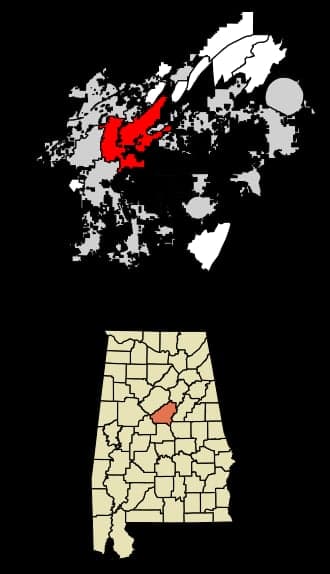
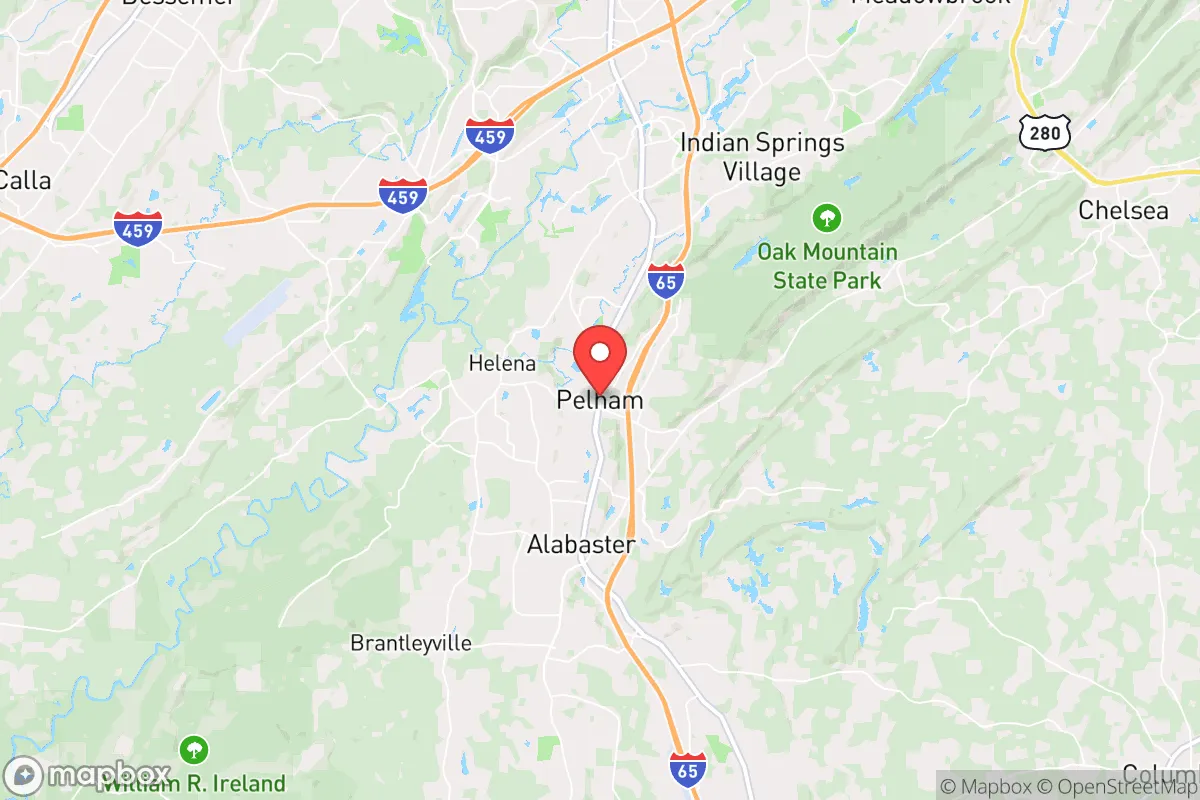
Photo: Wikipedia
Political ClimatePolitical Climate in Pelham, AL
District shown is the primary district for this city’s centroid. Cities may span multiple districts.
Local Political AnalysisPolitical Analysis of Pelham, AL
Pelham, Alabama, sits squarely in one of the most reliably conservative corners of the state, with a Cook PVI of R+20 that tells you exactly where the political gravity sits. This isn't a purple suburb hedging its bets; it's a place where Republican candidates routinely carry the vote by double digits, and the local culture reflects that stability. Over the past decade, the trajectory has held steady, though you can feel a subtle tension as Birmingham's metro area creeps southward, bringing with it some of the more progressive leanings you see in places like Homewood or Mountain Brook. For now, Pelham remains a stronghold of traditional values, but keeping an eye on those shifting demographics is wise if you value the way things have always been done around here.
How it compares
Drive ten minutes north into Hoover, and you'll find a more mixed political landscape—still conservative overall, but with pockets of blue that show up in local school board races and city council votes. Head east to Chelsea or west to Alabaster, and you're back in familiar R+20 territory, where the politics feel like a natural extension of Pelham's own. The real contrast comes when you cross into Jefferson County proper, where Birmingham's urban machine pushes a very different agenda on taxes, zoning, and public safety. Pelham's Shelby County location insulates it from a lot of that, but the county line is porous, and you'll see progressive ideas about land use and "equity" initiatives trying to creep into municipal discussions. The neighboring town of Helena has managed to keep a similar conservative bent, but it's worth noting that even there, you'll hear chatter about "diversity, equity, and inclusion" training for city staff—something that would have been unthinkable a decade ago.
What this means for residents
For the average Pelham family, the political climate translates into lower taxes, fewer regulations on property use, and a school system that hasn't been hijacked by ideological experiments. The city council and mayor's office have historically kept government out of your backyard—literally, when it comes to zoning disputes and business licensing. That's a breath of fresh air compared to what you see in states like California or even parts of the Northeast, where local governments feel entitled to micromanage everything from your lawn to your home-based business. The downside is that complacency can set in. If you're not paying attention, a progressive slate can slip into a city council race during a low-turnout election, and suddenly you're looking at new ordinances that restrict short-term rentals or mandate "affordable housing" quotas that drive up costs for everyone else. The long-term outlook depends on whether enough residents stay engaged to keep the political culture from drifting toward the kind of overreach you see in more liberal suburbs.
Culturally, Pelham still feels like a place where the Second Amendment is respected, where church attendance is the norm, and where the phrase "government knows best" gets a skeptical eye. The annual Pelhamfest and the heavy presence of youth sports leagues reinforce a community that values personal responsibility over state intervention. That said, there's been a noticeable uptick in out-of-state transplants who bring their voting habits with them, and some of the newer housing developments are attracting folks who don't share the local skepticism of big government. If you're considering a move here, you'll find a community that largely agrees with you on the fundamentals—but it's worth getting involved in the local civic scene early, because the political character of a place like Pelham doesn't preserve itself. It takes people who remember why we fought for local control in the first place.

State Political ClimatePolitical Climate in Alabama
State Political AnalysisPolitical Environment in the State
Alabama is a deeply conservative state, with Republicans holding every statewide elected office and supermajorities in both legislative chambers, a reality that has solidified over the past two decades. The state voted for Donald Trump by a margin of +25 points in 2024, a shift from the +14-point margin in 2012, reflecting a steady rightward drift even as the national map has tightened. This isn’t a purple state in any meaningful sense—it’s a place where conservative values on guns, taxes, and family structure are baked into the political DNA, though the flavor of that conservatism varies sharply between the booming suburbs of the I-65 corridor and the rural Black Belt.
Urban vs. rural divide
The political map breaks down along predictable lines, but with some surprising nuance. The major metros—Birmingham, Montgomery, and Mobile—are Democratic strongholds, driven by large African American populations and younger, college-educated voters. Jefferson County (Birmingham) went +15 for Biden in 2020, while Montgomery County went +28. But these cities are islands in a sea of red. The real action is in the fast-growing suburbs: Auburn and Opelika in Lee County are reliably Republican, with the university town’s professional class voting +18 for Trump. Madison, the Huntsville suburb, is a fascinating case—a tech-heavy, highly educated area that still leans Republican (+12 for Trump in 2024), but with a libertarian streak that resists social-issue crusades. The rural counties—Winston, Marshall, DeKalb—vote +40 to +50 points Republican, driven by evangelical churches and gun culture. The Black Belt counties like Greene and Lowndes are the inverse, voting +70 Democratic, but their populations are shrinking, diluting their electoral weight.
Policy environment
Alabama’s policy environment is a conservative laboratory. The state has no income tax on retirement income, a flat 2% corporate income tax rate, and a state sales tax that averages 9.2%—among the highest in the nation, but offset by low property taxes (average 0.33% of home value). The regulatory posture is light-touch: no state-level minimum wage above the federal $7.25, no universal background checks for gun purchases, and a right-to-work law that keeps unions weak. Education policy is a mixed bag: the Alabama Accountability Act allows tax credits for private school scholarships, and the state has a robust charter school law (passed in 2015), but public school funding per pupil ranks 46th nationally. Healthcare is a flashpoint—Alabama did not expand Medicaid under the ACA, leaving roughly 200,000 low-income adults in a coverage gap, a policy that conservative lawmakers defend as fiscally prudent but critics call a moral failure. Election laws are strict: voter ID is required, absentee ballot drop boxes are banned, and the state has a 10-day early voting window (no-excuse absentee is allowed). The 2021 voter suppression law (SB 1) made it a crime to distribute absentee ballot applications pre-filled with voter information, a move that drew lawsuits but survived court challenges.
Trajectory & freedom
On the freedom front, Alabama has been moving in a decidedly libertarian-conservative direction over the past five years. The 2022 permitless carry law (HB 272) allows any adult who can legally own a gun to carry it concealed without a permit—a major expansion of Second Amendment rights. The 2023 “Don’t Say Gay” law (HB 322) bans classroom instruction on sexual orientation and gender identity in K-5, a move that parental rights groups cheered but LGBTQ advocates decried. Medical autonomy took a hit with the 2019 near-total abortion ban (HB 314), which criminalizes the procedure at all stages with no exceptions for rape or incest—the most restrictive law in the nation. Property rights are strong: the state has no statewide zoning mandate, and the 2021 “Right to Farm” law (HB 246) protects agricultural operations from nuisance lawsuits. Taxation is trending downward: the 2024 tax cut package reduced the state’s grocery tax from 4% to 3% and accelerated the phase-out of the corporate franchise tax. The trajectory is clear: Alabama is doubling down on cultural conservatism and economic libertarianism, with no signs of a leftward pivot.
Civil unrest & political movements
Civil unrest in Alabama is sporadic but real. The 2020 George Floyd protests in Birmingham and Montgomery saw property damage and clashes with police, but the state’s conservative majority largely dismissed the movement as outside agitators. The “Stop the Steal” movement had a strong presence in 2020-2021, with rallies at the state capitol in Montgomery and a brief occupation of the rotunda. Immigration politics are heated but low-scale: the 2011 HB 56 law, once the nation’s strictest, was largely gutted by courts, but the state still has a cooperative agreement with ICE (287g) in several counties. There’s no sanctuary city movement—every major metro, including Birmingham and Huntsville, has declined to adopt such policies. Election integrity remains a live issue: the 2022 “election integrity” law (SB 1) tightened absentee ballot rules, and the state’s Republican Secretary of State, Wes Allen, has pushed for a voter roll purge of non-citizens. The most visible flashpoint for a new resident would be the Confederate monument debates—Mobile removed its statue in 2020, while Montgomery’s remains, a constant source of low-grade tension.
Projection
Over the next 5-10 years, Alabama will likely become more conservative, not less. In-migration is driving growth in the Huntsville metro (Madison County grew 12% from 2020-2024), bringing in defense contractors and tech workers who are culturally conservative but fiscally moderate—a demographic that tends to reinforce Republican dominance. The Black Belt’s population decline will continue to erode Democratic votes, while the Birmingham suburbs (Shelby County) are filling up with families fleeing the city’s crime and taxes. The state’s political leadership is aging—Governor Kay Ivey is 80—but the next generation of Republicans (Attorney General Steve Marshall, Lt. Gov. Will Ainsworth) is even more conservative. Expect further tax cuts, a push for school choice expansion, and continued resistance to federal mandates on climate and healthcare. The wild card is the 2025 redistricting fight: a federal court ordered Alabama to draw a second majority-Black congressional district, which could flip one seat to Democrats, but the state’s legislative and statewide offices will remain safely red.
For a new resident, the bottom line is this: Alabama offers a low-tax, low-regulation environment where conservative values are the default, not something you have to fight for. You’ll find strong gun rights, parental control over education, and a government that mostly stays out of your business—unless you’re in the abortion debate, where the state is deeply interventionist. The trade-offs are real: weak public schools outside the suburbs, a healthcare system with gaps, and a political culture that can feel insular. But if you’re looking for a place where the culture wars are largely settled in your favor, and where your tax dollars aren’t funding progressive experiments, Alabama is a solid bet. Just know that the freedom you get is the freedom to live by the community’s rules—and those rules are set by the church pew, not the city council.
* Values derived from national, state, county, city and local statistics and may differ in a specific area. Last updated: 2026-04-19T19:04:42.000Z
Narrative content on this page is AI-generated and may contain mistakes. Verify any details that matter before acting on them.
ReloMaps may earn a commission from affiliate links at no extra cost to you.

