Photo: Wikipedia
Demographics of Bucks County
Affluence Level in Bucks County
An upper-middle-class area. Household wealth, education levels, and homeownership run ahead of national benchmarks.
People of Bucks County
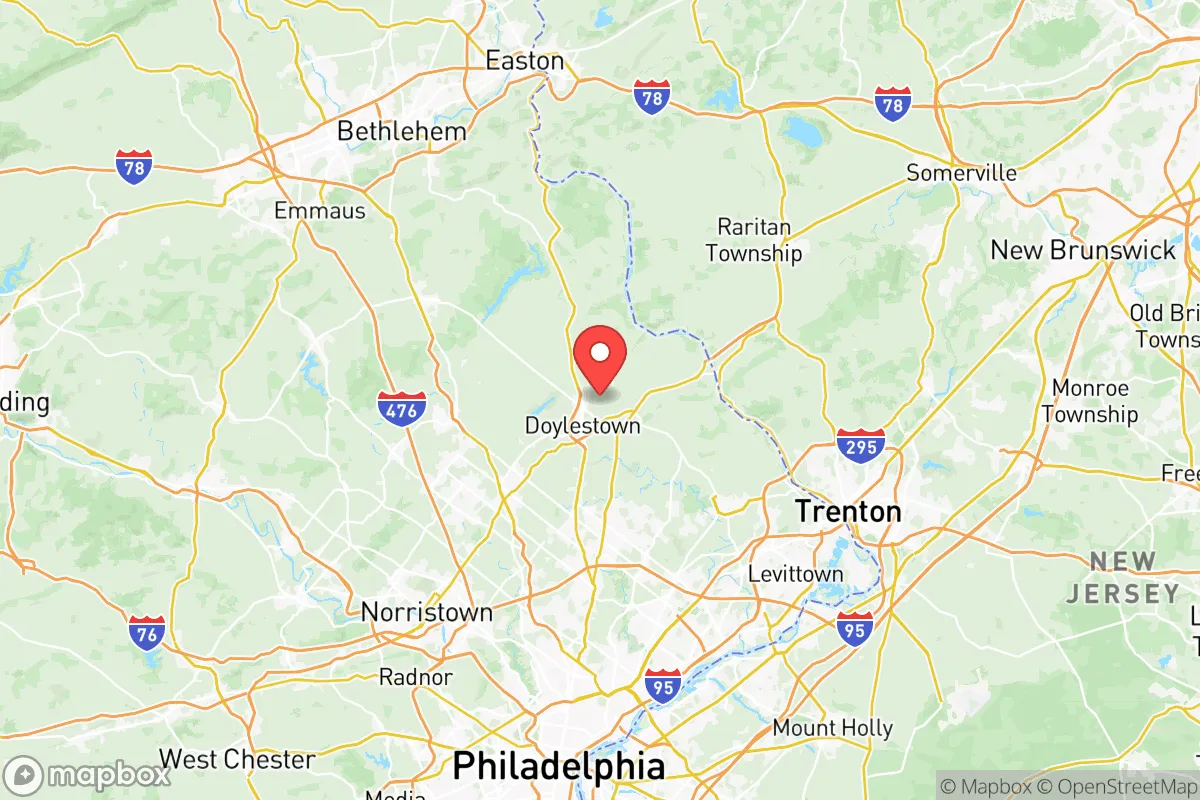
Today, the people of Bucks County, Pennsylvania, form a predominantly white (80.8%), highly educated (43.9% college-educated) population of 645,993 that blends historic small-town character with suburban growth. The county’s identity is rooted in its role as a cradle of American independence, yet its modern residents are increasingly diverse, with growing Hispanic (6.3%), Indian-subcontinent (2.9%), Black (3.6%), and East/Southeast Asian (2.0%) communities. Despite its proximity to Philadelphia, Bucks County retains a distinctly suburban, family-oriented feel, with a foreign-born population of just 3.5%—lower than the national average—and a political landscape that has shifted from reliably Republican to a competitive battleground.
Settlement & growth (pre-1960)
Long before European arrival, the region was home to the Lenape people, whose villages dotted the Delaware River. The first European settlers were Dutch and Swedish traders in the early 1600s, but the county’s lasting character was forged by William Penn’s English Quakers, who arrived after 1681. Penn’s promise of religious tolerance and fertile land drew a steady stream of English, Welsh, and German settlers. By the 1720s, German farmers—many from the Palatinate—established thriving agricultural communities in Bedminster and Hilltown townships, where their descendants still live today. The Welsh Tract, centered around Lower Gwynedd and extending into what is now Montgomery County, attracted Welsh Quakers who left a lasting place-name legacy.
The American Revolution cemented Bucks County’s place in history. In December 1776, George Washington’s famous crossing of the Delaware River launched from the county’s shores near Washington Crossing, a village that remains a historic landmark. During the war, the county served as a supply hub and refuge for the Continental Army. After independence, the population grew slowly but steadily, driven by agriculture and milling along the Delaware and its tributaries. The 1830s brought the Delaware Canal, linking Bristol to Easton and spurring industrial growth in towns like Bristol and Morrisville, where ironworks and textile mills attracted Irish and later Italian immigrants.
The late 19th and early 20th centuries saw waves of Eastern and Southern European immigrants. Poles and Hungarians settled in the industrial river towns of Bristol, Morrisville, and Tullytown, working in the booming steel and chemical plants. Italians arrived in the same period, establishing enclaves in Bristol Borough and Doylestown. The Great Migration of African Americans from the South brought Black families to Bucks County’s industrial centers, particularly Bristol and Levittown, from the 1940s onward. The single most transformative event for the county’s population was the construction of Levittown, the iconic post-World War II planned suburb, beginning in 1951. This massive development of affordable single-family homes drew tens of thousands of white, middle-class families—many from Philadelphia and other Northeastern cities—transforming Bucks County from a rural-agricultural area into a suburban powerhouse. By 1960, the county’s population had surged to over 300,000, and its character had shifted decisively toward suburban commuter life.
Modern era (post-1965)
The 1965 Hart-Cellar Act opened the door to new immigration, but Bucks County’s foreign-born population remains modest at 3.5%—far below the national average. The most notable post-1965 change has been the growth of the Indian-subcontinent community, which now stands at 2.9% of the population. This group, largely professionals in technology, healthcare, and academia, has concentrated in the county’s more affluent central and northern townships, including Newtown, Yardley, and Doylestown. These areas offer strong school systems and proximity to major employers like Johnson & Johnson in Newtown and the pharmaceutical corridor along Route 202.
Hispanic residents, now 6.3% of the population, have grown steadily since the 1990s, driven by both domestic migration from other U.S. regions and immigration from Mexico, Puerto Rico, and Central America. The largest Hispanic enclaves are in the county’s older industrial towns: Bristol Borough, Morrisville, and Bensalem Township, where lower housing costs and established community networks have attracted families. East/Southeast Asian residents (2.0%) include Chinese, Korean, and Vietnamese families, with notable concentrations in Upper Makefield and Newtown townships, drawn by the same school-quality and employment factors as the Indian community. The Black population (3.6%) remains concentrated in the county’s southeastern towns, particularly Bristol, Levittown, and Bensalem, where historic industrial employment and more affordable housing persist.
Domestic migration has reshaped the county as well. Since the 1980s, Bucks County has attracted families and retirees from New Jersey and New York, seeking lower taxes and more space. This “coastal flight” has been particularly strong in the county’s northern and central townships—places like Buckingham, Solebury, and Tinicum—where large-lot zoning and preserved farmland maintain a semi-rural character. At the same time, the county’s southeastern corner, including Bensalem and Bristol, has seen significant redevelopment of former industrial sites into mixed-use communities, attracting younger professionals priced out of Philadelphia. The county’s political shift from solidly Republican to a swing county reflects these demographic changes, with the growing diversity and educational attainment of its population pushing it toward the center.
The future
Bucks County is becoming more diverse, but slowly. The white share of the population has declined from over 90% in 1990 to 80.8% today, and this trend is expected to continue. The Indian-subcontinent and Hispanic communities are the fastest-growing groups, driven by both immigration and higher birth rates. Newtown, Yardley, and Doylestown will likely see continued growth in Indian and East/Southeast Asian populations, while Bristol and Bensalem will remain the primary destinations for Hispanic and Black families. The county’s overall population is projected to grow modestly, reaching roughly 670,000 by 2035, as development continues in the central and northern townships.
The cultural identity of Bucks County is evolving from its historic image as a white, Protestant, Republican stronghold to a more pluralistic, politically competitive suburb. The preservation of open space and historic districts—a priority for decades—will continue to shape where new residents settle, pushing development into designated growth areas rather than sprawling across the countryside. The county’s excellent school systems and proximity to Philadelphia and New York will remain its primary draws, but rising housing costs may eventually slow in-migration from coastal areas.
For someone moving in now, Bucks County offers a stable, family-oriented environment with strong schools and a growing diversity that is still modest by national standards. The county is becoming more varied in its population and politics, but it retains a distinctly suburban, small-town feel that appeals to those seeking a quieter alternative to the Philadelphia or New York metro areas. The future will likely see a continued blending of old and new—historic farmhouses alongside new subdivisions, long-established families alongside recent immigrants—as Bucks County slowly transforms from a predominantly white, conservative suburb into a more diverse, politically balanced community.

* Values derived from national, state, county, city and local statistics and may differ in a specific area. Last updated: 2026-08-14T08:27:42.000Z
Narrative content on this page is AI-generated and may contain mistakes. Verify any details that matter before acting on them.
ReloMaps may earn a commission from affiliate links at no extra cost to you.

