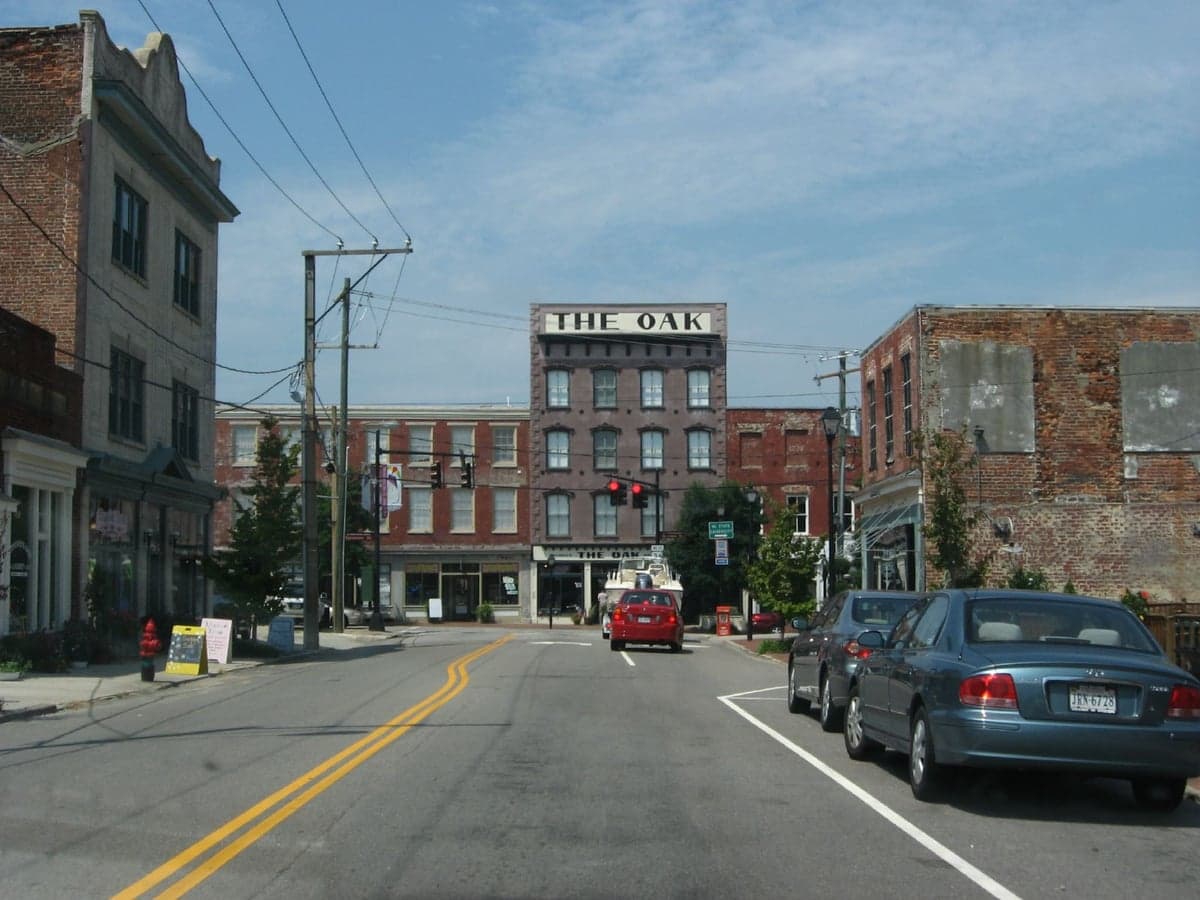
Photo: Wikipedia
Personal Sovereignty in Petersburg, VA
Viable for self-reliance. Generally workable, though some barriers may limit total independence.
What does Personal Sovereignty tell us?
Personal Sovereignty measures your capacity for self-reliance and independence with minimal government friction. Higher scores mean fewer barriers between you and the way you want to live... but it assumes you have the space you need and good neighbors.
What does this tell us?
Personal Sovereignty measures your capacity for self-reliance and independence with minimal government friction. Higher scores mean fewer barriers between you and the way you want to live... but it assumes you have the space you need and good neighbors.
State Policy
Energy independence: Importer (20% of energy produced in-state)
Personal Liberty
Homesteading

Personal Liberty Analysis
Petersburg, Virginia, presents a mixed picture for those prioritizing personal sovereignty, where the city's own local governance trends clash with the broader, more restrictive policies of the Commonwealth. While the state-level environment in Virginia has shifted significantly toward centralized control in recent years, Petersburg's specific economic and demographic realities create a unique, if constrained, space for self-reliance. For the survivalist or prepper, the key takeaway is that Petersburg offers affordability and a strategic location, but demands constant vigilance against both city hall and Richmond's expanding regulatory reach.
Tax burden and regulatory posture in Petersburg and Virginia
Virginia is not a low-tax haven, and Petersburg sits within a state that has increasingly embraced a high-service, high-regulation model. The state income tax is a flat 5.75% on all income over $17,000, which hits middle-class earners harder than a progressive system might. Sales tax in Petersburg is 6.3% (5.3% state plus 1% local option), which is moderate but not negligible. The real burden for property owners comes from the city's real estate tax rate, which at $1.30 per $100 of assessed value is among the highest in the region. This directly impacts the ability to hold land for long-term self-sufficiency. On the regulatory front, Virginia has moved aggressively on environmental and land-use controls, including the 2021 Virginia Clean Economy Act, which effectively mandates a transition away from natural gas and imposes costly energy standards on new construction and major renovations. For a prepper, this means any off-grid or alternative energy setup must navigate a thicket of state permits and local building codes that are not friendly to "do-it-yourself" infrastructure. The state's Department of Environmental Quality (DEQ) has broad authority over water rights and septic systems, making independent water sourcing a bureaucratic challenge. Petersburg's own zoning code is typical of an older urban core, with strict separation of uses that can complicate keeping livestock or running a home-based manufacturing operation without explicit variances.
Self-defense and gun law specifics in Petersburg and Virginia
This is the most volatile area for personal sovereignty in Petersburg. While Virginia was once a shall-issue state for concealed carry, the 2020 legislative session under a Democrat-controlled General Assembly fundamentally altered the landscape. The state now requires a background check for all firearm transfers, including private sales, effectively creating a de facto registry. The "one-handgun-a-month" law remains in effect, limiting the ability to stockpile arms. Petersburg itself is a Second Amendment Sanctuary City, having passed a resolution in 2019 declaring the city's intent to not enforce any "unconstitutional" gun laws. However, this resolution is symbolic and carries no legal weight against state preemption. The practical reality is that a Petersburg resident must comply with all state laws, including the ban on carrying firearms in certain public places like government buildings and schools. The city's violent crime rate, which is significantly higher than the national average, makes self-defense a pressing concern, but the legal tools to address it are increasingly restricted. For the prepper, the key is that while you can still own and carry (with a permit), the legal environment is hostile to the concept of an armed citizenry as a check on government overreach. The state's "red flag" law, passed in 2020, allows for the temporary seizure of firearms based on a complaint, a clear erosion of due process that any sovereignty-minded individual must factor into their planning.
Self-reliance and homesteading viability in Petersburg
Petersburg's urban core is not a homesteader's paradise, but its surrounding areas and the city's own older neighborhoods offer some surprising opportunities. The average lot size in the city is small, typically under a quarter-acre, but many properties have deep backyards that can support substantial vegetable gardens and small fruit trees. The city's zoning code does allow for "urban agriculture" including beekeeping and limited livestock (chickens are permitted with a permit, but roosters are not). Off-grid living is effectively illegal within city limits, as the city requires connection to municipal water and sewer for any habitable dwelling. This is a hard constraint for anyone seeking true independence from infrastructure. However, the real opportunity lies in the surrounding counties of Dinwiddie, Prince George, and Sussex, where land is still relatively cheap and zoning is far more permissive. A 5-10 acre parcel within a 20-minute drive of Petersburg can be had for under $100,000, and these areas generally allow for well water, septic systems, and even limited hunting. The challenge is that these counties are also subject to state-level restrictions on timber harvesting, wetland use, and pesticide application. For the prepper, the strategy is clear: live in Petersburg for the low cost of entry and proximity to jobs, but secure a rural property nearby for the actual homesteading and retreat capability. The city's location at the intersection of I-95 and I-85 is a double-edged sword—excellent for supply runs and escape routes, but also a major chokepoint that could be problematic in a grid-down scenario.
Personal liberties in Petersburg: parental rights, medical autonomy, speech, and property
On parental rights, Virginia has moved in a concerning direction. The state's Department of Education has adopted policies that allow for "gender-affirming" care without parental consent in school settings, and the 2020 law removing the requirement for schools to notify parents of a student's gender identity is a direct assault on parental authority. Petersburg Public Schools, like most districts, follows these state mandates. For medical autonomy, Virginia's vaccine mandates for school attendance remain in place, and the state's emergency powers during the pandemic were used to shut down businesses and restrict movement, a precedent that remains on the books. Property rights are under constant pressure from the state's aggressive use of eminent domain for transportation and development projects, particularly along the I-95 corridor. The city's own comprehensive plan includes provisions for "transit-oriented development" that could be used to justify taking private land for mixed-use projects. Free speech is protected under the First Amendment, but Virginia has enacted laws against "harassment" that have been used to target political protesters. The state's "bubble zone" laws around abortion clinics also restrict speech in certain public spaces. For the sovereignty-minded individual, the overall picture is one of a state that views personal autonomy as subordinate to government-defined "public health" and "social equity" goals. Petersburg, as a city with a strong African American political establishment, adds a layer of local politics that can be unpredictable for those outside the mainstream.
In the final analysis, Petersburg offers a strategic foothold in a state that is increasingly hostile to the core tenets of personal sovereignty. The low cost of living and the symbolic Second Amendment sanctuary status provide some breathing room, but the state-level tax burden, regulatory chokehold on self-reliance, and erosion of parental and medical autonomy are significant liabilities. Compared to a place like West Virginia or even rural North Carolina, Petersburg is a compromise—a place to stage from rather than to dig in. For the prepper who values affordability and location over a truly free environment, it can work, but only with a clear-eyed understanding that the fight for personal sovereignty here is a defensive one, waged against a state government that has made its priorities clear.

* Values derived from national, state, county, city and local statistics and may differ in a specific area. Last updated: 2026-05-01T07:45:45.000Z
Narrative content on this page is AI-generated and may contain mistakes. Verify any details that matter before acting on them.
ReloMaps may earn a commission from affiliate links at no extra cost to you.

