Strategic Assessment of Pine Ridge, FL
Workable tactical position. Some exposure to population density or targets, but generally defensible in a crisis.
What does the Strategic Assessment tell us?
Our Strategic Assessment grades tactical survivability of an area. Major population centers, military targets, fallout zones, natural disasters, and border exposure all drive risk — lower exposure means a more defensible position in a crisis.
This is heavily inspired by Joel Skousen's Strategic Relocation book. Highly recommended you checkout the book ($)What does this tell us?
Our Strategic Assessment grades tactical survivability of an area. Major population centers, military targets, fallout zones, natural disasters, and border exposure all drive risk — lower exposure means a more defensible position in a crisis.
This is heavily inspired by Joel Skousen's Strategic Relocation book. Highly recommended you checkout the book ($)Strategic Pillars

Key Distances
Regional Safe Places
Below is our recommended "safe zones" in Florida and the surrounding area based on our strategic heuristics. For most people, it's unrealistic to live in a “safe zone” full-time due to work, family or other personal reasons. They tend to be more rural. However, many of these areas are perfect for second homes and retreat properties that double as a vacation home or even a short-term rental.

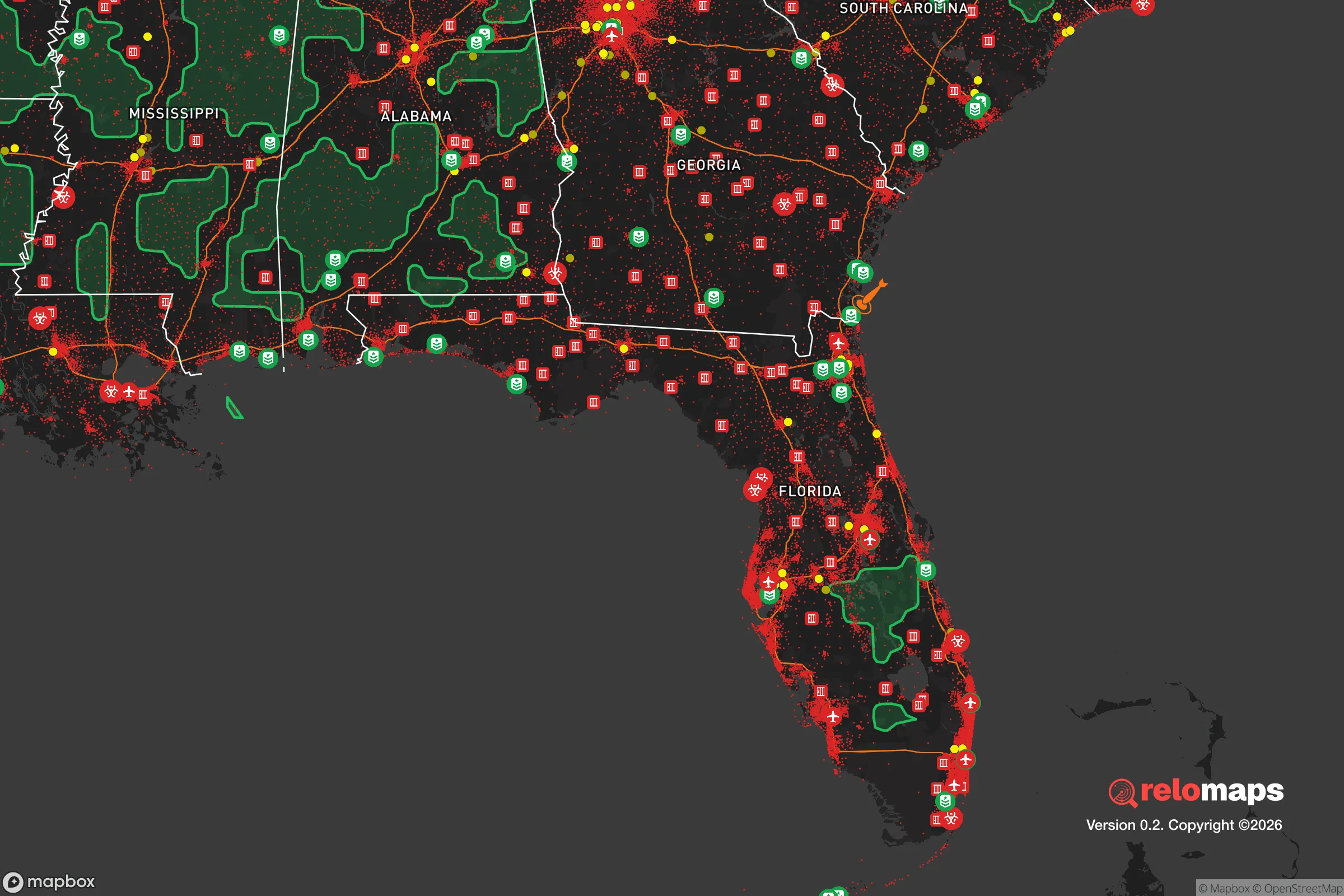


Important Note: For informational purposes only. This does not mean nothing bad ever happens in the green zones. Please use common sense. This is based on public data and modeled with AI. We tried to take a conservative approach but mistakes happen. We update this regularly as new information becomes available.
Solar Generator Recommendations
Backup power matters more here than in safer locations. We've picked three solar generators across budgets and capacity tiers — start with the budget unit if you only need a few essentials, or step up if you want to run a fridge and HVAC for days at a time.

Jackery Portable Power Station Explorer 300
Budget OptionPower on the Go: Weighing only 11 lbs, it's convenient to set up and store with book-sized foldable solar panels

BLUETTI Portable Power Station AC180
Designed for both indoor and outdoor scenarios, AC180 is highly capable as it has a robost capacity and continuous output power.

EF ECOFLOW DELTA Pro Ultra Power Station
Upgraded PickEcoFlow DELTA Pro Ultra is a whole-home energy system designed to grow with your family. Integrated with the Smart Home Panel 2, it scales to meet your evolving energy needs — keeping your home powered, intelligent, and secure through every stage of life.
We earn a commission, at no additional cost to you.
Strategic Assessment Analysis
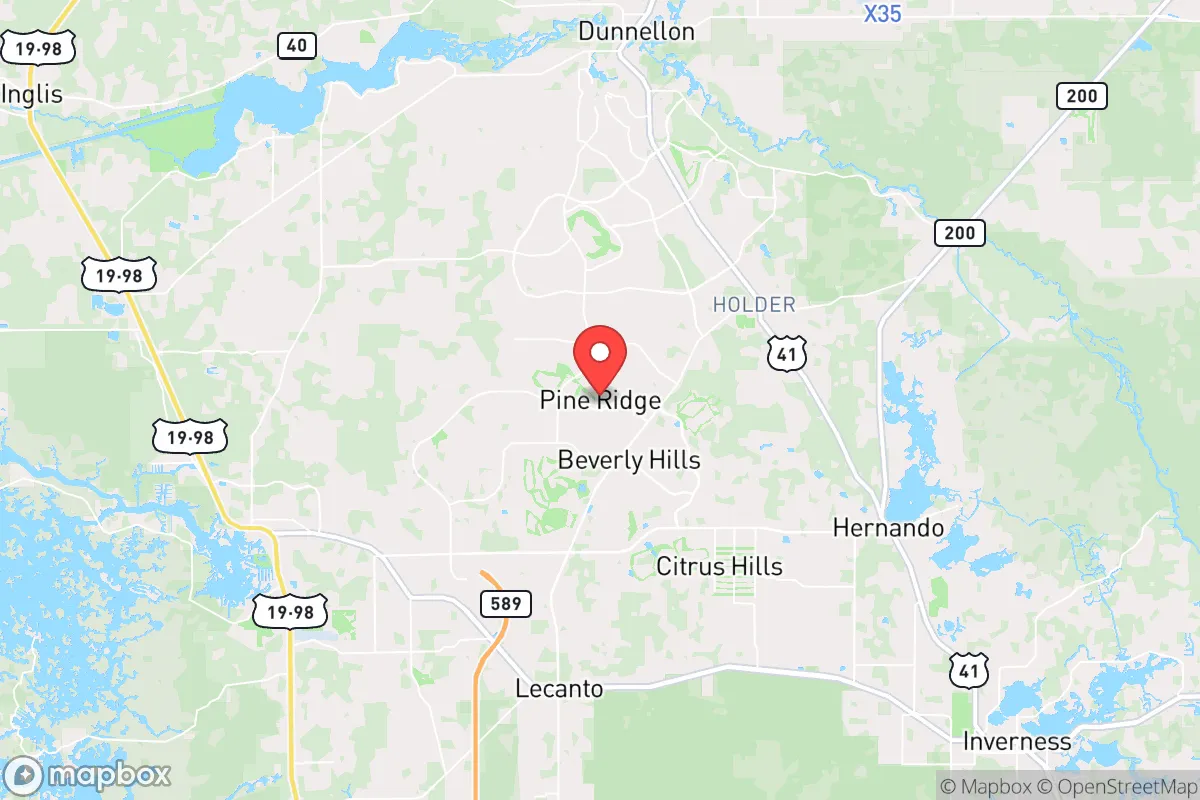
Pine Ridge, Florida, offers a surprisingly resilient position for those prioritizing strategic relocation, blending low population density with proximity to critical infrastructure without the immediate liabilities of a major metro. Located in Citrus County, this unincorporated community sits roughly 70 miles north of Tampa and 80 miles northwest of Orlando, placing it outside the blast and immediate fallout zones of those major population centers while still within a practical driving distance for supply runs or medical access. For the prepper or survivalist assessing long-term stability, Pine Ridge’s key advantage is its location on the Florida peninsula’s western spine—away from the coastal surge zones of the Gulf and the Atlantic, yet close enough to the Withlacoochee River and the Tsala Apopka Lake chain to secure a reliable freshwater source. The area’s modest population of roughly 4,500 means less competition for resources in a crisis, and its rural character provides a natural buffer against the cascading failures that would cripple dense urban centers.
Geographic position and natural advantages for long-term security
Pine Ridge sits on the Brooksville Ridge, a geological formation that provides slightly higher elevation—typically 30 to 70 feet above sea level—than much of Florida’s coastal flatlands. This elevation reduces flood risk significantly compared to nearby coastal communities like Crystal River or Homosassa, which face storm surge threats from even Category 1 hurricanes. The ridge’s sandy, well-drained soils also support private wells and septic systems, a critical factor for off-grid capability. The surrounding Citrus County landscape is dominated by the Withlacoochee State Forest and the Chassahowitzka Wildlife Management Area, offering thousands of acres of public land for hunting, foraging, and timber resources. For a relocator, this means immediate access to game like white-tailed deer, wild hogs, and turkey, plus a network of creeks and springs that remain potable with basic filtration. The region’s subtropical climate allows for year-round gardening, though the summer heat and humidity demand careful planning for food storage and water management. Importantly, Pine Ridge is far enough inland to avoid the direct hurricane landfall zone, yet close enough to State Road 44 and U.S. Highway 19 to enable evacuation if needed—a balance that few Florida locations achieve.
Risks, exposures, and proximity to fallout-relevant landmarks
No location is without vulnerabilities, and Pine Ridge has several that a strategic relocator must weigh. The most immediate risk is hurricane-related: while the ridge offers flood protection, the area still faces damaging winds from major storms tracking up the Gulf. Hurricane Hermine in 2016 and Hurricane Idalia in 2023 both caused widespread tree damage and power outages in Citrus County, with some rural areas staying dark for over a week. For a prepper, this means redundant power systems—solar with battery storage or a generator with fuel reserves—are non-negotiable. The second concern is proximity to the Crystal River Nuclear Plant, located roughly 15 miles west. While the plant is currently decommissioned and in safe storage, its spent fuel pools remain a potential target for sabotage or a cascading failure scenario. Pine Ridge sits outside the 10-mile emergency planning zone, but prevailing winds from the west could carry airborne contamination in a worst-case event. A more distant but relevant risk is MacDill Air Force Base in Tampa, a major command center for CENTCOM and SOCOM, which would be a high-value target in any conflict involving state actors. Pine Ridge is far enough to avoid direct blast effects, but the resulting refugee flow from Tampa (population 400,000+) could overwhelm local roads and resources. The area’s limited egress routes—primarily two-lane roads like County Road 486 and State Road 44—would become choke points during a mass evacuation, a factor that demands a “stay-put” mindset rather than a bug-out plan.
Practical resilience for a relocator: food, water, energy, and defensibility
For the individual or family serious about self-sufficiency, Pine Ridge offers a workable foundation with some deliberate effort. Water is the strongest asset: the Floridan Aquifer lies just 50 to 100 feet below the surface in this area, making private wells affordable and reliable. A hand pump or solar-powered well pump can provide water independent of the grid, and the numerous springs and rivers in the region offer backup sources that require only basic filtration or boiling. Food production is feasible but not effortless—the sandy soil needs amendment with compost or raised beds, and the growing season runs from February through November, allowing for two crop cycles of staples like beans, squash, and sweet potatoes. The surrounding forests support foraging for muscadine grapes, persimmons, and palmetto berries, though these are seasonal and not a primary calorie source. Livestock is common in the area, with many properties zoned for chickens, goats, or even a small cattle operation, but newcomers should budget for fencing and predator control (coyotes and bobcats are present). Energy independence is achievable: Citrus County averages 240 sunny days per year, making solar panels a viable primary or backup power source. However, the region’s frequent thunderstorms and hurricane-related cloud cover mean battery storage should be sized for at least three days of autonomy. Defensibility is moderate—the area’s low-density layout and winding dirt roads create natural obstacles for unwanted visitors, but the lack of natural barriers like mountains or rivers means a determined group could approach from multiple directions. A well-placed property with a long driveway and clear sightlines, combined with a neighborhood watch or mutual assistance group, would significantly improve security during a breakdown of civil order.
The overall strategic picture for Pine Ridge is one of calculated trade-offs. It avoids the catastrophic risks of coastal Florida—storm surge, mass refugee flows from Tampa or Orlando, and proximity to high-value military targets—while retaining access to freshwater, arable land, and a climate that supports year-round subsistence. The trade-offs are real: hurricane wind damage, a distant but non-zero nuclear storage risk, and limited road networks that could become traps during a regional crisis. For the conservative-minded relocator who values self-reliance and community over urban convenience, Pine Ridge represents a solid B+ option—not a fortress, but a defensible, resource-rich position that rewards preparation and local knowledge. The key is to arrive before the next crisis, not during it, and to invest in the infrastructure—well, solar, food storage—that turns this quiet corner of Citrus County into a genuine long-term refuge.

* Values derived from national, state, county, city and local statistics and may differ in a specific area. Last updated: 2026-05-14T02:26:57.000Z
Narrative content on this page is AI-generated and may contain mistakes. Verify any details that matter before acting on them.
ReloMaps may earn a commission from affiliate links at no extra cost to you.

