Photo: Wikipedia
Demographics of Plattsmouth, NE
Historical data isn't available for Plattsmouth, NE. Trends shown are for Cass County, NE.
Affluence Level in Plattsmouth, NE
A middle-class area roughly in line with national averages across income, home values, education, and employment.
People of Plattsmouth, NE
Plattsmouth, Nebraska, is a small, predominantly white community of 6,680 residents, characterized by its historic river-town identity and a population that is 82.9% white and 8.8% Hispanic. The city’s human history is one of early river-based settlement, a brief industrial boom, and a long period of demographic stability, with very limited foreign-born influence (1.2%) and a low college attainment rate of 26.0%. Today, Plattsmouth feels like a working-class, family-oriented enclave where generational roots run deep, and the population is slowly aging and slightly diversifying through Hispanic growth.
How the city was settled and grew
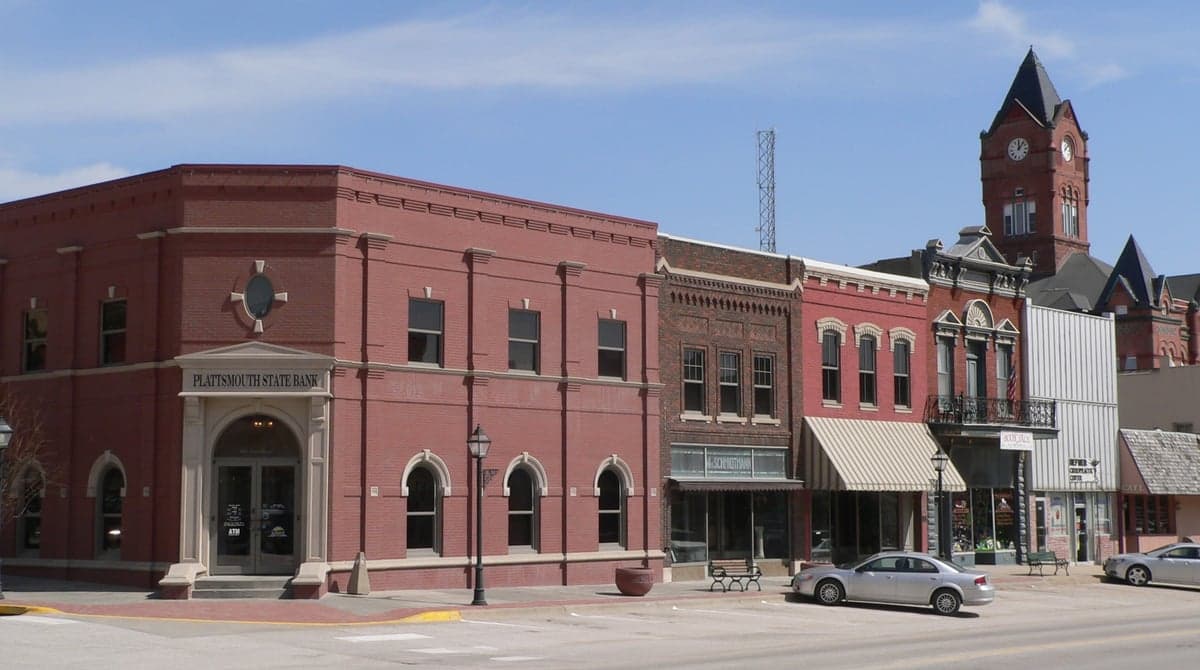
Plattsmouth’s founding population was overwhelmingly white, drawn by the Missouri River’s commercial potential and the promise of fertile farmland. The city was officially platted in 1855, and its early growth was fueled by steamboat traffic and the arrival of the railroad in the 1860s. The original settlers were predominantly German, Irish, and English immigrants who built the core of what is now the Old Town Historic District, a neighborhood of Victorian homes and brick storefronts along Main Street. By the late 19th century, a smaller wave of Czech and Polish families arrived, settling in the South Side area near the railroad tracks, where they worked in the city’s flour mills and the Plattsmouth Bridge Company. The city’s population peaked around 7,500 in the 1890s, then stabilized as the river trade declined and Omaha’s growth drew away younger residents. No major land grants or large-scale industrial recruitment occurred; the city grew organically as a county seat and agricultural service center.
Modern era (post-1965)
After the 1965 Hart-Cellar Act, Plattsmouth saw virtually no new immigration from Asia or Africa. The foreign-born population remains at just 1.2%, and the city’s East/Southeast Asian share is a negligible 0.5%, with no Indian-subcontinent population recorded. The most significant demographic shift since the 1970s has been the growth of the Hispanic population, now at 8.8%, driven by domestic migration from Texas and the Southwest for work in agriculture, meatpacking, and construction. These families have concentrated in the West Side neighborhoods near Highway 34 and in the Hillcrest subdivision, where newer, more affordable housing was built in the 1990s and 2000s. Meanwhile, the white population has aged in place, particularly in the North Park area and the historic core, where many homes date to the early 1900s. Suburbanization from Omaha has had a modest effect, with some commuters settling in the South Hills development, but Plattsmouth has not experienced the rapid exurban growth seen in nearby Gretna or Papillion.
The future
The population is heading toward slow, incremental diversification rather than rapid change. The white share is projected to decline gradually as older residents pass away and younger families move out, while the Hispanic share is likely to rise to 12-15% over the next decade, driven by higher birth rates and continued domestic migration. The East/Southeast Asian and Black populations are expected to remain below 1% each, as Plattsmouth lacks the job base or ethnic infrastructure to attract significant new immigrant groups. The city is not tribalizing into distinct enclaves; rather, Hispanic families are dispersing across the West Side and Hillcrest, while the white population remains dominant in Old Town and North Park. The college-educated share (26.0%) is below the state average, suggesting that the city will continue to attract working-class families rather than professionals or remote workers. The next 10-20 years will likely see a slightly younger, more Hispanic Plattsmouth, but the overall character—quiet, family-oriented, and politically conservative—will remain intact.
For a conservative-leaning individual or family considering a move, Plattsmouth offers a stable, low-crime, and culturally homogeneous environment with a strong sense of local history. The city is becoming slightly more diverse through Hispanic growth, but it remains overwhelmingly white and native-born, with no signs of rapid demographic upheaval. The trade-off is limited economic opportunity and a low share of college-educated neighbors, which may matter for those seeking a more dynamic or cosmopolitan setting.

* Values derived from national, state, county, city and local statistics and may differ in a specific area. Last updated: 2026-04-21T14:14:24.000Z
Narrative content on this page is AI-generated and may contain mistakes. Verify any details that matter before acting on them.
ReloMaps may earn a commission from affiliate links at no extra cost to you.

