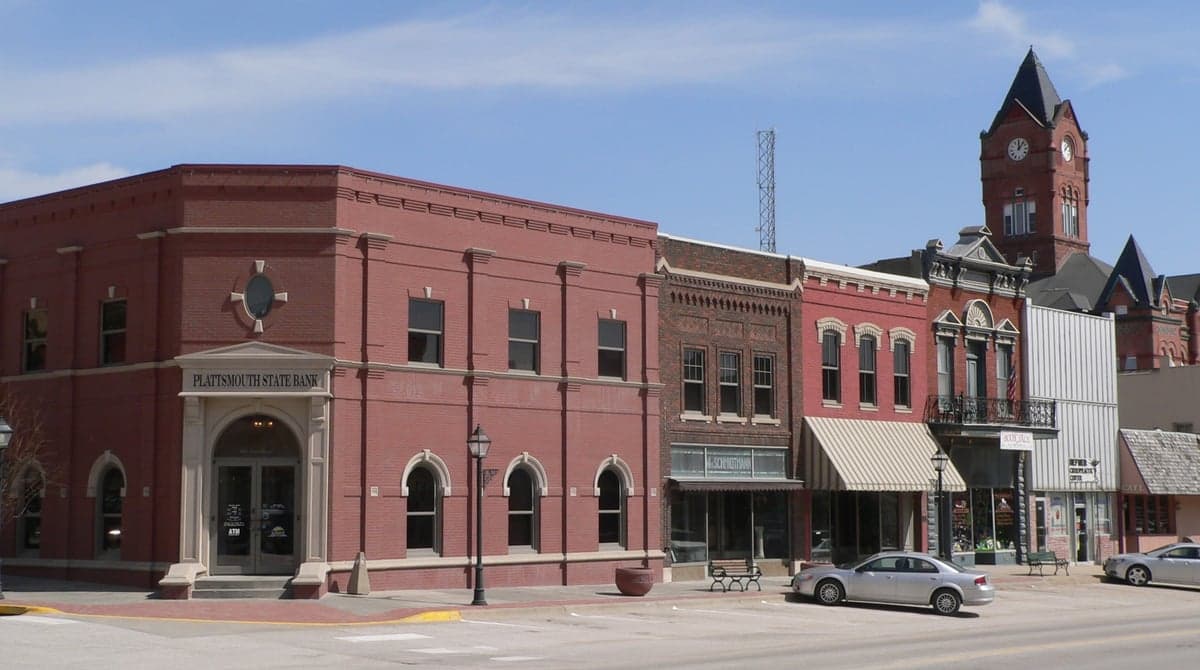
Photo: Wikipedia
Political ClimatePolitical Climate in Plattsmouth, NE
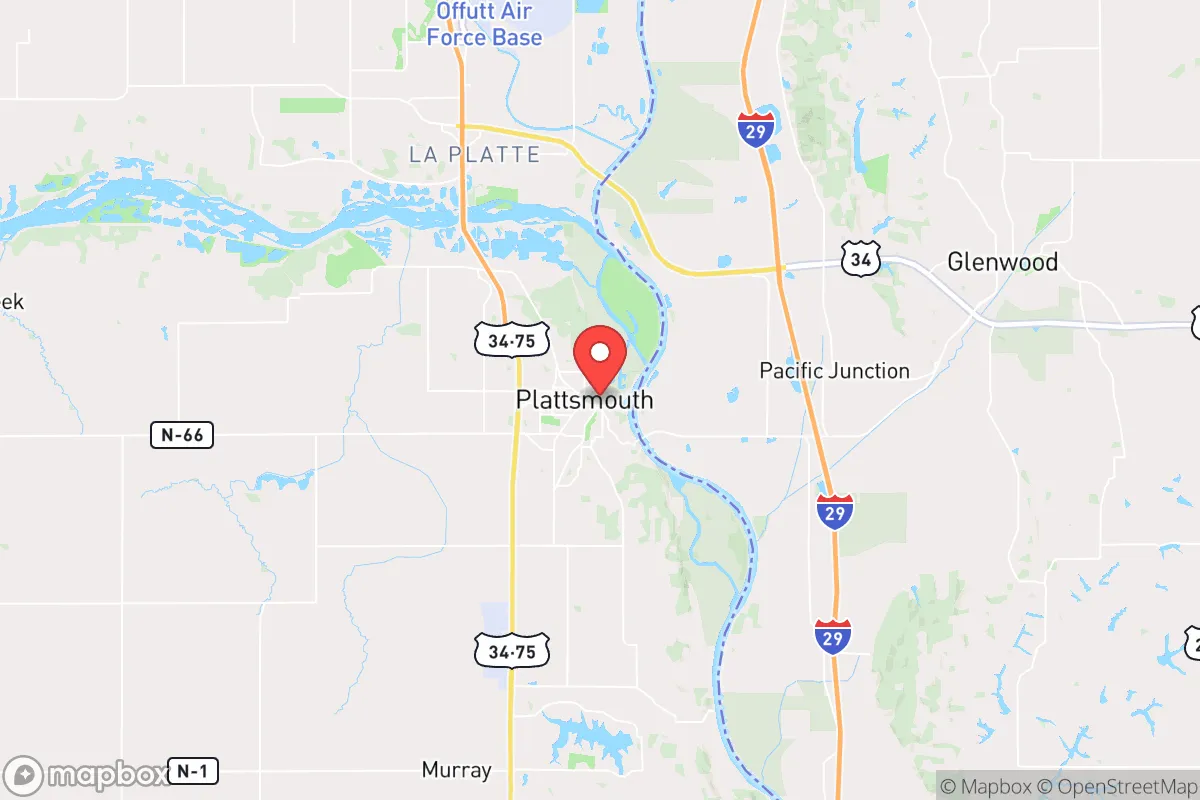
District shown is the primary district for this city’s centroid. Cities may span multiple districts.
Local Political AnalysisPolitical Analysis of Plattsmouth, NE
Plattsmouth, Nebraska, has long been a solidly conservative community, and that hasn't changed much, though you can feel the winds shifting a bit. The Cook PVI of R+6 tells you the baseline, but it doesn't capture the local flavor. In the last few presidential cycles, Cass County has voted reliably Republican, but the margins have tightened slightly as Omaha's influence creeps south along the river. It's still a place where folks wave the flag and value their independence, but you'll hear more chatter about "progressive" ideas from newcomers than you did a decade ago.
How it compares
If you drive ten miles north into Omaha, you're in a different world politically—blue-leaning, with a much more active progressive scene. Head west to Lincoln, and it's even more pronounced. But Plattsmouth itself? It's a bastion of traditional values compared to those cities. The real contrast is with smaller towns like Weeping Water or Louisville, which are even more conservative and less exposed to outside influence. Plattsmouth sits right on the edge of that urban-rural divide, so you get a mix of longtime locals who remember when the town was all farming and railroad, and newer folks who commute to jobs in the city and bring back different ideas. That's where the tension is—it's not a full-on culture war yet, but you can feel the ground shifting under your feet.
What this means for residents
For those of us who've been here a while, the biggest concern is government overreach creeping into local decisions. We've seen it with zoning fights, school board meetings, and even mask mandates during the pandemic—folks pushing for more control from the top down. The local government is still pretty hands-off, but there's a growing push from some quarters to adopt policies that feel like they're imported from Lincoln or Omaha. Property taxes are a constant sore spot, and the fear is that as the area grows, we'll see more regulations that chip away at personal freedoms—like restrictions on land use or even local business licensing that favors chain stores over mom-and-pop shops. The good news is that the county commission and city council are still dominated by folks who believe in limited government, but you have to stay vigilant. Every election cycle, there's a new slate of candidates who talk about "equity" and "sustainability" in ways that sound an awful lot like control masquerading as compassion.
Culturally, Plattsmouth still holds onto its small-town character—the Fourth of July parade, the county fair, the sense that your neighbor will help you without asking for a government program. But there's a quiet unease. The school board has had some heated debates over curriculum and library books, and you'll see more "In This House We Believe" signs than you used to. The long-term trajectory depends on who moves in and who stays. If the growth continues to be families looking for a quieter, freer life, the conservative character will hold. But if it attracts folks who want to turn Plattsmouth into a bedroom community for Omaha's progressive politics, we could see a real fight for the soul of this town. For now, it's still a place where you can live your life without too much interference, but you'd better keep an eye on the ballot box.

State Political ClimatePolitical Climate in Nebraska
State Political AnalysisPolitical Environment in the State
Nebraska has long been a reliably conservative state, with a strong Republican lean that has only deepened in recent cycles. The state hasn't voted for a Democratic presidential candidate since 1964, and in 2024, Donald Trump carried it by a comfortable 19-point margin. However, the political landscape is far from monolithic — the state’s unique unicameral legislature and nonpartisan structure create a more nuanced environment than the raw numbers suggest. Over the past two decades, the dominant coalition has shifted from a pragmatic, farm-oriented conservatism to a more culturally and fiscally assertive brand, driven by suburban growth in places like Elkhorn and Papillion and a hardening rural base across the Sandhills.
Urban vs. rural divide
The political map of Nebraska is a textbook case of urban-rural polarization. Omaha (Douglas County) and Lincoln (Lancaster County) are the state’s blue islands, with Omaha’s 2nd Congressional District famously delivering one electoral vote to Joe Biden in 2020. Lincoln, home to the University of Nebraska, leans left but not overwhelmingly — it’s more of a purple city with a strong progressive activist core. Meanwhile, the rest of the state is deeply red. Scottsbluff in the Panhandle, Norfolk in the northeast, and Kearney in central Nebraska all vote Republican by 30-40 point margins. The suburban ring around Omaha — particularly Gretna, Bennington, and Waterloo — has become a key battleground, with these fast-growing towns trending more conservative as they absorb families fleeing the city’s leftward drift. The rural counties along the Platte River and in the Sandhills are among the most Republican in the nation, often voting 80%+ for GOP candidates.
Policy environment
Nebraska’s policy environment is broadly favorable to conservatives, though not without its frustrations. The state has no income tax on Social Security benefits and a flat individual income tax rate that was recently cut from 6.84% to 5.84%, with a path to 3.99% by 2027. Property taxes remain a perennial complaint — they’re high relative to the region, especially in rural areas where school funding relies heavily on local levies. The unicameral legislature is officially nonpartisan, but in practice, Republicans hold a supermajority. This has allowed passage of a constitutional carry law (LB 77 in 2023) and a near-total abortion ban after 12 weeks (LB 574, also 2023). Education policy is a flashpoint: the state passed a school choice program (LB 753) in 2023, allowing tax-credit scholarships for private and religious schools, but it faces ongoing legal challenges from teachers’ unions. Election laws are solid — voter ID was enacted in 2023, and Nebraska has no same-day registration, which keeps the system stable. Healthcare is a mixed bag; the state expanded Medicaid under the Affordable Care Act in 2018 via ballot initiative, a move many conservatives opposed, but the program has been administered without major controversy.
Trajectory & freedom
On balance, Nebraska is moving in a more freedom-oriented direction, but the pace is uneven. The 2023 passage of constitutional carry was a major win for gun rights advocates, eliminating the need for a permit to carry concealed firearms. Parental rights were strengthened with LB 1080 (2024), which requires schools to notify parents of any curriculum involving sexuality or gender identity — a direct response to the Omaha Public Schools’ controversial policies. On the other hand, the state’s COVID-era emergency powers were a sore spot; Governor Pete Ricketts’ broad executive orders in 2020-2021 drew criticism from both libertarians and conservatives who felt they overreached. Since then, the legislature has reined in gubernatorial emergency authority (LB 392, 2022), requiring legislative approval for any emergency order lasting more than 30 days. Medical freedom remains a live issue: the 2023 abortion ban passed with no exceptions for rape or incest, which some conservatives see as a necessary protection of life, while others worry about government overreach into private medical decisions. Property rights are generally strong, with no state-level rent control and minimal zoning restrictions outside of Omaha and Lincoln.
Civil unrest & political movements
Nebraska has seen relatively little civil unrest compared to coastal states, but there have been notable flashpoints. The 2020 George Floyd protests in Omaha turned violent on May 29-30, with looting and fires in the Old Market district, leading to a heavy National Guard presence. Since then, the activist left has remained organized, particularly around abortion rights and transgender issues — the group Nebraska Abortion Resources has been vocal in opposing the 12-week ban. On the right, the Nebraska Republican Party has seen a grassroots takeover by more populist, anti-establishment factions, with the 2022 state convention featuring heated debates over election integrity and critical race theory. Immigration politics are less heated than in border states, but the Scottsbluff area has seen tensions over meatpacking plant workers, with some local officials pushing for stricter enforcement. There is no serious secession or nullification movement, though some rural counties have floated the idea of leaving Douglas and Lancaster counties to form a separate state — a long-shot proposal that reflects deep cultural frustration. Election integrity controversies have been minimal; Nebraska’s paper ballot system and post-election audits are widely trusted, though some activists continue to push for more restrictive voter ID rules.
Projection
Over the next 5-10 years, Nebraska is likely to become more conservative, not less. The key demographic driver is the continued exodus from Omaha and Lincoln to the surrounding suburbs and exurbs. Elkhorn, now part of Omaha but growing fast, and Gretna are absorbing young families who want good schools and lower crime — and they vote Republican. Meanwhile, rural depopulation is slowly reducing the Democratic base in the state’s few blue pockets. The in-migration from blue states is modest but noticeable, particularly in the Lincoln area, where tech and insurance jobs are drawing some newcomers from California and Illinois. However, these migrants tend to be moderate or conservative-leaning, not progressive activists. The biggest wildcard is the state’s unicameral legislature — if Democrats ever break the Republican supermajority (unlikely but possible in a wave year), it could slow the conservative agenda. Realistically, expect continued tax cuts, further school choice expansion, and a hardening of cultural policies on abortion and transgender issues. The state’s electoral college split (Omaha’s 2nd District) will remain a national battleground, but the statewide trend is solidly red.
Bottom line for a new resident: If you’re moving to Nebraska for a freer, more traditional way of life, you’ll find a state that largely delivers — low taxes (and getting lower), strong gun rights, parental control in schools, and a government that mostly stays out of your business. The trade-offs are high property taxes and a cold, long winter. The cities of Omaha and Lincoln are the only places where you’ll encounter significant progressive influence, and even there, the suburbs offer a buffer. For conservatives looking to escape the chaos of coastal states, Nebraska is a solid bet — just be prepared for the occasional legislative fight over how far freedom should go.
* Values derived from national, state, county, city and local statistics and may differ in a specific area. Last updated: 2026-04-21T14:14:24.000Z
Narrative content on this page is AI-generated and may contain mistakes. Verify any details that matter before acting on them.
ReloMaps may earn a commission from affiliate links at no extra cost to you.

