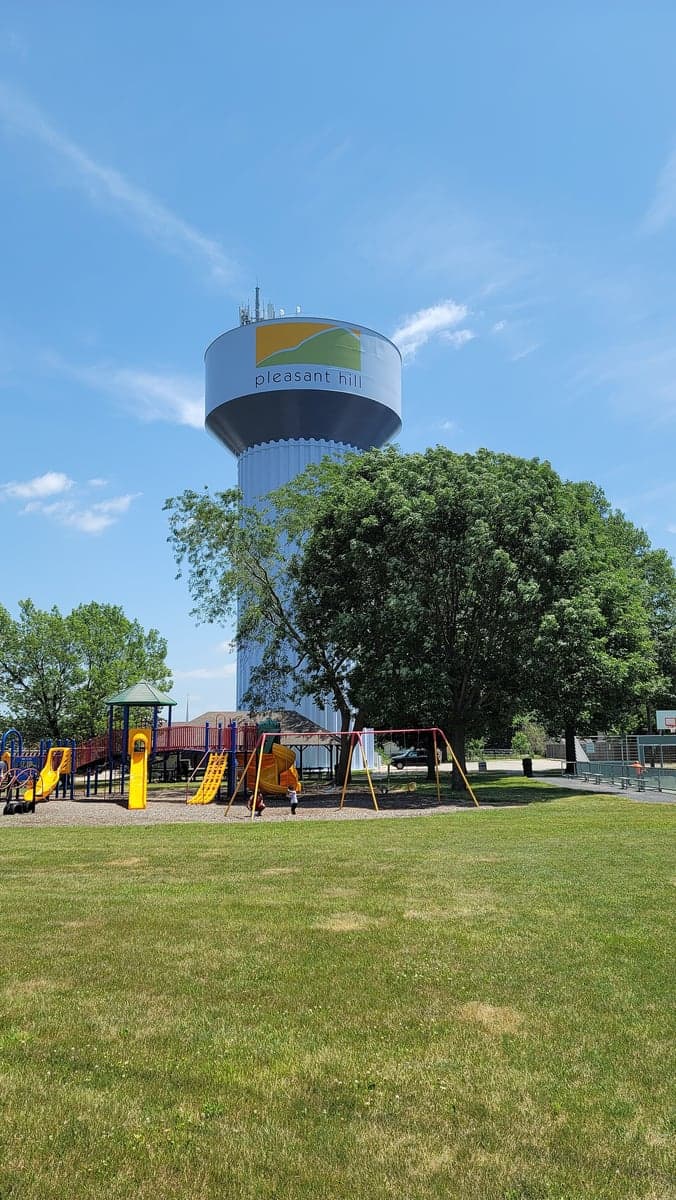
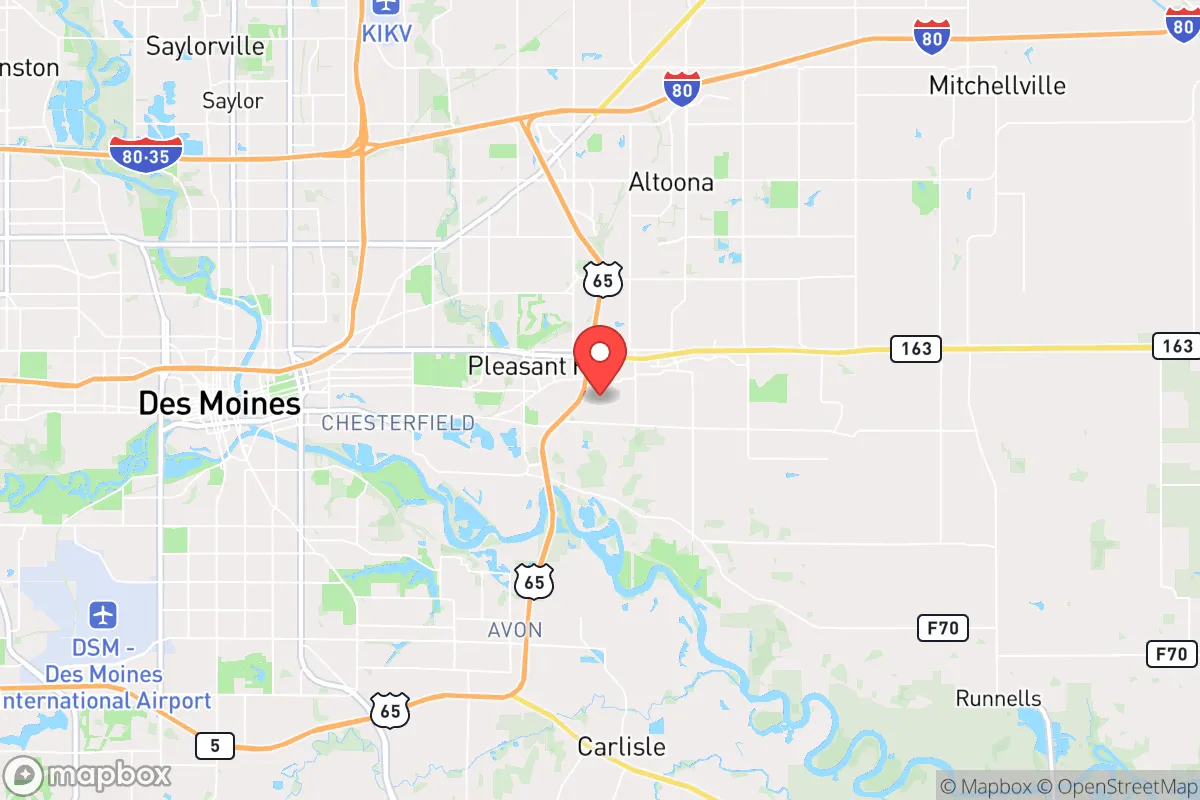
Photo: Wikipedia
Demographics of Pleasant Hill, IA
Affluence Level in Pleasant Hill, IA
A middle-class area roughly in line with national averages across income, home values, education, and employment.
People of Pleasant Hill, IA
The people of Pleasant Hill, Iowa, today form a predominantly white, family-oriented community of 10,796 residents, characterized by a notably low foreign-born population of just 0.2% and a strong local identity distinct from neighboring Des Moines. The city’s population is 82.1% white, with a Hispanic share of 7.4%, a Black population of 4.9%, and East/Southeast Asian communities making up 3.4%. With 32.2% of adults holding a college degree, Pleasant Hill leans toward a middle-to-upper-middle-class, suburban profile, where single-family homes and a quiet, safe reputation attract conservative-leaning families and individuals seeking space from the urban core.
How the city was settled and grew
Pleasant Hill’s human history begins not with a dramatic founding but with slow, agricultural settlement in the mid-19th century. The area was originally part of the larger Four Mile Creek watershed, drawing Yankee and German farmers who valued the fertile, rolling land. The first wave of settlers, primarily of German and English stock, arrived in the 1850s and 1860s, establishing small homesteads along what is now the Four Mile Creek Greenbelt corridor. By the early 1900s, a handful of families had clustered around the intersection of today’s University Avenue and NE 46th Street, forming a loose hamlet. No major land grants or industrial booms occurred; instead, the population grew slowly through natural increase and the arrival of a few additional farm families. The historic Old Town district, centered near the intersection of NE 56th Street and University Avenue, retains the original modest farmhouses and early 20th-century bungalows built by these pioneer families. The city remained a tiny crossroads until the post-World War II era, when the first suburban spillover from Des Moines began to trickle in.
Modern era (post-1965)
The modern transformation of Pleasant Hill began in earnest after 1965, driven by the construction of Interstate 235 and the expansion of Des Moines’ eastern suburbs. The 1970s and 1980s saw the first major wave of domestic in-migration: white, middle-class families from Des Moines and rural Iowa seeking larger lots and newer homes. This wave built out the Pleasant Hill Estates neighborhood, a subdivision of ranch-style and split-level homes that became the city’s first planned residential area. The 1990s and 2000s brought a second, larger wave of domestic migrants, again overwhelmingly white, who filled the Hickory Ridge and Woodland Creek subdivisions with two-story colonial and craftsman homes. These neighborhoods remain the demographic heart of the city today, with very low racial diversity. The small Hispanic population (7.4%) is concentrated in a few apartment complexes along University Avenue, such as those near the Pleasant Hill Town Center, while the Black and East/Southeast Asian residents are scattered thinly across newer subdivisions like Prairie Ridge. The foreign-born share of 0.2% is among the lowest in the Des Moines metro, indicating that nearly all growth has come from domestic migration rather than international immigration.
The future
The population of Pleasant Hill is likely to continue its trajectory of slow, homogenizing growth, driven by domestic in-migration from other parts of Iowa and the Midwest. The city’s low foreign-born share and minimal racial diversity suggest that it will not become a hub for immigrant communities in the next 10–20 years. Instead, the demographic future points toward a gradual aging of the existing white population, with younger families moving into newer subdivisions like Copper Creek and Stonegate, which are currently under development. The Hispanic share may rise modestly as service-sector workers seek affordable housing, but the city’s zoning and housing stock—dominated by single-family homes on large lots—will likely limit significant diversification. The East/Southeast Asian and Black populations are expected to remain small, plateauing at or near current levels. Pleasant Hill is not tribalizing into distinct ethnic enclaves; rather, it is homogenizing into a predominantly white, middle-class suburb with a stable, family-oriented character.
For someone moving in now, Pleasant Hill is becoming a predictable, low-diversity suburb where the population is stable, the schools are solid, and the pace of change is slow. The city offers a quiet, safe environment for families and individuals who prioritize space and community cohesion over urban diversity. The lack of significant immigration or rapid demographic turnover means that the social fabric will remain familiar to those accustomed to traditional Midwestern suburban life.

* Values derived from national, state, county, city and local statistics and may differ in a specific area. Last updated: 2026-04-30T08:10:08.000Z
Narrative content on this page is AI-generated and may contain mistakes. Verify any details that matter before acting on them.
ReloMaps may earn a commission from affiliate links at no extra cost to you.

