
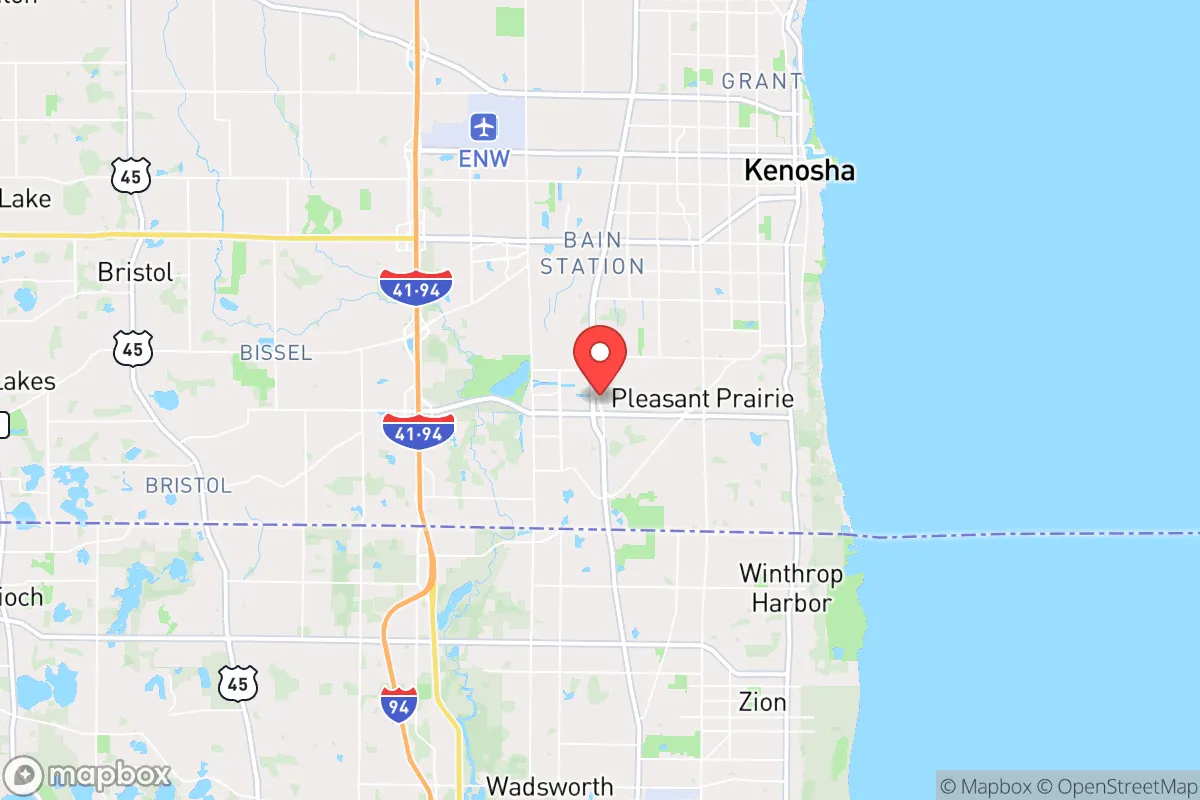
Photo: Wikipedia
Personal Sovereignty in Pleasant Prairie, WI
Moderate friction. Expect trade-offs in some aspect of personal liberty and independence.
What does Personal Sovereignty tell us?
Personal Sovereignty measures your capacity for self-reliance and independence with minimal government friction. Higher scores mean fewer barriers between you and the way you want to live... but it assumes you have the space you need and good neighbors.
What does this tell us?
Personal Sovereignty measures your capacity for self-reliance and independence with minimal government friction. Higher scores mean fewer barriers between you and the way you want to live... but it assumes you have the space you need and good neighbors.
State Policy
Energy independence: Importer (15% of energy produced in-state)
Personal Liberty
Homesteading

Personal Liberty Analysis
Pleasant Prairie, Wisconsin offers a notably strong environment for personal sovereignty, particularly when compared to the regulatory-heavy climates of neighboring Illinois or the coastal states. This southeastern Wisconsin village, while part of the Kenosha County metro area, retains a distinct character that prioritizes individual autonomy, lower taxation, and a legal framework that generally respects the rights of residents to live as they see fit. For those seeking to minimize government overreach into daily life—whether through tax policy, self-defense laws, or the ability to provide for oneself—Pleasant Prairie presents a compelling option that balances suburban convenience with a distinctly Midwestern libertarian-leaning ethos.
Tax burden and regulatory posture: How Pleasant Prairie compares to Illinois and the national average
Wisconsin’s overall tax burden is moderate, but Pleasant Prairie benefits from the state’s relatively restrained regulatory environment, especially when contrasted with its southern neighbor. The village itself has a property tax rate that, while not the lowest in the state, is kept in check by a robust commercial tax base—thanks to major retail and logistics hubs like the Pleasant Prairie Premium Outlets and Amazon fulfillment centers. For a single individual or family, the absence of a state-level estate tax and the ability to deduct federal taxes from state returns (a feature lost in many states) provides meaningful relief. More importantly, Wisconsin is a right-to-work state, meaning no one can be forced to join a union as a condition of employment—a significant factor for those who view compulsory association as an infringement on personal liberty. The state’s regulatory posture on business and property is generally permissive, with no state-level rent control, minimal zoning overreach in unincorporated areas, and a Department of Natural Resources that, while active, is far less aggressive than counterparts in states like California or New York. For the prepper-minded, this means fewer bureaucratic hurdles for building a workshop, storing supplies, or running a small home-based business.
Self-defense and gun law specifics: What Wisconsin’s Castle Doctrine and permitless carry mean for residents
Wisconsin is a strong Second Amendment state, and Pleasant Prairie residents enjoy some of the most protective self-defense laws in the Midwest. The state operates under a Castle Doctrine with no duty to retreat—meaning that if someone unlawfully enters your home, vehicle, or workplace, you are legally presumed to have a reasonable fear of imminent death or great bodily harm, and you may use deadly force without legal penalty. This is codified in Wisconsin Statute 939.48, and it applies broadly. Furthermore, Wisconsin is a permitless carry (constitutional carry) state as of 2024, so law-abiding adults 18 and older can carry a concealed firearm without a license. For those who prefer the added legal protection of a permit for reciprocity when traveling, the state issues licenses on a shall-issue basis with no discretionary denial. There are no magazine capacity bans, no "assault weapon" bans, and no state-level firearm registration. The village of Pleasant Prairie itself has no local ordinances that further restrict state law—a critical point for those who worry about municipal overreach. For the survivalist, this legal framework means that your ability to defend your home and person is not subject to the whims of local politicians, and the state’s preemption statute prevents cities like Kenosha from enacting their own stricter rules.
Self-reliance and homesteading viability: Lot sizes, zoning, and off-grid feasibility in Pleasant Prairie
Pleasant Prairie is a mixed bag for full-scale homesteading, but it offers more room to maneuver than most suburban communities. The village’s zoning code allows for agricultural and rural residential lots in certain areas, particularly in the western and northern parts of the village, where lot sizes can range from 1 to 5 acres. This is not a dense suburb; the village has preserved significant open space, and many properties have room for gardens, small livestock (chickens are permitted with a license), and even a few goats or bees under the village’s animal ordinances. Off-grid feasibility is limited by state building codes—Wisconsin requires connection to the electrical grid for new construction in most platted subdivisions—but existing homes on larger parcels can install solar panels with net metering, and rainwater collection for irrigation is legal. The village’s water utility is reliable, but those on private wells (common on larger lots) have full control over their water supply. For the prepper, the key is to target the Agricultural/Residential (A-R) zoning district, which permits a wider range of self-reliance activities than the standard suburban R-1 or R-2 districts. The village’s proximity to Lake Michigan also provides a secondary water source and a natural barrier against total isolation—a strategic consideration for those thinking about long-term resilience.
Personal liberties: Parental rights, medical autonomy, speech, and property protections
Wisconsin has a strong track record on several fronts of personal liberty that matter deeply to those wary of government overreach. Parental rights are explicitly protected under state law, with a presumption that parents have the fundamental right to direct the upbringing, education, and healthcare of their children. The state does not have a universal vaccine mandate for school attendance (though individual school districts may have policies), and parents can opt out of sex education. Medical autonomy is more nuanced: Wisconsin does not have a state-level right-to-try law for terminally ill patients (though federal law applies), and the state’s COVID-era emergency orders were controversial. However, the legislature has since passed laws limiting the governor’s ability to issue extended emergency orders without legislative approval—a check on executive overreach that many preppers view as essential. Free speech is robust, with no state-level hate speech laws that criminalize protected expression, and the village has no local noise or signage ordinances that would prevent political or religious expression on private property. Property rights are protected by Wisconsin’s strong eminent domain laws, which require just compensation and a public purpose, and the state has no statewide rent control or forced inclusionary zoning. For the individualist, the legal environment in Pleasant Prairie is one where you can largely live your life without the state dictating your medical choices, your children’s education, or what you can say on your own land.
Overall, Pleasant Prairie ranks as a strong-to-moderate sovereignty environment within the Midwest. It lacks the extreme libertarian legal frameworks of states like New Hampshire or Alaska, but it far surpasses the regulatory density of Illinois, Minnesota, or any coastal state. The village’s combination of constitutional carry, Castle Doctrine, right-to-work status, and permissive zoning for self-reliance activities makes it a viable destination for those who prioritize personal freedom over government-provided security. The primary trade-off is proximity to the Chicago metro area—which brings both economic opportunity and the risk of cultural and political spillover. For the strategic relocator, Pleasant Prairie offers a buffer zone: close enough to urban resources, but far enough from the overreach that defines so much of modern American governance.

* Values derived from national, state, county, city and local statistics and may differ in a specific area. Last updated: 2026-04-21T10:13:15.000Z
Narrative content on this page is AI-generated and may contain mistakes. Verify any details that matter before acting on them.
ReloMaps may earn a commission from affiliate links at no extra cost to you.

