
Photo by Nils Huenerfuerst on Unsplash
Demographics of Pleasant Valley, WV
Affluence Level in Pleasant Valley, WV
A below-average socioeconomic profile. Incomes, home values, and educational attainment trail the U.S., with higher poverty and unemployment.
People of Pleasant Valley, WV
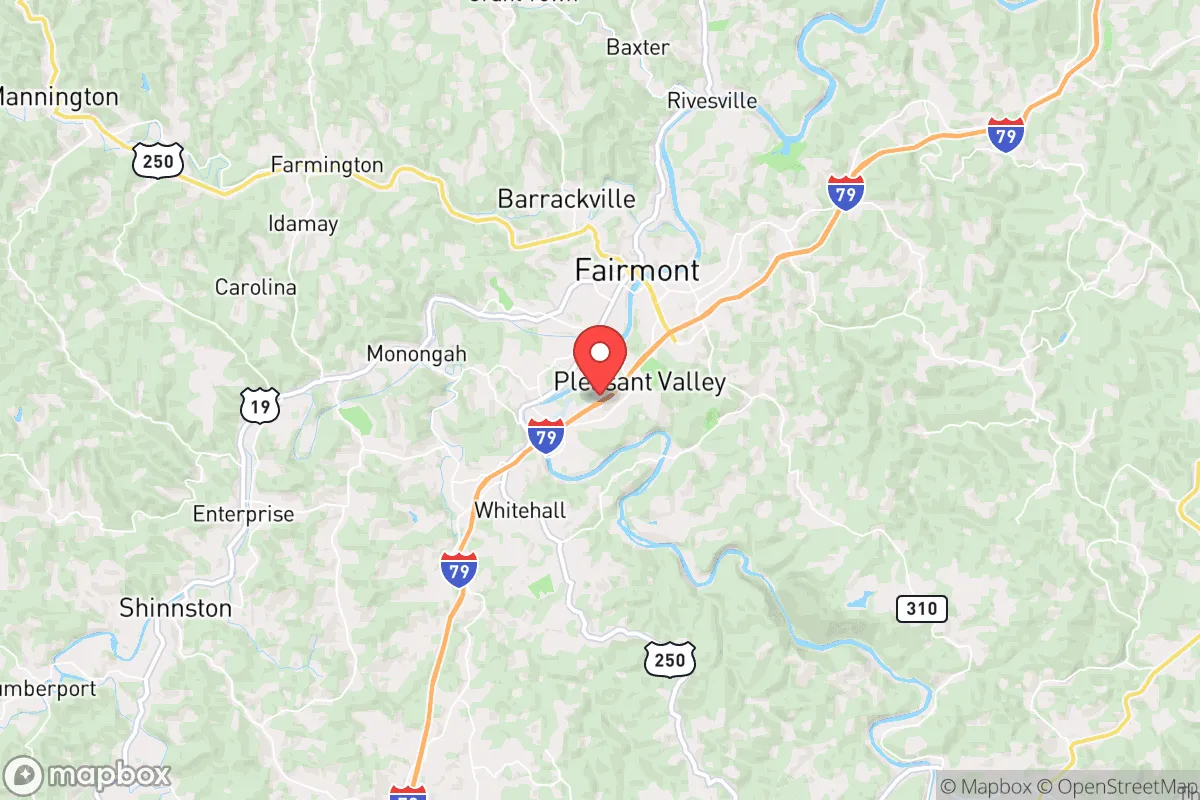
Pleasant Valley, West Virginia, is a small, predominantly white community of 3,494 residents where nearly 90% of the population shares a European-American heritage and only 1.0% is foreign-born. The city’s character is shaped by its roots as a quiet, working-class suburb of Fairmont, with a density that feels more like a close-knit town than an urban center. Distinctive markers include a high proportion of college-educated residents at 35.0%, a low Hispanic presence at 2.4%, and minimal racial diversity, with Black residents at 2.2% and East/Southeast Asian communities at 0.6%. This is a place where generational continuity and local ties define daily life, not rapid demographic change.
How the city was settled and grew
Pleasant Valley’s settlement began in the late 19th century as an offshoot of Fairmont’s coal and natural gas boom. Unlike older Appalachian towns founded on subsistence farming, Pleasant Valley was platted in the 1890s as a residential enclave for managers and skilled workers employed by the region’s energy industries. The original population was almost entirely of English, Irish, and German descent, drawn by jobs in the nearby mines and gas fields. The Old Town district, centered along Pleasant Valley Road, was the first cluster of homes, built by these early industrial laborers. By the 1920s, a second wave of Italian and Polish immigrants arrived, settling in the East End neighborhood, where they worked in the coal-processing plants along the Monongahela River. The city remained small and homogeneous through the mid-20th century, with no major influxes beyond these European-origin groups.
Modern era (post-1965)
After the 1965 Hart-Cellar Act, Pleasant Valley saw virtually no immigration-driven diversification. The foreign-born share has never exceeded 1.5%, and the city’s demographic story since 1965 is one of domestic stability rather than ethnic change. Suburbanization from Fairmont brought a modest wave of white families in the 1970s and 1980s, who built homes in the Woodland Hills subdivision, a planned development of single-family houses on larger lots. The South Ridge area, annexed in the 1990s, attracted younger families seeking affordable housing within commuting distance of Morgantown’s growing healthcare and tech sectors. The Black population, at 2.2%, is concentrated in a small pocket near the Fairmont Avenue corridor, a legacy of limited post-Civil Rights era migration from nearby Marion County. East/Southeast Asian residents (0.6%) are almost entirely professionals affiliated with West Virginia University, living in newer apartments off Pleasant Valley Road. The Indian subcontinent population is effectively zero, and Arab communities are absent from census data.
The future
Pleasant Valley’s population is aging and slowly shrinking, with a median age of 42.3 years and a birth rate below replacement. The city is homogenizing rather than diversifying: the white share has held steady at 89-91% for two decades, while the small Hispanic and Asian populations are plateauing due to limited economic opportunities and a lack of ethnic infrastructure like cultural centers or ethnic grocery stores. The Meadowbrook neighborhood, built in the early 2000s, has attracted a few out-of-state retirees but no significant immigrant inflow. Over the next 10-20 years, the city will likely become slightly older and whiter, with out-migration of young adults to Morgantown or Pittsburgh offset by a trickle of remote workers seeking low property taxes. No new ethnic enclaves are forming, and the foreign-born share is expected to remain below 2%.
For someone moving in now, Pleasant Valley is a stable, culturally uniform community where change comes slowly. It offers safety, low crime, and a strong sense of local identity, but little racial or ethnic diversity. New residents should expect a place where neighbors have deep roots and newcomers are welcomed primarily if they share the area’s traditional values and lifestyle. This is not a melting pot or a rapidly evolving suburb—it is a small, enduring pocket of Appalachian stability.

* Values derived from national, state, county, city and local statistics and may differ in a specific area. Last updated: 2026-04-23T05:44:32.000Z
Narrative content on this page is AI-generated and may contain mistakes. Verify any details that matter before acting on them.
ReloMaps may earn a commission from affiliate links at no extra cost to you.

