 Popular
Photo: Wikipedia
Demographics of Portsmouth, NH
Affluence Level in Portsmouth, NH
An upper-middle-class area. Household wealth, education levels, and homeownership run ahead of national benchmarks.
People of Portsmouth, NH
The people of Portsmouth, New Hampshire, today form a densely educated, predominantly white population of 22,332, with a notably high college attainment rate of 63.4%. The city’s character is defined by a blend of historic New England coastal identity and a growing professional class, with a foreign-born share of just 4.3%—well below the national average. Distinctive markers include a strong preservationist ethos, a vibrant downtown anchored by Market Square, and a demographic profile that is slowly diversifying along its edges, particularly with East/Southeast Asian and Indian subcontinent communities.
How the city was settled and grew
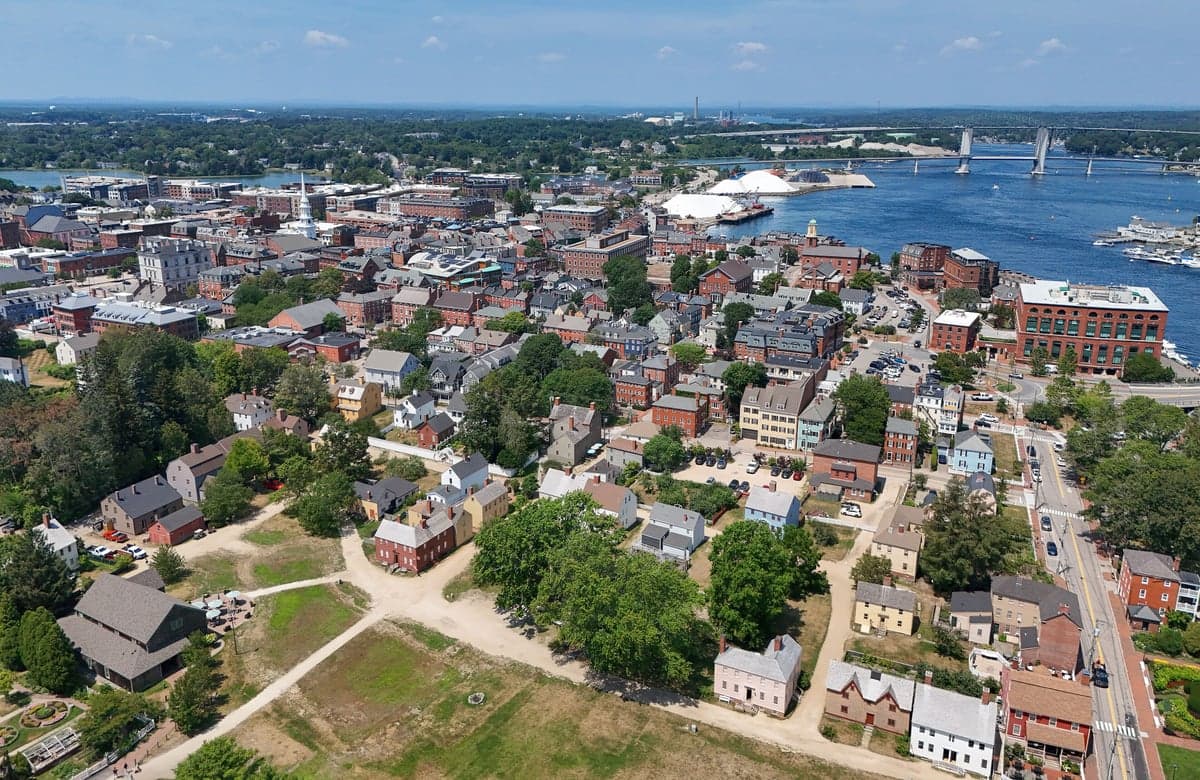
Portsmouth was founded in 1623 as a fishing and trading outpost by English settlers, making it one of the oldest continuously inhabited European settlements in the United States. The original population clustered along the Piscataqua River in what is now the South End and Strawbery Banke neighborhoods, building a maritime economy around shipbuilding, fishing, and trade with the West Indies. Through the 18th and 19th centuries, the city attracted waves of Irish and Scottish immigrants who worked the docks and shipyards, settling in the Pannaway Manor area and the working-class streets near the waterfront. By the early 20th century, French-Canadian families arrived to labor in the city’s textile mills and shoe factories, establishing a strong presence in the Islington Creek and Franklin Street corridors. These waves created a largely white, Catholic, and union-oriented population that persisted through the mid-20th century.
Modern era (post-1965)
After the 1965 Hart-Cellar Act, Portsmouth saw only modest immigration compared to larger U.S. cities. The foreign-born share remains low at 4.3%, but the composition has shifted. The city’s West End and Atlantic Heights neighborhoods have absorbed most of the newer arrivals, including a small but visible East/Southeast Asian community (2.4% of the population) and an Indian subcontinent population (1.5%). These groups are concentrated in professional and tech-sector jobs, drawn by Portsmouth’s proximity to the Portsmouth Naval Shipyard and the broader Seacoast economy. Domestic in-migration has been far more significant: since the 1990s, the city has attracted educated professionals from Boston and New York, driving up home prices and the college-educated share to 63.4%. The Hispanic population (3.5%) and Black population (0.7%) remain small, with no single neighborhood becoming a majority-minority enclave. The Downtown and Islington Creek areas have seen the most demographic turnover, as older working-class families have been replaced by younger, wealthier transplants.
The future
Portsmouth’s population is trending toward greater homogeneity in socioeconomic terms—more educated, more affluent, and whiter than the national average—even as it slowly diversifies at the margins. The East/Southeast Asian and Indian subcontinent communities are growing from a very small base, but they are not forming distinct ethnic enclaves; instead, they are assimilating into the city’s professional class. The Hispanic and Black populations are plateauing, with no major secondary migration expected. The city’s high cost of housing is the primary demographic filter: it attracts high-income newcomers and discourages lower-income families, regardless of ethnicity. Over the next 10-20 years, Portsmouth will likely remain a predominantly white, highly educated city, with a small but stable mix of East/Southeast Asian and Indian subcontinent residents concentrated in the West End and Atlantic Heights. The South End and Strawbery Banke areas will continue to be historic, high-value districts with little demographic change.
For someone moving in now, Portsmouth is becoming an increasingly exclusive, knowledge-economy city with a strong sense of place but limited demographic diversity. The population is stable in size but shifting in character toward higher education and income levels, making it a good fit for professionals and families who value historic charm, coastal access, and a low-crime environment—but not for those seeking a racially or economically diverse community.

* Values derived from national, state, county, city and local statistics and may differ in a specific area. Last updated: 2026-05-01T22:27:08.000Z
Narrative content on this page is AI-generated and may contain mistakes. Verify any details that matter before acting on them.
ReloMaps may earn a commission from affiliate links at no extra cost to you.

