Photo: Wikipedia
Demographics of Pottstown, PA
Affluence Level in Pottstown, PA
A low-income area with significant economic hardship. Household wealth and educational attainment are well below national averages.
People of Pottstown, PA
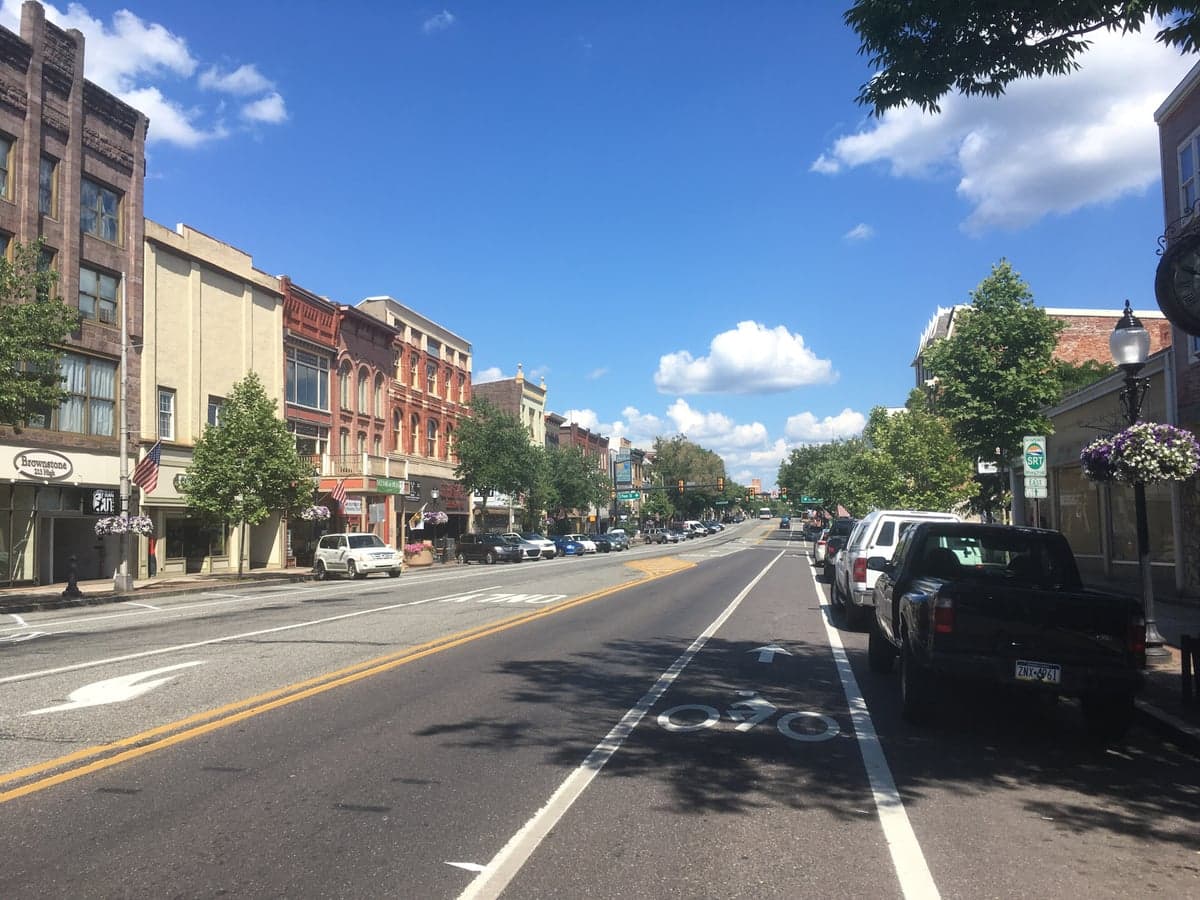
Pottstown, Pennsylvania, is a compact borough of 23,392 residents that has transformed from a predominantly white, industrial mill town into a racially and economically diverse community. Its population density of roughly 4,500 people per square mile gives it a tight-knit, walkable urban feel, but its identity is now defined by a stark contrast: a majority-minority population alongside a 20.3% college-educated rate that lags behind state averages. The people of Pottstown today are a mix of long-standing white working-class families, a substantial Black community, a growing Hispanic population, and small but notable East/Southeast Asian and Indian subcontinent enclaves, all navigating the legacy of deindustrialization.
How the city was settled and grew
Pottstown’s human history begins with its founding in 1752 by John Potts, an ironmaster who established the town along the Schuylkill River as a hub for iron production. The original population was overwhelmingly German and English, drawn by the promise of work in the Potts family’s iron furnaces and forges. By the mid-19th century, the arrival of the Philadelphia and Reading Railroad cemented Pottstown as a rail and manufacturing center, attracting a second wave of Irish immigrants who settled in the North End neighborhood, near the railroad yards and factories. A third wave of Eastern European immigrants—Poles, Slovaks, and Ukrainians—arrived between 1880 and 1920, clustering in the South End around the steel mills and foundries. These groups built distinct ethnic parishes and social clubs, such as St. Mary’s Catholic Church in the South End, which still anchors that community today. The borough’s population peaked at over 26,000 in the 1950s, when the industrial base—including Bethlehem Steel, Dana Corporation, and Firestone—employed thousands of white, largely native-born workers who lived in neighborhoods like Beech Street and High Street, near the downtown commercial core.
Modern era (post-1965)
The post-1965 era brought profound demographic change. The 1965 Hart-Cellar Act opened immigration from Asia and Latin America, but Pottstown’s foreign-born population remains low at just 2.2%, meaning most of its modern diversity comes from domestic migration. The collapse of heavy industry in the 1970s and 1980s triggered white flight to surrounding townships like Lower Pottsgrove and North Coventry, leaving behind a hollowed-out downtown and affordable housing stock. This opened the door for Black families moving from Philadelphia and the urban Northeast, who concentrated in the West End and East End neighborhoods, near the former industrial corridors along Industrial Highway and the Schuylkill River. Today, Black residents make up 22.2% of the population, the largest non-white group. Hispanic residents—12.3% of the population—began arriving in the 1990s, primarily from Puerto Rico and Mexico, and have settled in the South End and along the Charlotte Street corridor, where they have opened bodegas and churches. The East/Southeast Asian community (1.7%) is small but visible, with Vietnamese and Korean families concentrated in the North End near the former St. Aloysius Church. The Indian subcontinent population (0.3%) is tiny, mostly professionals drawn to nearby hospitals and engineering firms, and is scattered rather than clustered. The white population, now 56.6%, is older and concentrated in the Beech Street and High Street historic districts, where many remain in homes their grandparents bought during the industrial heyday.
The future
Pottstown’s population is trending toward further diversification, but the pace is slow. The Hispanic share is growing steadily, driven by births and continued migration from Puerto Rico and Mexico, and is expected to reach 15-18% within a decade, with the South End becoming more distinctly Hispanic. The Black population is plateauing, as younger Black families continue to move to newer suburbs like Gilbertsville and Douglassville for better schools. The white population is declining due to aging and out-migration, but the borough is not homogenizing—instead, it is tribalizing into distinct enclaves: the West End remains predominantly Black, the South End increasingly Hispanic, and the North End and Beech Street areas remain white and older. The East/Southeast Asian and Indian communities are too small to form enclaves and are likely to assimilate into the broader population. The next 10-20 years will likely see Pottstown become a majority-minority borough, with a Hispanic plurality, but without a single dominant group. The college-educated rate may rise slowly as redevelopment efforts along the Schuylkill River attract younger professionals, but the borough’s low median income and underfunded schools will limit rapid change.
For someone moving in now, Pottstown is a place of distinct, neighborhood-level identities rather than a unified community. It offers affordable housing and a walkable downtown, but the demographic trajectory points toward a working-class, majority-minority borough with persistent economic challenges. New residents should expect a town where ethnic and racial lines are visible in everyday life, and where the future is being shaped by the slow replacement of an aging white population with younger Hispanic and Black families.

* Values derived from national, state, county, city and local statistics and may differ in a specific area. Last updated: 2026-05-01T07:21:23.000Z
Narrative content on this page is AI-generated and may contain mistakes. Verify any details that matter before acting on them.
ReloMaps may earn a commission from affiliate links at no extra cost to you.

