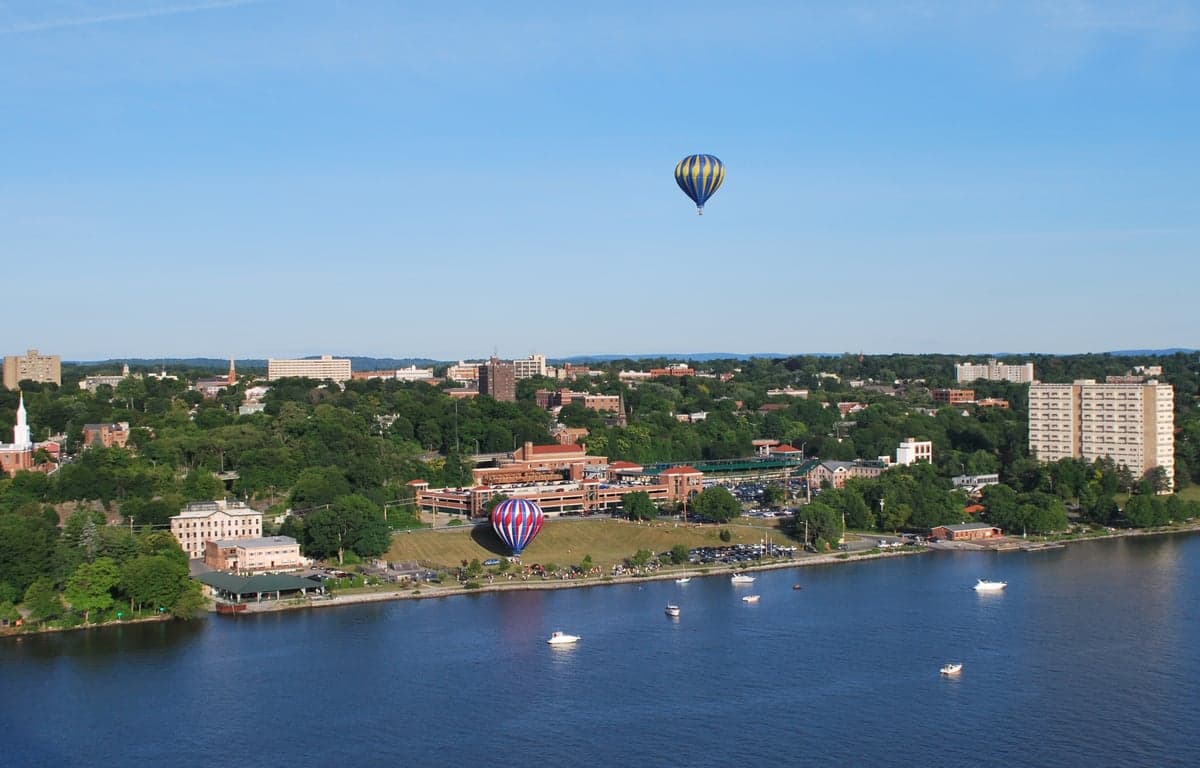
Photo: Wikipedia
Demographics of Poughkeepsie, NY
Affluence Level in Poughkeepsie, NY
A middle-class area roughly in line with national averages across income, home values, education, and employment.
People of Poughkeepsie, NY
The people of Poughkeepsie, NY today form a densely diverse, majority-minority city of 31,778 residents, characterized by a near-equal tri-ethnic split between White (34.5%), Black (31.3%), and Hispanic (24.7%) populations, with a small but growing East/Southeast Asian community (1.0%) and a separate Indian-subcontinent population (0.5%). The city is notably more diverse than its surrounding Dutchess County suburbs, with a foreign-born share of 12.1% and a college-educated rate of 31.5%, reflecting a population shaped by successive waves of industrial migration, urban renewal, and recent professional in-movement. Distinctive identity markers include a strong Black institutional presence rooted in the city's 19th-century abolitionist history, a rapidly expanding Hispanic community concentrated in the central and southern neighborhoods, and a small but visible cohort of Vassar College and Marist College affiliates who have gentrified parts of the historic Academy Street district.
How the city was settled and grew
Poughkeepsie was originally settled by Dutch and English colonists in the late 17th century, with the city formally incorporated in 1854. The Hudson River location and the arrival of the railroad in the 1840s transformed it into a major industrial and commercial hub, drawing waves of Irish and German immigrants who built the Fairview and Arlington neighborhoods as working-class enclaves. By the late 19th century, Italian immigrants arrived in significant numbers, settling primarily in the Smith Street area near the waterfront, where they established Catholic parishes and mutual-aid societies. African Americans began migrating to Poughkeepsie during the Great Migration (1910–1970), drawn by factory jobs at DeLaval Separator Company, Smith Brothers Cough Drops, and the IBM plant in nearby East Fishkill. They concentrated in the North Clinton Street corridor and the Poughkeepsie City School District zone, building a robust community anchored by the A.M.E. Zion Church and the Black-owned businesses along Main Street. The city's population peaked at roughly 41,000 in 1950, before suburbanization and industrial decline began reshaping the demographic landscape.
Modern era (post-1965)
The post-1965 era brought profound demographic change. The Hart-Celler Immigration Act opened doors for new arrivals, while the collapse of manufacturing after the 1970s triggered White flight to surrounding towns like Hyde Park and Lagrangeville. By 1990, Poughkeepsie had shifted from a majority-White city to a majority-minority one. The Hispanic population grew rapidly from the 1980s onward, driven by Puerto Rican and later Dominican and Mexican immigration, settling heavily in the Southside neighborhood along South Road and the Washington Street corridor. Today, 24.7% of residents identify as Hispanic, making this the fastest-growing demographic segment. The Black population, at 31.3%, remains concentrated in the Northside and Arlington districts, though middle-class Black families have increasingly moved to the town of Poughkeepsie and other suburbs. The East/Southeast Asian community (1.0%) is small but visible near the Vassar College campus, while the Indian-subcontinent population (0.5%) is scattered, with no single ethnic enclave. The college-educated share of 31.5% reflects the influence of Vassar, Marist, and Dutchess Community College, which have drawn a professional class to the Academy Street historic district and the Hudson River waterfront condos, creating a gentrifying corridor that contrasts with the older, poorer neighborhoods inland.
The future
The population trajectory points toward continued diversification and modest growth, with the Hispanic share likely to rise above 30% within a decade, driven by both immigration and higher birth rates. The White population, already a plurality at 34.5%, is expected to shrink further as older residents age out and younger families choose suburbs. The Black population appears stable, with out-migration to suburbs offset by new arrivals from the New York City metro area. The city is not homogenizing but rather tribalizing into distinct enclaves: the waterfront and Academy Street areas are becoming whiter and wealthier, the Southside is becoming more heavily Hispanic, and the Northside remains predominantly Black. The East/Southeast Asian and Indian communities are too small to form enclaves and are likely to remain dispersed. The next 10–20 years will likely see Poughkeepsie become a more pronounced class-divided city, with a gentrified core along the river and a poorer, more Hispanic interior.
For someone moving in now, Poughkeepsie offers a genuinely diverse urban environment with strong institutional anchors, but the city's future is one of increasing economic and ethnic stratification. The choice of neighborhood will largely determine one's experience, with the waterfront and Academy Street offering a college-town atmosphere and the Southside and Northside providing more traditional, working-class community life. The city is becoming more Hispanic and more professional simultaneously, creating a dynamic but potentially polarized social landscape.

* Values derived from national, state, county, city and local statistics and may differ in a specific area. Last updated: 2026-05-01T10:03:27.000Z
Narrative content on this page is AI-generated and may contain mistakes. Verify any details that matter before acting on them.
ReloMaps may earn a commission from affiliate links at no extra cost to you.

