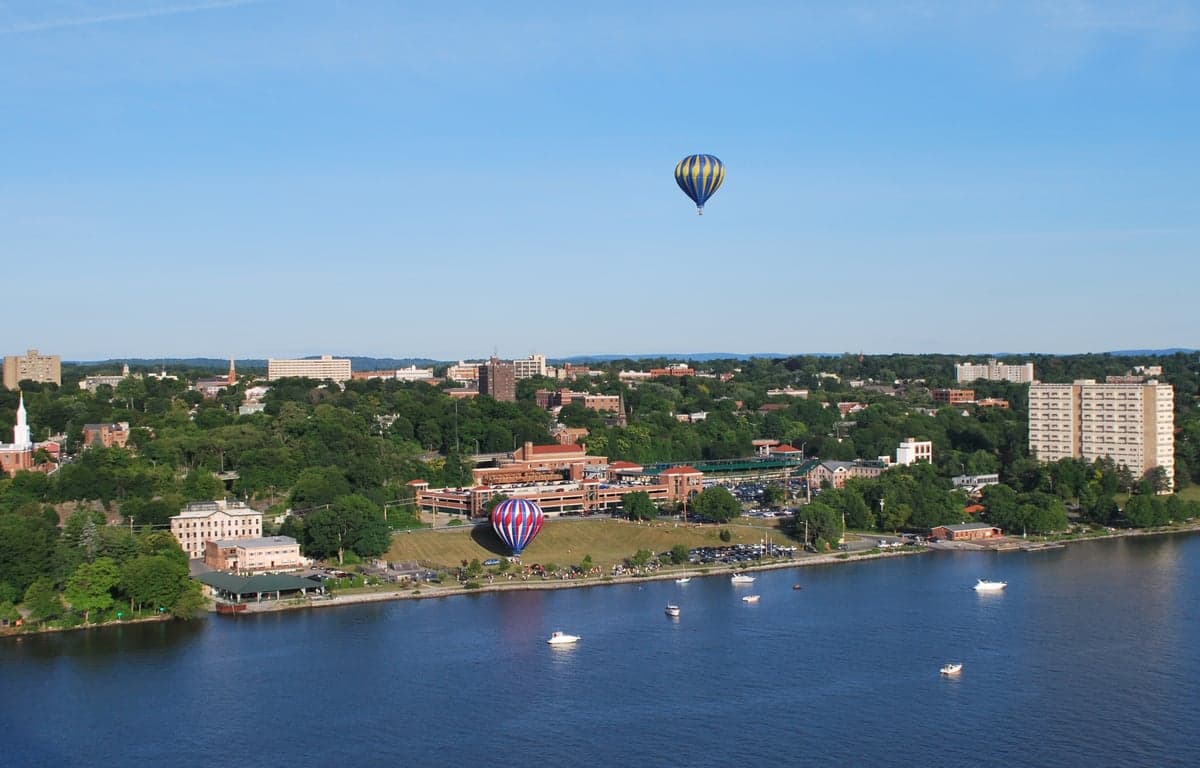
Photo: Wikipedia
Personal Sovereignty in Poughkeepsie, NY
Moderate friction. Expect trade-offs in some aspect of personal liberty and independence.
What does Personal Sovereignty tell us?
Personal Sovereignty measures your capacity for self-reliance and independence with minimal government friction. Higher scores mean fewer barriers between you and the way you want to live... but it assumes you have the space you need and good neighbors.
What does this tell us?
Personal Sovereignty measures your capacity for self-reliance and independence with minimal government friction. Higher scores mean fewer barriers between you and the way you want to live... but it assumes you have the space you need and good neighbors.
State Policy
Energy independence: Importer (12% of energy produced in-state)
Personal Liberty
Homesteading

Personal Liberty Analysis
For a relocation researcher assessing personal sovereignty, Poughkeepsie, New York presents a complex picture: the city itself sits within a state that has aggressively expanded government authority in recent years, but the surrounding Dutchess County landscape offers pockets of relative autonomy for those willing to navigate the regulatory terrain. The overarching reality is that New York State ranks among the most restrictive environments in the nation for individual liberty, with Poughkeepsie serving as a microcosm of that tension—a place where the theoretical freedoms of the Hudson Valley collide with Albany’s top-down mandates on everything from firearms to energy use. For the survivalist or prepper-minded individual, the key question isn’t whether Poughkeepsie is a libertarian haven (it isn’t), but whether its specific constraints can be managed or worked around while still accessing the region’s strategic advantages—proximity to the Adirondack redoubt, water resources, and a relatively low population density compared to downstate.
Tax burden and regulatory posture: what the state takes and controls
New York’s tax burden is the heaviest in the continental United States, and Poughkeepsie residents feel that weight directly. The state income tax rate tops out at 10.9% for high earners, and combined state and local sales tax in Dutchess County hits 8.125%. Property taxes are the real killer: the effective rate in Poughkeepsie hovers around 2.5% of assessed home value, meaning a $300,000 home costs roughly $7,500 annually in property taxes alone—money that funds a school system and municipal services you may not fully control or agree with. The regulatory posture is equally aggressive: New York’s Climate Leadership and Community Protection Act mandates a statewide transition to 70% renewable electricity by 2030 and zero-emissions electricity by 2040, which translates into building code restrictions on natural gas hookups and increasing pressure on homeowners to electrify heating and cooking. For the prepper, this means any off-grid or self-sufficient setup must account for state-level energy mandates that could limit generator use or propane storage. The state also maintains strict environmental conservation laws that restrict land clearing, water diversion, and even the collection of rainwater in some interpretations—though enforcement in rural Dutchess County is less zealous than in the Hudson Valley’s more populated corridors.
Self-defense and gun law specifics: what you can and cannot do
New York’s gun laws are among the most restrictive in the nation, and Poughkeepsie is no exception. The Concealed Carry Improvement Act (CCIA) of 2022 requires a pistol permit for any concealed carry, and the permitting process involves a background check, fingerprinting, a 16-hour safety course, and a “good moral character” determination by the county judge—a subjective hurdle that can be used to deny permits. The state bans so-called “assault weapons” by feature, including adjustable stocks, threaded barrels, and pistol grips, and magazine capacity is capped at 10 rounds. For the survivalist, this is a significant limitation: standard-capacity magazines for rifles and handguns are illegal to possess, and transporting firearms across state lines for training or relocation requires meticulous compliance. Open carry is effectively banned in most circumstances. However, Dutchess County’s sheriff’s office has historically been more amenable to issuing permits than downstate jurisdictions, and the county’s rural areas see less aggressive enforcement of the CCIA’s “sensitive location” restrictions—which prohibit carry in parks, public transportation, and private businesses unless explicitly posted. The practical workaround for many preppers is to maintain a primary residence outside New York while keeping a secondary property in Poughkeepsie for work or family ties, but that’s a costly and logistically complex solution. For those committed to living in the area, the best strategy is to invest in bolt-action rifles, lever-action carbines, and pump shotguns—all of which remain largely unregulated—and to store any restricted items in a trust or out-of-state location.
Self-reliance and homesteading viability: lot sizes, zoning, and off-grid feasibility
The viability of a self-reliant lifestyle in Poughkeepsie depends heavily on whether you’re inside city limits or in the surrounding Dutchess County townships. Within the city, lot sizes average 0.1 to 0.25 acres, and zoning restricts livestock, large gardens, and accessory structures like workshops or root cellars. The city’s building code also mandates connection to municipal water and sewer, making true off-grid living impossible without a variance. But drive 15 minutes north to the towns of Hyde Park, Red Hook, or Rhinebeck, and the picture changes dramatically: rural zoning allows lots of 2 to 10 acres, and many properties have existing wells and septic systems. The county’s agricultural district program offers tax breaks for landowners who keep at least 7 acres in active farming, which can offset property taxes by 30-50%. For the prepper, the sweet spot is a 5-10 acre parcel in a township like Stanford or Milan, where you can raise chickens, goats, and a substantial garden without neighbor complaints. Off-grid solar is technically feasible, but New York’s net metering laws require grid interconnection for any system over 10 kW, and the state’s building code mandates that off-grid homes meet the same energy efficiency standards as grid-tied ones—a costly hurdle. Rainwater collection for potable use is restricted by the state health code, but non-potable collection for irrigation is generally allowed. The biggest regulatory obstacle is the State Environmental Quality Review Act (SEQRA), which can delay or block construction of any structure that the local planning board deems environmentally significant—a common tool used to stop large-scale homesteading projects.
Personal liberties: parental rights, medical autonomy, speech, and property
New York’s legal framework for personal liberties is a mixed bag that leans heavily toward government authority over individual choice. Parental rights have been eroded by the state’s education policies: the New York State Education Department mandates comprehensive sex education that includes LGBTQ+ content, and parents cannot opt their children out of specific lessons—only the entire health curriculum. The state also requires vaccination for school attendance with no philosophical exemption, only medical and religious exemptions that are increasingly difficult to obtain. Medical autonomy is similarly constrained: New York’s public health law allows the state health commissioner to mandate vaccines during declared emergencies, and the state’s COVID-era mandates set a precedent for future restrictions. On the property front, the state’s Environmental Conservation Law gives the Department of Environmental Conservation broad authority to regulate land use, including restrictions on cutting trees near wetlands, building within floodplains, and even removing invasive species without a permit. Free speech is constitutionally protected, but New York’s hate crime laws and social media regulations create a chilling effect for those who express dissenting views on public health or immigration. For the prepper, the most concerning liberty issue is the state’s emergency powers: the governor can suspend laws and issue binding executive orders during a declared state of emergency, as seen during COVID, without legislative approval. This means that in a crisis, your ability to travel, stockpile supplies, or defend your property could be curtailed by a single executive order.
In the broader context of personal sovereignty, Poughkeepsie and Dutchess County rank somewhere in the middle tier of U.S. locations—far more restrictive than Texas, Florida, or the rural West, but significantly less oppressive than New York City or California. The state’s tax burden, gun laws, and regulatory overreach are real obstacles, but the region’s relatively low population density, access to water and farmland, and proximity to the Adirondack wilderness offer strategic advantages for those willing to work within the system. The survivalist who chooses Poughkeepsie must be prepared for constant vigilance: maintaining compliance with state mandates while quietly building redundancy in food storage, water collection, and defensive capability. It’s not a place for the libertarian purist, but for the pragmatic prepper who values the Hudson Valley’s resources and is willing to navigate the bureaucratic maze, it can be a viable base of operations—provided you keep a bug-out bag packed and an eye on Albany’s next move.

* Values derived from national, state, county, city and local statistics and may differ in a specific area. Last updated: 2026-05-01T10:03:27.000Z
Narrative content on this page is AI-generated and may contain mistakes. Verify any details that matter before acting on them.
ReloMaps may earn a commission from affiliate links at no extra cost to you.

