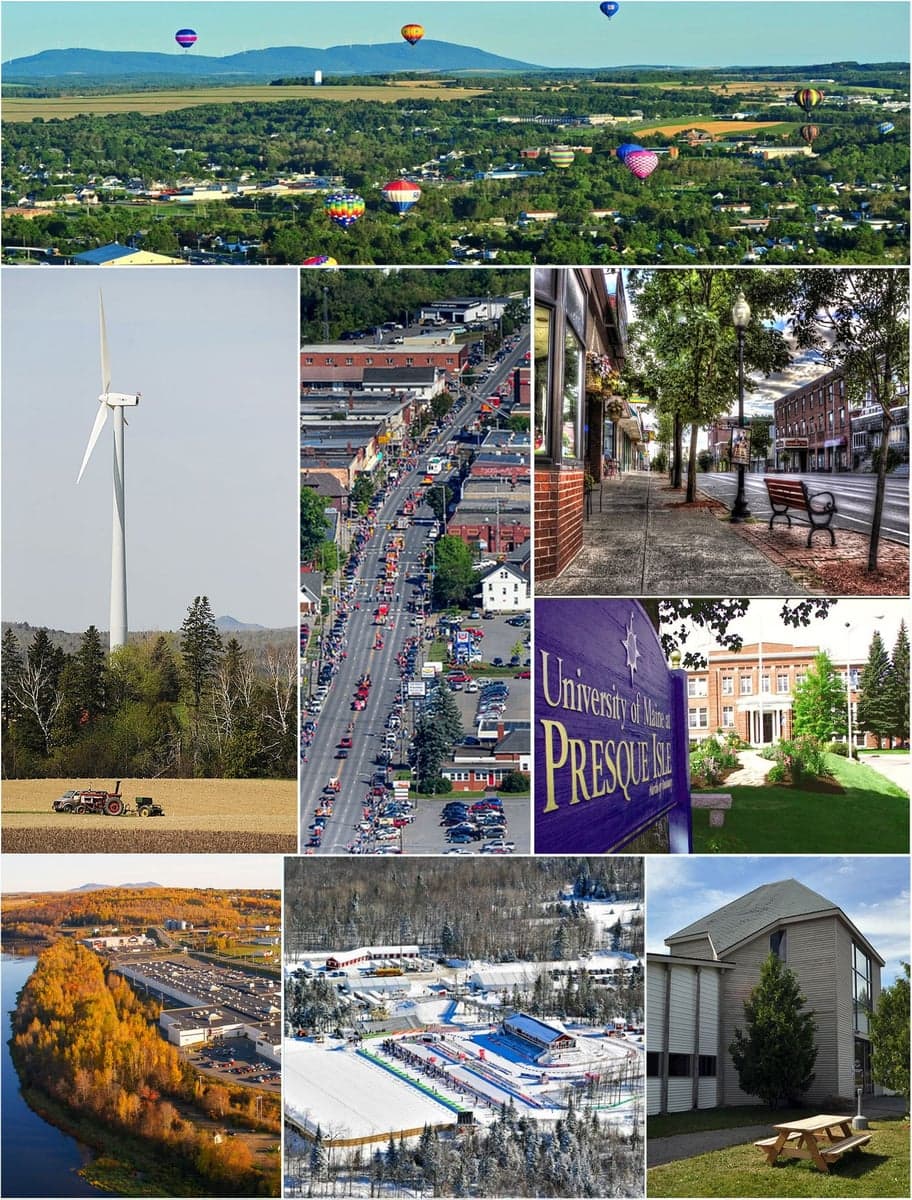
Photo: Wikipedia
Demographics of Presque Isle, ME
Affluence Level in Presque Isle, ME
A middle-class area roughly in line with national averages across income, home values, education, and employment.
People of Presque Isle, ME
The people of Presque Isle, Maine, today number 8,736, forming a predominantly white (90.6%) and native-born (98.0% U.S.-born) community with a modest college attainment rate of 26.8%. The city’s identity is rooted in its role as the commercial and agricultural hub of Aroostook County, with a population that is older than the national median and culturally tied to the region’s potato-farming and timber heritage. Unlike many New England towns, Presque Isle has seen minimal racial or ethnic diversification in recent decades, with Hispanic (1.1%), Black (0.9%), and East/Southeast Asian (0.6%) populations remaining very small. The city’s character is distinctly rural, self-reliant, and shaped by generations of families who have worked the land and local industries.
How the city was settled and grew
Presque Isle’s permanent settlement began in the 1820s, when the Massachusetts legislature granted land to veterans of the War of 1812, drawing primarily Anglo-American farmers from southern Maine and New Hampshire. The original village clustered around the Aroostook River near what is now the Main Street Historic District, where the first sawmills and gristmills were built. The arrival of the Bangor and Aroostook Railroad in 1895 transformed the settlement into a regional shipping center for potatoes and lumber, spurring a second wave of migrants—French-Canadian families from Quebec seeking work in the mills and on the potato farms. These families established a distinct neighborhood in the Fairmount area, where French was spoken in homes and churches well into the mid-20th century. A smaller wave of Irish and Scottish immigrants arrived during the same period, settling along the Parsons Street corridor, where they worked as railroad laborers and farmhands. By 1900, Presque Isle had grown to roughly 3,000 residents, with a social fabric built around Catholic and Protestant parishes, the potato harvest, and the railroad economy.
Modern era (post-1965)
After the 1965 Hart-Cellar Act, Presque Isle saw virtually no new immigration from outside North America, a pattern that continues today with a foreign-born share of just 2.0%. The post-1965 period instead brought domestic out-migration, as younger residents left for college and jobs in Portland or southern New England, and a gradual suburbanization within the city limits. The Skyway Park and Maple Street neighborhoods developed in the 1970s and 1980s as middle-class subdivisions for families working at the Loring Air Force Base (closed in 1994) and the local potato-processing plants. These areas remain predominantly white and home-owning, with a mix of retirees and blue-collar workers. The city’s small East/Southeast Asian population (0.6%) is largely composed of a handful of Hmong and Vietnamese families who arrived in the 1980s as secondary migrants from larger resettlement cities, concentrated near the University of Maine at Presque Isle campus. The Indian-subcontinent population is effectively zero (0.0%), and the Black and Hispanic populations are each under 1.1%, reflecting the city’s limited draw for non-white migrants. The Downtown district has seen a modest revival of small businesses and apartments, but the overall demographic profile has remained remarkably stable since the 1990s.
The future
Presque Isle’s population is projected to continue a slow decline, mirroring the broader trend across rural Maine, as the median age rises (currently around 44) and young adults leave for urban job markets. The city is not homogenizing further—it is already nearly as homogeneous as possible—but it is also not tribalizing into distinct enclaves, given the tiny size of minority groups. The East/Southeast Asian community is plateauing, with no new refugee resettlement programs active in the area, and the Hispanic population is growing only through a handful of seasonal agricultural workers who rarely settle permanently. The next 10–20 years will likely see a continued aging of the white population, with in-migration limited to retirees from southern Maine and a small number of remote workers attracted by low housing costs. The Riverside neighborhood, near the Aroostook River, may see some new construction for this cohort, but the city’s overall character will remain that of a stable, slow-shrinking, predominantly white rural hub.
For someone moving in now, Presque Isle offers a tight-knit, low-crime community where family names and local history still matter deeply. The population is not diversifying in any meaningful way, and the city’s future is one of gentle contraction rather than growth or transformation. It is a place for those who value quiet, space, and a known way of life—not for those seeking demographic change or urban energy.

* Values derived from national, state, county, city and local statistics and may differ in a specific area. Last updated: 2026-05-01T04:37:23.000Z
Narrative content on this page is AI-generated and may contain mistakes. Verify any details that matter before acting on them.
ReloMaps may earn a commission from affiliate links at no extra cost to you.

