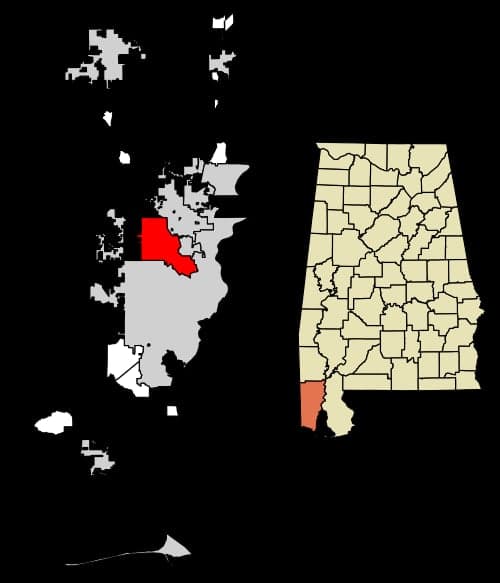
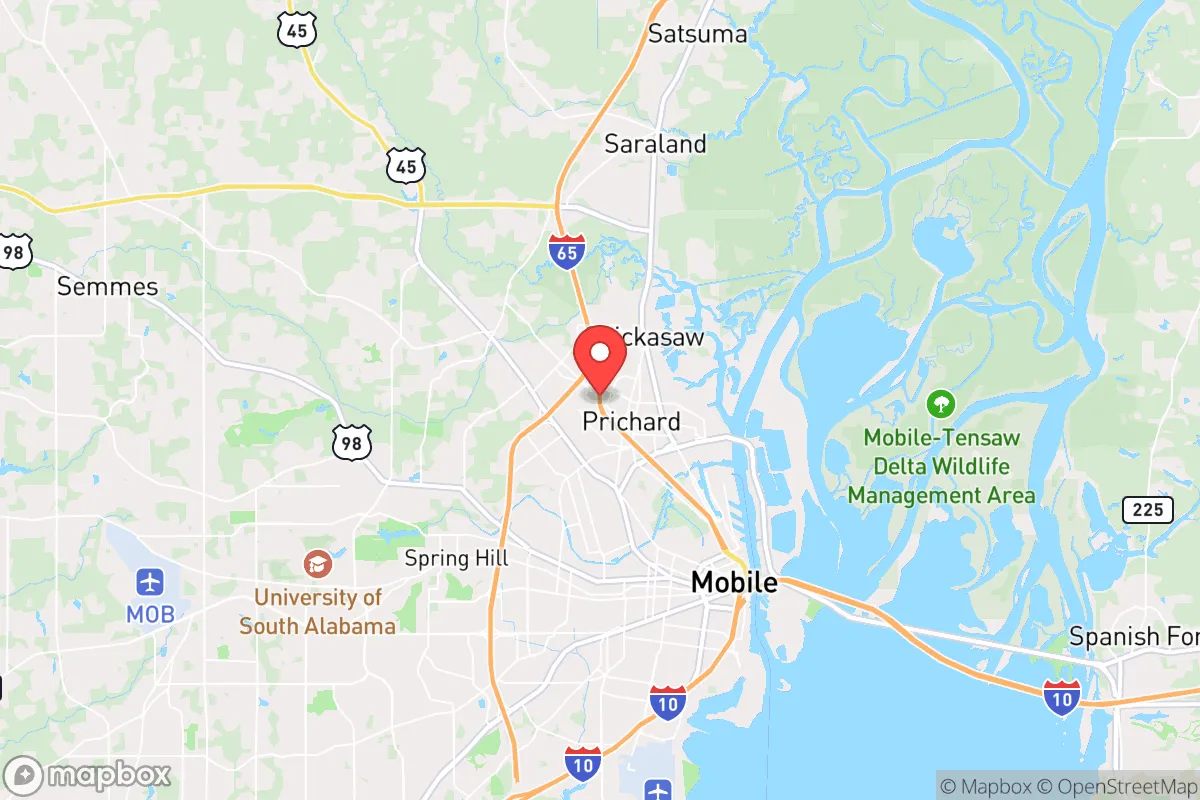
Photo: Wikipedia
Demographics of Prichard, AL
Affluence Level in Prichard, AL
A low-income area with significant economic hardship. Household wealth and educational attainment are well below national averages.
People of Prichard, AL
The people of Prichard, Alabama, today form a predominantly Black community of 19,121 residents, with a density that reflects its historic role as a working-class industrial suburb of Mobile. The city is 88.7% Black, 9.0% White, and 1.6% Hispanic, with a foreign-born population of 0.0% and a college attainment rate of just 9.4%. This is a deeply rooted, majority-Black city with a strong sense of place, shaped by decades of industrial employment, racial transition, and economic challenges that have left it one of the poorest municipalities in Alabama.
How the city was settled and grew
Prichard was founded in 1834 as a small agricultural settlement, but its real growth began after the Civil War when the Mobile and Ohio Railroad established a depot here in the 1870s. The city was formally incorporated in 1925, and its population exploded during the mid-20th century as the nearby shipyards, paper mills, and chemical plants of Mobile Bay drew thousands of workers. The original white working-class population settled in neighborhoods like Whistler and Eight Mile, which were built around the railroad and the lumber industry. African Americans, who had long worked as domestic laborers and dockworkers in Mobile, began moving into Prichard in significant numbers during the Great Migration (1910–1970), settling in areas like Chickasaw Heights and the Roper neighborhood, which became the city's first substantial Black enclaves. By 1950, Prichard's population had reached 19,000, roughly 40% Black and 60% White, with the white population concentrated in the newer subdivisions near the Mobile city line.
Modern era (post-1965)
The 1965 Hart-Cellar Act did not directly drive immigration to Prichard—the city's foreign-born population remains 0.0% today—but the post-1965 era was defined by domestic racial turnover. White flight accelerated sharply after the 1967 election of the city's first Black mayor, and by 1980 Prichard was 65% Black. The white population continued to depart for neighboring Mobile and Baldwin County suburbs through the 1990s, leaving behind a city that was 88.7% Black by 2020. The neighborhoods that absorbed the growing Black population during this period include Happy Hill and College Park, both of which transitioned from majority-white to majority-Black between 1970 and 1990. The Eight Mile area, once a white working-class stronghold, also became predominantly Black by the 2000s. Today, Prichard's population is highly homogeneous: the White share (9.0%) is concentrated in a few pockets near the Mobile city limits, while the Hispanic share (1.6%) is scattered and small. The East/Southeast Asian population (0.1%) and Indian subcontinent population (0.0%) are negligible.
The future
Prichard's population is projected to continue its slow decline—it peaked at 41,578 in 1960 and has fallen by more than half since then. The city is not homogenizing further in a racial sense; it is already near-maximum Black share. Instead, the trend is one of economic and demographic stagnation. The 0.0% foreign-born rate means no new immigrant communities are forming to offset out-migration. The college attainment rate of 9.4% is among the lowest in Alabama, and the city's poverty rate hovers near 40%. Younger residents with educational or career ambitions tend to leave for Mobile or the Gulf Coast. The next 10–20 years will likely see a continued slow population decline, with the remaining population aging in place. No significant new housing developments or industrial projects are on the horizon to reverse the trend.
For someone moving in now, Prichard offers the lowest housing costs in the Mobile metro area—median home values are around $60,000—but at the cost of limited services, high crime rates, and a shrinking tax base. This is a city that has become a majority-Black, low-income community with a deep local history but few economic engines. It is not a place of demographic change or growth, but of stability in decline. Prospective residents should weigh the affordability against the realities of a city that has lost two-thirds of its peak population and has not yet found a new economic footing.

* Values derived from national, state, county, city and local statistics and may differ in a specific area. Last updated: 2026-04-19T19:07:22.000Z
Narrative content on this page is AI-generated and may contain mistakes. Verify any details that matter before acting on them.
ReloMaps may earn a commission from affiliate links at no extra cost to you.

