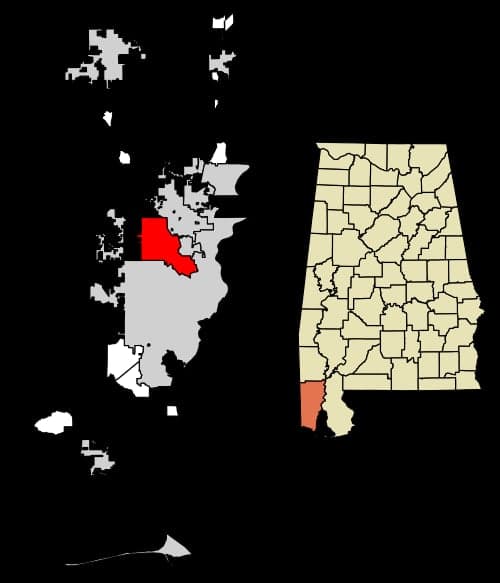
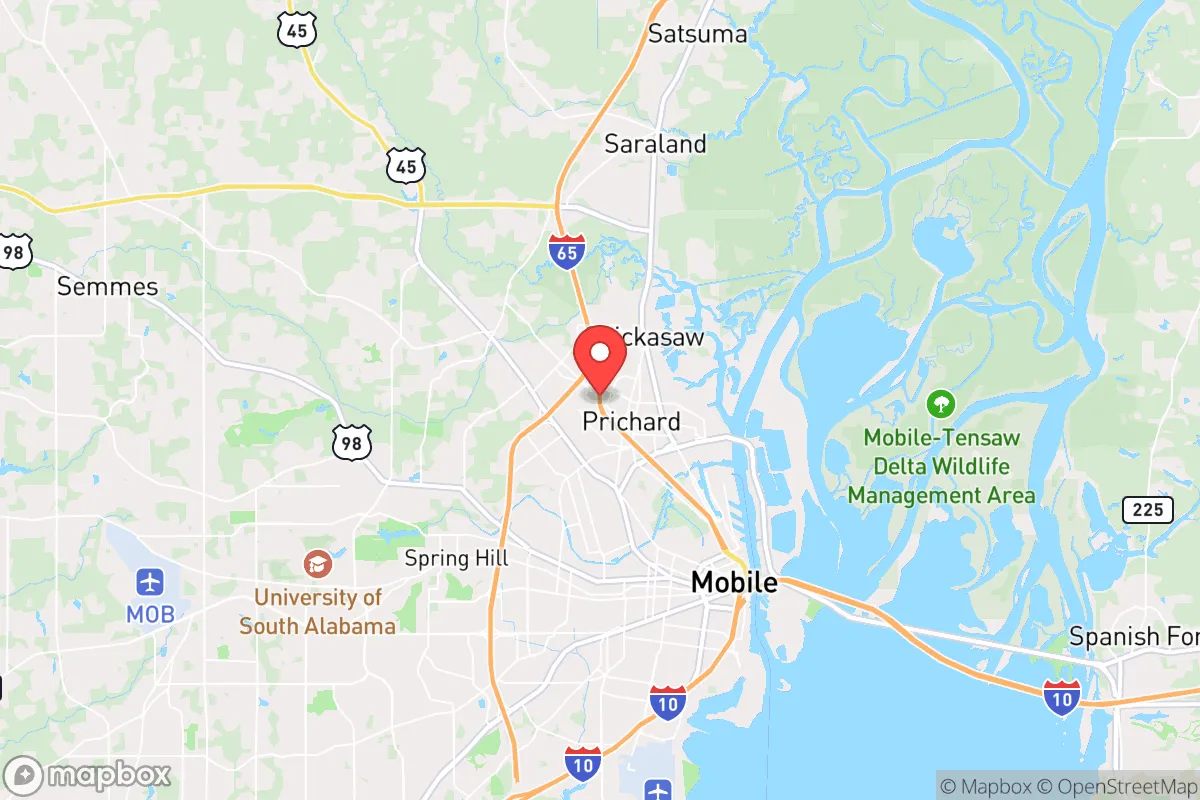
Photo: Wikipedia
Political ClimatePolitical Climate in Prichard, AL
District shown is the primary district for this city’s centroid. Cities may span multiple districts.
Local Political AnalysisPolitical Analysis of Prichard, AL
Prichard, Alabama, leans heavily Democratic, with a Cook PVI of D+5, and that’s been the case for as long as I can remember. But what’s really changed over the years is the direction of that politics—it’s shifted from a more moderate, community-focused approach to something that feels a lot more like top-down control. Back in the day, folks here were mostly concerned with keeping the lights on and the streets safe, but now you see a lot more progressive policies creeping in, and that’s got a lot of us worried about personal freedoms and how much say the government has in our daily lives.
How it compares
If you drive just a few miles west to Mobile, you’ll see a completely different political landscape. Mobile County as a whole leans more conservative, with a lot of folks there voting Republican in recent elections. Prichard, though, is an island of blue in that red sea, and it’s not just a party thing—it’s about the kind of policies that get pushed through. While Mobile tends to keep government out of your business, Prichard has seen more ordinances and regulations that feel like they’re telling you how to live. Compare that to places like Saraland or Semmes, where the local governments are more hands-off, and you start to see why some of us feel like we’re being squeezed. The contrast is stark: in those towns, you can make your own choices about property, business, and even how you raise your kids, but here in Prichard, there’s a growing sense that the city council thinks it knows better than you do.
What this means for residents
For the folks who live here, this political climate means you have to be more careful about what you say and do. There’s a real concern that if you don’t fall in line with the progressive agenda, you might get labeled as out of touch or even hostile. I’ve seen it happen—people who speak up at city meetings about wanting less government interference get brushed off. The push for things like stricter zoning laws and more oversight on small businesses makes it harder for locals to start a side hustle or fix up their own property without jumping through hoops. And when it comes to schools, there’s a lot of talk about “equity” programs that sound good on paper but end up meaning more bureaucracy and less choice for parents. It’s not the Prichard I grew up in, where neighbors helped each other out without the government getting in the middle.
On the cultural side, Prichard has a strong sense of community, but the politics are starting to fray that. There’s a lot of pressure to adopt policies that come straight from Washington or Montgomery, and it feels like local values are being pushed aside. If this keeps up, I worry we’ll see more people moving out to places like Chickasaw or even further north, where the government still remembers that it works for you, not the other way around. The long-term trajectory? Unless there’s a real shift back to common-sense, limited government, Prichard’s going to keep losing its identity—and its people.

State Political ClimatePolitical Climate in Alabama
State Political AnalysisPolitical Environment in the State
Alabama is a deeply conservative state, with Republicans holding every statewide elected office and supermajorities in both legislative chambers. The state has voted for the GOP presidential candidate by margins of 25-30 points in every election since 2008, and that trend has only solidified over the past decade. While the state remains reliably red, the political climate is not monolithic — there are distinct regional divides, a growing suburban shift, and a policy environment that has become increasingly assertive on cultural and economic freedom issues.
Urban vs. rural divide
The political map of Alabama is straightforward: rural and small-town areas are overwhelmingly Republican, while the state’s few urban centers lean Democratic. The Birmingham metro area, particularly Jefferson County, is the largest Democratic stronghold, driven by the city of Birmingham itself and its inner-ring suburbs like Mountain Brook and Homewood — though these affluent suburbs have shifted leftward in recent cycles. Mobile County, home to the port city of Mobile, has trended Republican but remains competitive at the local level. Montgomery, the capital, is reliably Democratic, powered by a large African American population and state government employees. Huntsville, in the northern part of the state, is a fascinating exception: it’s a fast-growing, high-tech hub anchored by Redstone Arsenal and NASA’s Marshall Space Flight Center, and it votes Republican — but with a more moderate, educated, and libertarian-leaning flavor than the rest of the state. The rural Black Belt counties, stretching from the Mississippi border to the Georgia line, are heavily Democratic due to high African American populations, but their turnout is lower and their influence is shrinking as population declines. The rest of the state — from the Wiregrass in the southeast to the Tennessee Valley in the north — is solidly red, with counties like Shelby, Baldwin, and Lee routinely delivering 70-80% GOP margins.
Policy environment
Alabama’s policy environment is among the most conservative in the nation. The state has no state income tax on retirement income, a flat 5% income tax on wages, and a relatively low property tax burden — though sales taxes can be high, especially in cities like Birmingham and Montgomery where combined rates exceed 10%. The regulatory posture is business-friendly, with right-to-work laws and limited zoning in most rural areas. Education policy has been a flashpoint: the state passed a robust school choice law in 2024, creating Education Savings Accounts (ESAs) worth roughly $7,000 per student, which can be used for private school tuition, homeschooling, or tutoring. This was a major victory for parental rights advocates. Healthcare is a mixed bag — Alabama did not expand Medicaid under the Affordable Care Act, keeping the system lean, but rural hospital closures remain a persistent problem. Election laws are strict: voter ID is required, early voting is limited, and absentee voting requires an excuse. The state also passed a 2021 law banning curbside voting and limiting absentee ballot drop boxes, which election integrity advocates praised as necessary safeguards.
Trajectory & freedom
Over the past five years, Alabama has moved decisively in the direction of expanding personal freedom on several fronts. The 2022 permitless carry law (HB 272) allows any law-abiding adult to carry a concealed firearm without a permit — a significant expansion of Second Amendment rights. The 2024 ESA law mentioned above is a major win for educational freedom. On medical freedom, the state passed a 2023 law prohibiting COVID-19 vaccine mandates by private employers and government entities, and it has resisted federal vaccine mandates for healthcare workers. Property rights were strengthened by a 2021 law limiting the ability of local governments to impose moratoriums on new housing development. However, there are areas where freedom has contracted. The state’s medical cannabis program, passed in 2021, has been mired in licensing disputes and has yet to issue a single dispensary license — a frustrating example of bureaucratic overreach. Additionally, the state’s strict abortion ban, enacted in 2019 with no exceptions for rape or incest, has created legal uncertainty for doctors and has been cited as a factor in the state’s high maternal mortality rate. On balance, Alabama is trending more free on guns, education, and medical choice, but less free on reproductive healthcare and cannabis access.
Civil unrest & political movements
Alabama has not seen the large-scale civil unrest that has hit other states, but there have been notable flashpoints. The 2020 George Floyd protests in Birmingham and Montgomery were relatively small and peaceful compared to other cities, though there were isolated incidents of property damage. The state has a strong and active conservative grassroots movement, particularly around election integrity and parental rights. The Alabama Policy Institute and Eagle Forum of Alabama are influential voices pushing for limited government and traditional values. Immigration politics are less heated here than in border states, but there is a vocal faction pushing for stricter enforcement, particularly in areas like Albertville and Russellville, which have seen significant Hispanic population growth. There is no serious secessionist movement, though some rural counties have passed symbolic resolutions asserting local control over federal land management. Election integrity remains a hot-button issue: the 2022 Secretary of State race was fiercely contested, with the Republican winner, Wes Allen, making voter roll maintenance and non-citizen voting prevention his top priorities. A new resident would notice that political signs and bumper stickers are common, but the culture is generally civil — Alabamians tend to avoid heated political arguments in public.
Projection
Over the next 5-10 years, Alabama is likely to become more conservative, not less. The primary driver is in-migration: people moving to the state from California, Illinois, and New York are disproportionately conservative or libertarian, attracted by lower taxes, gun rights, and a slower pace of life. Huntsville is the epicenter of this trend, with its population growing by over 20% since 2020, and it is pulling the state’s political center of gravity northward. The Birmingham suburbs are also growing, but they are trending more moderate — places like Hoover and Vestavia Hills are seeing an influx of younger professionals who are less reliably Republican. The rural Black Belt will continue to lose population and political clout, while the coastal areas around Baldwin County (Gulf Shores, Orange Beach) are booming with retirees and remote workers, most of whom lean red. The biggest wildcard is the state’s education system: if the ESA program succeeds in improving outcomes, it will cement Alabama’s reputation as a leader in school choice. If it falters, it could fuel a backlash. Expect the state to remain a solidly red, low-tax, high-freedom environment, with the main political fights centering on how much local control to grant cities versus the state legislature.
For a new resident, the bottom line is this: Alabama offers a political climate that is stable, predictable, and overwhelmingly conservative. You will find a state government that respects gun rights, parental choice in education, and low taxes, but you should also expect limited healthcare options in rural areas, a strict abortion ban, and a slow-moving bureaucracy on issues like cannabis. If you value personal freedom and a community that largely shares those values, Alabama is a safe bet — just know that the pace of change is slow, and the state’s politics are deeply rooted in tradition.
* Values derived from national, state, county, city and local statistics and may differ in a specific area. Last updated: 2026-04-19T19:07:22.000Z
Narrative content on this page is AI-generated and may contain mistakes. Verify any details that matter before acting on them.
ReloMaps may earn a commission from affiliate links at no extra cost to you.

